Wow! eBook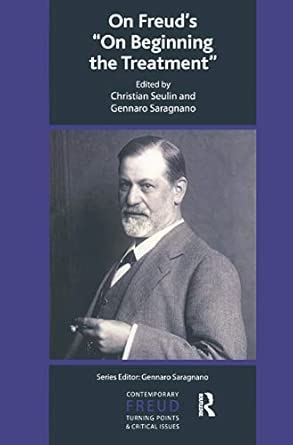
On Freud's On Beginning the Treatment
Author(s): Gennaro Saragnano (Editor), Christian Seulin
- Publisher: Routledge
- Publication Date: 12 Aug. 2019
- Edition: 1st
- Language: English
- Print length: 224 pages
- ISBN-10: 0367325764
- ISBN-13: 9780367325763
Book Description
Like his other papers on technique, Freud’s 1913 essay “On beginning the treatment” had an enduring influence on psychoanalysts for generations to come, providing them with a solid and worldwide-accepted conceptual basis on how to initiate psychoanalytic treatments. After a century of clinical experience and theoretical research, are all o
Editorial Reviews
Review
“The original title in German of this seminal work, in its full version, was reproposed as it was in the English translation by Joan Riviere of 1924. Subsequently, it was shortened in the version for the Standard Edition: ‘On Beginning the Treatment’, as Strachey explains in his presentation of the Freudian text, was the first part of a trilogy that included ‘The Question of the First Communications’ and ‘The Dynamics of the Cure’. Seeing it as a trilogy that goes beyond the beginning of the treatment returns the work to its original importance. Although Freud protects himself by using the metaphor of the game of chess, his ‘recommendations’ (not rules) lay the bases for what today we still consider to be the fundamental characteristics of the psychoanalytical method. All the circumstances – and there are several – that advise us not to ask for ‘any unconditional acceptance’ of the recommendations, do not prevent the author from establishing a procedure ‘to set in motion a process’. In psychoanalysis, everything is played out between these two elements: the method and the process, i.e. the instruments that set in motion the process and the process itself. The reader of this book will find that the authors of the various chapters have carefully explored the possibilities offered by a contemplation of the method that crosses Freud’s entire life until chapter VI of ‘An Outline of Psychoanalysis’. Only by working hard on the method and its raisons d’être will we be able in the future – as we were in the past – to broaden the therapeutic possibilities of psychoanalysis.”–Jorge Canestri, MD, psychiatrist and psychoanalyst, training and supervising analyst,
About the Author
Saragnano, Gennaro