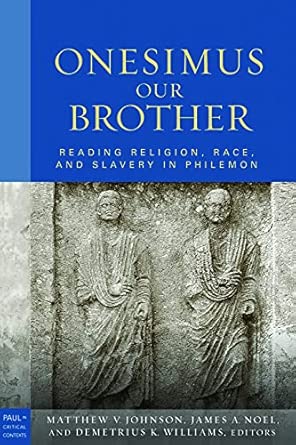
Onesimus Our Brother: Reading Religion, Race, and Culture in Philemon
Author(s): Matthew V. Johnson Sr. (Author), Demetrius K. Williams (Author), James A. Noel (Author)
Publisher: Fortress Press
Publication Date: 1 July 2012
Language: English
Print length: 184 pages
ISBN-10: 9780800663414
ISBN-13: 0800663411
Book Description
Philemon is the shortest letter in the Pauline collection, yetbecause it has to do with a slave separated from his masterit has played an inordinate role in the toxic brew of slavery and racism in the United States. In Onesimus Our Brother, leading African American biblical scholars tease out the often unconscious assumptions about religion, race, and culture that permeate contemporary interpretation of the New Testament and of Paul in particular. The editors argue that Philemon is as important a letter from an African American perspective as Romans or Galatians have proven to be in Eurocentric interpretation. The essays gathered here continue to trouble scholarly waters, interacting with the legacies of Hegel, Freud, Habermas, Ricoeur, and James C. Scott, as well as the historical experience of African American communities.Contributors include the editors and Mitzi J. Smith, Margaret B. Wilkerson, James W. Perkinson, and Allen Dwight Callahan.
Editorial Reviews
Review
Philemon is the shortest letter in the Pauline collection, yet because it has to do with a slave separated from his master it has played an inordinate role in the toxic brew of slavery and racism in the United States. In Onesimus Our Brother, leading African American biblical scholars tease out the often unconscious assumptions about religion, race, and culture that permeate contemporary interpretation of the New Testament and of Paul in particular. The editors argue that Philemon is as important a letter from an African American perspective as Romans or Galatians have proven to be in Eurocentric interpretation. The essays gathered here continue to trouble scholarly waters, interacting with the legacies of Hegel, Freud, Habermas, Ricoeur, and James C. Scott, as well as the historical experience of African American communities.
Contributors include the editors and Mitzi J. Smith, Margaret B. Wilkerson, James W. Perkinson, and Allen Dwight Callahan. –From the Back Cover
From the Back Cover
Philemon is the shortest letter in the Pauline collection, yet because it has to do with a slave separated from his master it has played an inordinate role in the toxic brew of slavery and racism in the United States. In Onesimus Our Brother, leading African American biblical scholars tease out the often unconscious assumptions about religion, race, and culture that permeate contemporary interpretation of the New Testament and of Paul in particular. The editors argue that Philemon is as important a letter from an African American perspective as Romans or Galatians have proven to be in Eurocentric interpretation. The essays gathered here continue to trouble scholarly waters, interacting with the legacies of Hegel, Freud, Habermas, Ricoeur, and James C. Scott, as well as the historical experience of African American communities.
Contributors include the editors and Mitzi J. Smith, Margaret B. Wilkerson, James W. Perkinson, and Allen Dwight Callahan.
About the Author
Matthew V. Johnson is senior pastor of the Good Shepherd Church (Baptist), Atlanta, Georgia.
 Wow! eBook