Wow! eBook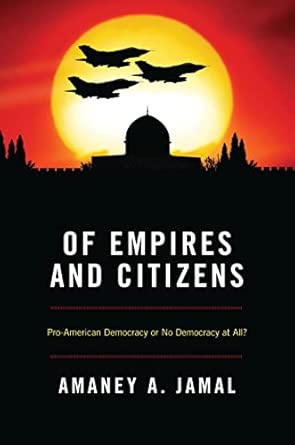
Of Empires and Citizens – Pro–American Democracy or No Democracy at All? Illustrated Edition
Author(s): Amaney A. Jamal (Author)
- Publisher: Princeton University Press
- Publication Date: 7 Sept. 2012
- Edition: Illustrated
- Language: English
- Print length: 296 pages
- ISBN-10: 9780691149646
- ISBN-13: 069114964X
Book Description
Editorial Reviews
Review
From the Back Cover
“This original book adds to the substantial research concerned with domestic factors and the persistence of authoritarianism in the Arab world. It also opens a new line of inquiry by demonstrating the role of international factors in relationships between the Arab governments and the United States. An impressive and rich work.”–Mark Tessler, University of Michigan
“This book shows that democracy in the Middle East threatens the interests of the middle classes who rely heavily on American aid. They fear that democracy will bring to power populists wishing to undermine American regional hegemony resulting in a loss of their aid lifeline. The book’s compelling argument and its relevance to current policy concerns are significant.”–David Laitin, Stanford University
“Arguing that the lack of democratization in the Middle East is tied to the critical role the United States plays in the region, this strong book extends our understanding of how international relations affects citizens’ perceptions and engagement with the state.”–Ellen Lust, Yale University
“Jamal makes a persuasive case for an important but never-before tested argument: U.S. policy in the Arab world has been one of the principal obstacles to democratic development in the region. A wonderful addition to debates about impediments to democracy, the sources and consequences of anti-Americanism, and the character of U.S. foreign policy, this book is essential reading.”–Lisa Anderson, American University in Cairo
About the Author
Excerpt. © Reprinted by permission. All rights reserved.
OF EMPIRES AND CITIZENS
Pro-American Democracy or No Democracy at All?By AMANEY A. JAMAL
PRINCETON UNIVERSITY PRESS
Copyright © 2012 Princeton University Press
All right reserved.
ISBN: 978-0-691-14964-6
Contents
List of Tables and Figures……………………………………………………………………………………………………………ixPreface…………………………………………………………………………………………………………………………….xiAcknowledgments……………………………………………………………………………………………………………………..xiiiA Note on Transliteration…………………………………………………………………………………………………………….xvCHAPTER ONE Introduction: Pro-American Democracy or No Democracy at All?………………………………………………………………….1CHAPTER TWO Becoming Jordan and Kuwait: The Making and Consolidating of U.S. Client Regimes…………………………………………………38CHAPTER THREE Islamist Momentum in the Arab World: Jordan’s Islamic Action Front and Kuwait’s Islamic Constitutional Movement…………………..63CHAPTER FOUR Engaging the Regime through the Lens of the United States: Citizens’ Political Preferences………………………………………103CHAPTER FIVE Support for Democracy and Authoritarianism: The Geostrategic Utility of Cooperative Leadership…………………………………..142CHAPTER SIX Morocco: Support for the Status Quo………………………………………………………………………………………..174CHAPTER SEVEN Palestine and Saudi Arabia and the Limits of Democracy……………………………………………………………………..191CHAPTER EIGHT The Influence of International Context on Domestic-Level Models of Regime Transition and Democratic Consolidation…………………221Bibliography………………………………………………………………………………………………………………………..245Index………………………………………………………………………………………………………………………………267
Chapter One
Introduction
Pro-American Democracy or No Democracy at All?
Since the downfall of the Soviet Union, the world has witnessed a new WAVE of global democratization. Freedom House, which monitors democracy around the globe, reports that between 1994 and 2009, the number of electoral democracies increased from 69 out of 167 total states to 119 out of 192. Between 1994 and 2005, the number of “free” countries in the world similarly increased from 76 to 89, while the number of “partly free” countries decreased from 61 to 54, and the number of “not free” countries decreased from 54 to 49. On a seven-point scale, with seven being the most democratic, Eastern Europe improved both its political and civil liberties by a margin greater than three points. Other regions followed suit. Countries in Africa improved their scores by over one point, and even regions like Latin America, where political and civil liberties were already much better than in other regions, witnessed significant improvements (see table 1.1).
The Arab world stands apart from this trend. Political and civil liberty scores between 1989 and 2009 remained nearly constant, improving only marginally. Even Russia, which slightly regressed in terms of its political and civil liberties and abounds with stories of rebounding oligarchy, did better in general on these scores than the Arab world. The Arab world witnessed further regressions in civil liberties—this despite progress along several pertinent modernization indicators including education, literacy, gross domestic product (GDP), life expectancy, health care, and human development (see fig. 1.1).
This reality stands in sharp contrast to expectations. As countries in the Middle East modernized and grew economically, the common reasoning goes, they should have liberalized as well. And although current developments in Egypt, Yemen, Bahrain, and Tunisia are reasons for increasing levels of optimism, the Arab world in general continues to withstand demands for more democracy and to witness persistent levels of authoritarianism. Even while citizens have demonstrated a strong commitment to democracy, existing regimes don’t appear to reflect the will of the people.
What accounts for this seeming paradox of continued economic development and persistent authoritarianism? The argument of this book is simple: one can’t understand the lack of Arab democratic transitions—or the nature of future political liberalization and consolidation trajectories more generally—without taking into account U.S. entrenchment. In the Arab world, U.S. involvement has stifled indigenous democratization gains of the last several decades and levels of anti-Americanism have intersected with the growing influence of Islamism to stifle citizen democratic contestation across most Arab states.
Anti-Americanism, I argue, is the key variable. Too often absent from political science theoretical models on democratization and political development, it is the preeminent factor in shaping the everyday political engagements and negotiations of ordinary citizens in the region. Understanding state-society relations and the rationalizations citizens make about democracy and the geostrategic utility of existing less-democratic regimes requires us to understand how and why anti-Americanism has come to play a crucial role in the Arab region. Exploring this state of affairs, both in theory and on the ground, is the job of this book.
Specifically, this book explores Kuwait and Jordan as two states that have similar clientelistic ties to the United States. Both are monarchies holding parliamentary elections, and each has similar levels of support for its Islamist opposition movements (estimates in each country put levels of support between 35 percent and 60 percent). But the two states vary in their levels of anti-American sentiment among these Islamist opposition forces (my key explanatory variable). This core difference reveals how concerns about a country’s international relations shape state-society relations more broadly.
Although the book builds its argument by focusing on the cases of Kuwait and Jordan, it also draws on evidence from two other monarchies that have varying degrees of anti-American sentiment among their Islamist opposition as well: Morocco and Saudi Arabia. Further, I extend the findings to Palestine’s democratic experience, which resulted in Hamas’s parliamentary victory in 2006.
The U.S. Strategic Approach to Democracy
Since the end of the Cold War, comparative politics has treated the role of the United States in the international context as one that monolithically generates democracy. As Samuel Huntington argues in The Third Wave, “External actors significantly helped third wave democratizations. Indeed, by the late 1980s the major sources of power and influence in the world [including the United States] were actively promoting liberalization and democratization.” Studies of Latin America, the former Soviet Union, and Africa all emphasize the role the United States played in promoting democracy.
Yet sometimes democracy may not suit the strategic interests of the United States. This is the case for the Arab world, a situation that has not been fully accounted for thus far in the political science literature. Studies looking at the involvement of international actors in the domestic politics of states have assumed that such involvement will result in more, not less democracy. This work assumes that the United States systematically and universally—and not strategically—promotes democracy across the globe, even in regions like the Arab world, where anti-American sentiment is rampant. In these settings, however, greater democratization could clearly bring groups unsympathetic to the United States into power, thus jeopardizing the interests of both the United States and the citizens of the region. The loss of patron support can result in several outcomes with devastating economic results, such as decreased access to resources in the form of aid, denial of access to external markets or preferential trade agreements, and even sanctions if the patron deems a governing authority a threat.
The Arab region is of fundamental importance to the United States, even as Arab states are highly reliant on the United States for security and economic aid. Yet U.S. engagement with the region has been structured by strategies that have placed the interests of the United States above and beyond the daily welfare of Arab citizens. Four major interests shape U.S. involvement in the region today: access to oil, the containment of Iran, support for the state of Israel, and the limiting of Islamist strength and their access to power and weapons of mass destruction. U.S. policies have been designed to secure these interests—not necessarily to increase democracy. As a result, the United States supports pro-American regimes, and most of these pro-American regimes happen to be authoritarian regimes that will not only guarantee the United States access to Middle Eastern oil but also maintain peaceful relations with the state of Israel while simultaneously curbing the influence of Iran and Islamist movements.
In general, Islamist groups oppose these U.S. goals, and therefore it is in the interest of the United States and existing regime leaders to limit the ability of Islamists to influence policy—a reality not lost on ordinary citizens. In fact, citizens, especially those who hope to benefit from greater global economic integration, will prefer supporting the status quo rather than jeopardizing American patronage. Thus, given the conditions of U.S. entrenchment in the Arab region, indigenous demands for democracy will only grow and become sustained if the United States promises to honor the outcome of any democratic experiment, regardless of outcome. Conversely, demands for democracy will grow if democratic reformers are assured that Islamists won’t jeopardize ties to the United States. That the United States has demonstrated that it will only tolerate pro-American democratic outcomes while it simultaneously does very little to weaken anti-Americanism continues to influence debates about political liberalization and democratization. Put more simply, the United States will only tolerate friends in power and has done little to win friends from within these societies.
Would-be democratic reformers understand that a push toward democracy may result in bringing anti-American forces to power—which would mean jeopardizing U.S. patronage—and therefore prefer the status quo. The U.S. democracy promotion establishment has erroneously assumed that democracy promotion would by default also bring about pro-American attitudes—regardless of U.S. policies in the region. That citizens of the Arab world could come to appreciate the underpinnings of democracy while simultaneously harboring deep resentment toward the United States was an outcome that the United States had been less prepared for.
This explanation stands in sharp contrast to standard reasoning as it pertains to the Arab world. That reasoning advances two general explanations to account for the lack of Arab democratization, both of which focus on societal determinants of authoritarian tendencies. The first is grounded in political culture, the second in the region’s political economy. Central to both approaches is the notion that Arab societies have not attained the levels of political and economic modernization that equip citizens with the requisite values and economic interests to pose significant challenges to existing authoritarian rule. Absent these by-products of modernization, citizens remain locked into supportive relations with their regimes.
Scholars and policy makers have systematically viewed political culture and economic development as central to citizen democratic contestation of existing regimes. Examples range from the feudal transition to democracy in England, to the third wave of democratization and the demise of the former Soviet Union. Because citizens had acquired new democratic values and had become more autonomous and empowered through economic development, the story goes, they could effectively assert significant pressure on existing regimes. Countries in the third and subsequent waves of democracy had another advantage: the United States had emerged successful from the Cold War and could now, without the threat of the Soviets, continue with its democracy agenda the world over.
None of these theories, though, explains the lack of Arab democratization. The Arab world does not lack an appreciation of democratic values. Not only do the so-called Arab Spring protests of 2011 attest to the strong democratic current in the region but public opinion data from the region collected since the year 2000 also reveal overwhelming support for democracy. Polls across the region indicate that democracy enjoys support from close to 85 percent of the region’s population. Further, the recent wave of protests across the region suggests that citizens long for more accountability, transparency, and representation—hallmarks of democracy.
Neither has the Arab world stagnated in its economic development. The many countries in the Arab world have gradually begun to enjoy greater economic growth, lower poverty rates, a more stable middle class, privatization and globalization, and greater rates of foreign direct investment (FDI).
Existing Theories: Political Culture
It’s worth first examining the two standard theories in greater depth before addressing the role that America has played in the lack of Arab democratization. First, renowned scholars in the field—including Gabriel Almond and Sidney Verba; Larry Diamond, Juan Linz, and Seymour Martin Lipset; Samuel Huntington; Ronald Inglehart; and Robert Putnam—have linked modernization to values and orientations that would serve as democratic prerequisites. Through modernization, theories suggest, citizens would not only acquire better economic opportunities but would also develop the norms necessary for democracy. That is, development encourages supportive democratic cultural orientations. Thus, economic development was deemed important to generating pertinent values useful to democratization.
The second theory highlights the importance of civil society for democracy. As societies develop, this line of reasoning goes, so too should their civil societies develop in ways that would make democracy a more viable outcome. 13 This scholarship examines the role of civic associations as schools for civic virtue and generators of social capital, and how they thus form major counterweights to existing authoritarian rulers. Civil society can check the powers of the state, encourages citizen participation, helps the development of a democratic culture of tolerance and bargaining, generates new channels for representing interests, creates crosscutting cleavages, serves as forum for the retention of development of new political leaders, and allows for the enrichment and circulation of information to citizens. Thus, civil society has a vital role to play in shaping democratic attitudes and behaviors among populations. Where democratic contestation is weak or lacking, one plausible arena of exploration is civil society. In the context of the Arab world, the region’s political culture remains one key set of variables explaining the persistence of authoritarian rule.
A third theory suggests that the political culture of the region might be incompatible with democracy. In the context of the Arab world, this theme links the support for authoritarianism directly to Islam. The political culture of Islam, some argue, impedes the development of the prerequisites of modernization because Islam and democracy simply don’t mix well.
This third line of argument maintains that, first, Muslims are more likely to accept the status quo, however disadvantageous it may be, as part of a doctrine of divine destiny. That is, citizens of the Arab world are more likely to attribute their political situations to “Allah’s way.” Such adherence to the status quo bars any contestation of the established order. Second, as Huntington argues in his seminal work on the clash of civilizations, Islam and democracy are inherently incompatible because Islam, emphasizes the community over the individual and does not recognize the church-state divide. Individualism, Huntington maintains, is a key asset to liberal democratic orders. Third, as other scholars like Francis Fukuyama argue, Islam poses a grave threat to liberal democracy because its doctrinal emphasis lacks a liberal democratic orientation. Fourth, Islam does not advocate political freedoms and in fact mobilizes people against democratic values. Fifth, Steven Fish finds that the status of women in Muslim societies hinders democracy. Daniela Donno and Bruce Russett argue that the link between the inferior status of women and democracy is only substantiated in the Arab world.
Following this logic, even if Arab societies are able to attain the necessary levels of modernization, Muslim societies are unlikely to appreciate and function within the norms of a democratic polity.
Existing Theories: Political Economy
Scholars have advanced two main formulations to explain how existing economic structures shape citizen support for their authoritarian regimes in the Arab world. The first is an extension of modernization theories. Because Arab societies have not developed economically, or because their economic trajectories have been marked by only slow progress, this line of reasoning goes, the Arab world has not developed autonomous middle-class groups that can place the necessary constraints on regimes. Scholars who work on the economic and political development of the Arab world, like Eva Bellin, Melanie Claire Cammett, Kiren Aziz Chaudhry, Jill Crystal, Pete Moore, and Benjamin Smith, have examined how existing business interests remain tied to the regimes in power. This lack of business and middle-class autonomy, according to this theory, explains authoritarian persistence. Absent the development of independent economic interests separate from the regime, citizens remain bound in close supportive relations with these regimes, which further solidify authoritarian rule.
(Continues…)
Excerpted from OF EMPIRES AND CITIZENSby AMANEY A. JAMAL Copyright © 2012 by Princeton University Press. Excerpted by permission of PRINCETON UNIVERSITY PRESS. All rights reserved. No part of this excerpt may be reproduced or reprinted without permission in writing from the publisher.
Excerpts are provided by Dial-A-Book Inc. solely for the personal use of visitors to this web site.