Wow! eBook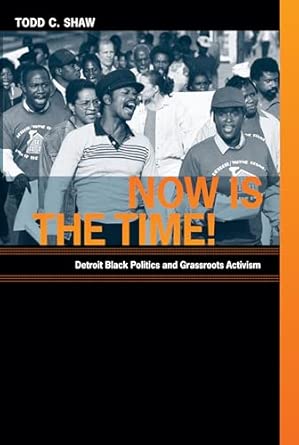
Now Is the Time!: Detroit Black Politics and Grassroots Activism
Author(s): Todd C. Shaw (Author)
- Publisher: Duke University Press
- Publication Date: 25 Sept. 2009
- Edition: Illustrated
- Language: English
- Print length: 304 pages
- ISBN-10: 0822344955
- ISBN-13: 9780822344957
Book Description
Shaw uses the tools of social movement analysis, including the quantitative analysis of budgets, electoral data, and housing statistics, as well as historical research and personal interviews, to better understand the dilemmas, innovations, and dynamics of grassroots activism. He begins with a history of discriminatory housing practices and racial divisions that deeply affected Detroit following the Second World War and set the stage for the election of the city’s first black mayor, Coleman Young. By emphasizing downtown redevelopment, Mayor Young’s administration often collided with low-income housing advocates. Only through grassroots activism were those advocates able to delay or derail governmental efforts to demolish low-income housing in order to make way for more upscale development. Shaw then looks at present-day public housing activism, assessing the mixed success of the nationally sponsored HOPE VI project aimed at fostering home ownership in low-income areas. Descriptive and prescriptive, Now Is the Time! traces the complicated legacy of community activism to illuminate what is required for grassroots activists to be effective in demanding public accountability to poor and marginalized citizens.
Editorial Reviews
Review
“What makes this book so significant is that it places African-American politics within the context of grassroots organizing and local coalition-building. Using the case of Detroit and focusing on the mayoralty of Coleman A. Young, Todd C. Shaw explores how grassroots groups have organized and mobilized in Detroit around low-income and affordable housing. In particular, it explores how these groups have strategized during Young’s long reign. This book is a must read for those interested in racial politics, urban politics, and urban housing policy.”–
Marion Orr, Fred Lippitt Professor of Public Policy and Political Science, Brown UniversityFrom the Back Cover
About the Author
Todd Shaw is Assistant Professor of Political Science and African American Studies at the University of South Carolina.
Excerpt. © Reprinted by permission. All rights reserved.
NOW IS THE TIME!
Detroit Black Politics and Grassroots ActivismBy Todd C. Shaw
Duke University Press
Copyright © 2009 Duke University Press
All right reserved.
ISBN: 978-0-8223-4495-7
Contents
Acknowledgments…………………………………………………………………………..ixIntroduction. The Right Tactic, Time, and Place………………………………………………11. Making Black Activism Matter…………………………………………………………….132. Where are the People? Early Black Housing Poverty and Grassroots Activism…………………….393. Trading Activism: The Young Regime and the Context of Black Politics…………………………644. Picking Up Spears: The Timing and Utility of Renewed Activism……………………………….855. Holding Them Responsible: Community Development Activism……………………………………1066. Now Is the Time!: Public Housing and Anti-Homelessness Activism……………………………..1337. A Change Is Gonna Come? The Archer Regime and Housing Politics beyond Detroit…………………163Activism…………………………………………………………………………………191Appendix 1……………………………………………………………………………….197Appendix 2……………………………………………………………………………….201Notes……………………………………………………………………………………209Bibliography……………………………………………………………………………..245Index……………………………………………………………………………………279
Chapter One
Making Black Activism Matter
[Homeless] people started telling us, “This is the first time I have an opportunity to get arrested for something that is decent-for a house, for a home, for something decent. I don’t care.” -Marian Kramer, president, National welfare rights union, 1994, commenting on the dangers of sit-ins in vacant public-housing units in Detroit
POLITICS IS NOT ENOUGH
In their book Protest Is Not Enough, Rufus Browning, Dale Marshall, and David Tabb explore black and Latino political incorporation in ten California cities in the 1970s and 1980s. They conclude, “Although demand-protest yields some measurable gain in responsiveness from city governments, the [political] incorporation of the [minority] groups yield much more.” There is nothing particularly controversial about this conclusion. In fact, it reflects a strong pragmatism about the limits of protest politics. What is questionable, however, is the timing of their claim. Once we pass the initial phase of minority incorporation in several major cities such as Detroit and Atlanta, how do we assess whether local government is responsive to African Americans, especially the poor? How, if at all, can contemporary grassroots leaders and groups pressure black elected officials to not become jaundiced incumbents who are oblivious to vital community needs?
In this chapter, I present my theory of how effective black grassroots activism in this post-Civil Rights Movement era can prompt public accountability to black low-income communities despite the barriers of race, class, gender, and regime. But those who seek to shake up the powers that be in government must calculate which form of political action is the right tactic, at the right time, and in the right place. Thus, they have strategic choices to make-sit-ins, lobbying for funds, electoral politics, and so on. To invert the claim of Browning and his colleagues that “protest is not enough,” I respond that a contemporary politics divorced from a broadly defined grassroots activism is equally inadequate for empowering the black poor. My Effective Black Activism Model (EBAM) asserts that activism induces accountability when black and other advocates consider its utility, timing, and context. Thus, at the very least, they recruit powerful allies, or disruptive coalitions and group networks; exploit game rules, or strategic advantages; and employ flexible political actions, or adaptive tactics. Protest has strategic value in inducing accountability within black politics, but my task is to explain why it is only one strategy in the grassroots activist’s repertoire. Later in this chapter, I also explain why critics such as Robert Smith and Adolph Reed believe that an unintended consequence of the enormous political gains African Americans derived from the Civil Rights Movement has been the hyper-institutionalization of black politics and the demobilization of grassroots activism. Using what I label a fusionist approach, I explain the theoretical linkages between my chief independent variable, accountability, and my key dependent variable, grassroots activism. Then I present, and later disassemble, my model to specify when and how grassroots activism matters in inducing political accountability to the black poor.
THE LINKS BETWEEN ACCOUNTABILITY, GRASSROOTS ACTIVISM, AND PROTEST
Political Accountability and Responsiveness
Political accountability is a process whereby a public official explains policy stances or governmental actions to a constituent group and takes responsibility for the detrimental or potentially detrimental outcomes of such policy stances or governmental actions. I measure political accountability by examining public officials’ reactions and explanatory statements-budget vetoes, press conferences, statements at public hearings-especially when these officials or their colleagues are the targets of dissent. The community-organizing tradition interprets the notion of accountability not as a mere protocol of public input or accurate bookkeeping but, instead, as a broad ethic of public officials answering to citizens. For instance, during municipal elections in Detroit in 1989, neighborhood activists banded together to write a “PEOPLE’s Platform” as a guideline to assess mayoral and City Council candidates and declared, “Accountability and accessibility are vital elements of good leadership. It is time for the elected leadership to remember to whom they are answerable.” I agree with Hannah Pitkin’s criticism that, within the representation puzzle, the actions of an official who merely “accounts for” past wrongs (formalistic representation) lack the gravitas of one who “acts for” or on behalf of constituents (substantive representation.) Urban policing and public education are just two arenas in which accountability has a highly contested meaning. Still, accountability is a vital starting point. If a black mayor or black school-board member cannot at least explain a government’s actions and take responsibility for outcomes that jeopardize constituents’ well-being-for example, Philadelphia’s Mayor Wilson Goode apologizing for the police bombing of a neighborhood to subdue a black militant group-then it is difficult to imagine how she can more proactively represent the same constituents’ interests.
Responsiveness is a process whereby a public official promotes, as well as favorably responds to, the demands, preferences, or expectations of a constituent group. I measure responsiveness by examining public officials’ policy initiatives and symbolic acts of solidarity with grassroots constituencies: initial budget votes, policy proposals, speeches at rallies, and so on. Not as a reaction or afterthought but as part of her active intent, a public official must pursue policies that embrace the demands of citizens to be considered responsive. For example, the initial election of Mayor Harold Washington in Chicago by a highly energized black community encouraged him to redirect funds toward black and other low-income neighborhoods. Put differently, accountability is reactive because it is explanatory behavior usually initiated after a precipitating event, and responsiveness is proactive because it is representative behavior usually initiated before a precipitating event. Ultimately, to conclude that a politician or bureaucrat is truly being attentive, accountability and responsiveness must be part of a string of continuous actions rather than isolated or compulsory behavior.
Grassroots Activism and Protest
Having defined the representation side of the problem, I now turn to the mobilization side. Grassroots activism, or community organizing, is a form of political action that assumes ordinary citizens can confront maldistributions of power by organizing as communities of geographic or ascriptive identity (race, class, gender) and thus use their indigenous creativity, leadership, and resources. While protest has often been mistaken as synonymous with grassroots activism, it is only one strategy within this activism’s dynamic range. Our principal question is: What tactic best suits the ends of empowering the disadvantaged at a given moment? Michael Owens challenges the view that the breadth of black grassroots activism is simply delimited by the poles of protest or electoral politics. Observant of black churches engaged in community development, he interjects programming as a halfway point where black public-private collaborations build community capacity, leverage community influence, and serve the needy. According to Sekou Franklin, black grassroots activism involves black-led attempts to organize and mobilize disadvantaged communities, whether these black activists are in mono-racial, multiracial/multiethnic, or single-issue groups. The local social movement field debates whether a group consensus of organizing around economic or material interests too often glosses over equally important cleavages and identities-race, gender, sexual orientation-and whether the provision of programmatic services such as housing, job training, or youth programs, requires a group to cooperate with government and business at the expense of politically confronting them. To determine whether leaders are most inclined to pursue collaborative or confrontational approaches to activism, we must know whether they are part of an urban interest-group system.
Although I am interested in understanding the broad range of actions grassroots organizations use to advocate their causes, protest is a unique form of political action, a unique strategy, because it seeks to voice opposition publicly by disturbing business as usual. Protest, or insurgency, is the range of confrontational and often disruptive political actions that grassroots groups use to assert their interests in various arenas to challenge other interests that are more dominant and entrenched. Peter Eisinger says that protest includes various “collective manifestations, disruptive in nature, designed to provide ‘relatively powerless people’ with bargaining leverage in the political process.” It often has a symbolic or theatrical value, but it is most instrumental when it trespasses on the property of those in power and provokes them to negotiate with the trespassers. Event-history analysis is useful in measuring occurrences of protest as reported in newspapers or organizational records. Neglected or unrecognized claims such as those of homeless advocates may use insurgency to reinforce the advocacy of public officials who are their allies, to convert other public officials into allies, or to compel indifferent or obstinate public officials to heed their demands. Among others, Leonard Moore has examined how reformist black politicians such as Mayor Carl Stokes of Cleveland relied on local grassroots activists to make noise to create pressure for new agendas of racial and economic reform. My thinking coincides with Michael Lipsky’s assumption that protest is a “political resource” because it can potentially attract the attention of reference publics from whom politicians derive their legitimacy. And as E. E. Schattschneider’s work has long reminded us, it is the less powerful who need to draw attention to their plight by starting a fight or by “socializing conflict.”
The Potential and the Limits of Protest
All of the above suggests that sometimes protest may make a difference, but in the contemporary black urban context, when does it make a difference? Recall that the efficacy of protest depends on its disruptive potential, which is an assumption I borrow from Frances Fox Piven and Richard Cloward. In their book Poor People’s Movements, they define disruption as “simply the application of a negative sanction, the withdrawal of a crucial contribution on which others depend, and it is therefore a natural resource for exerting power over others.” Moments of societal transition or crisis-the Great Depression; shifts in Southern agricultural production; tension in urban ghettoes-provide opportunities for this disruption to have leverage in making demands on the power structure. However, Piven and Cloward assert that the black poor will have difficulties in using disruption: “Influence depends, first of all, on whether or not the contribution withheld is crucial to others; second, on whether or not those who have been affected by the disruption have resources to be conceded; and third, on whether the obstructionist group can protect itself adequately from reprisals. Once these criteria are stated, it becomes evident that the poor are usually in the least strategic position to benefit from defiance.” Poor people may retaliate through actions that James Scott and Robin Kelley call “infrapolitics,” or various non-collective acts of resistance, such as confronting a public-housing manager or drawing political graffiti on a wall. Still, when compared with individual dissidence, collective action is a more visible form of resistance that requires communal discourse. Piven and Cloward likely overstated their case when they assumed that permanent organizations are incapable of sustaining protest, but we must appreciate their warning that contentious politics eventually affect an organization’s viability and longevity. Critics have fairly pointed out several clear limitations to protest, not the least of which is that disruption has repercussions and can make negotiation quite difficult. But it is also true that, on occasion, confrontation is not only useful but necessary. Conflict practitioners and theorists-from John Lewis of the United Mine Workers to Dianne Nash of the Student Non-Violent Coordinating Committee (SNCC)-have argued that agitation is required when it compels those in power to negotiate or suffer political instability. It is for this very reason that Frederick Douglass’s axiom has cogently warned generations of black activists: “Power concedes nothing without demand. It never did and it never will.” To be effective, activists have to pick and choose their battles and their weapons based on the vulnerabilities of the regime, the temperament of the times, and the specific arena of combat.
THE EFFECTIVE BLACK ACTIVISM MODEL
Political Opportunities and the Activist Standpoint
Because opportunities for activism to compel accountability partly depend on the specific disposition and stability of the targeted government, I borrow from the political opportunity structures (POS) literature. Unlike some of the POS literature, I am interested not simply in which conditions foster activism but, rather, in when such political actions have an impact on government and public policies. It is difficult, however, to consider whether activism can make a difference if it occurs in political systems that are closed and thus zealously repress, discourage, or inhibit public dissent. So the POS literature is a useful starting point in constructing the EBAM. Peter Eisinger introduced the concept of POS to examine the institutional factors that affected whether a large subsample of American cities witnessed protest behavior in the late 1960s. He discovered that black protest most often occurred within systems that had either a mixture of open and closed features or mayor-council forms of government, sizable overall populations, or large numbers of black elected officials. All of the above aptly describe Detroit. After comparing the works of several prominent POS theorists, Doug McAdam and colleagues discerned that the variables theorists most commonly cited as significant were whether a political system is open or closed, the stability or instability of elite governing coalitions, the presence or absence of elite allies for insurgents, and a state’s capacity and propensity for repression. Each of these variables is integrated into features of my model.
Although Eisinger’s and McAdam’s conclusions are useful, they provide grist for critics who complain that POS theory is entirely too structuralist and gives inordinate weight to static factors such as government institutions at the expense of dynamic factors such as ideology and public norms. Jeff Goodwin and James Jasper are concerned that POS is unimaginative and displaces the agency of activists. Taken to its logical extreme, the structuralism of POS implies that insurgents can protest only as much as state institutions allow. Mindful of these criticisms, including the healthy self-critique of some POS adherents, I place the perceptions and imaginations of activists at the center of my model. In this respect, my model is a “signal model” because I choose to understand the chances for effective grassroots insurgency from the vantage point of leaders and groups. To avoid the thought puzzle-“Does a protest opportunity exist if no activist sees it?”-I choose to focus on the range of possibilities activists perceive and, for whatever reason, are or are not able to act on.
(Continues…)
Excerpted from NOW IS THE TIME!by Todd C. Shaw Copyright © 2009 by Duke University Press. Excerpted by permission.
All rights reserved. No part of this excerpt may be reproduced or reprinted without permission in writing from the publisher.
Excerpts are provided by Dial-A-Book Inc. solely for the personal use of visitors to this web site.