 Wow! eBook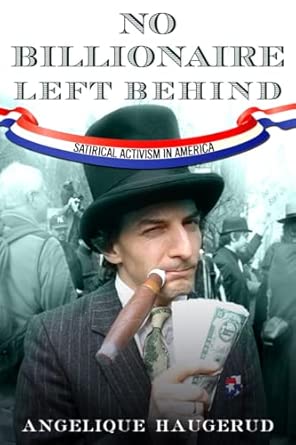
No Billionaire Left Behind: Satirical Activism in America
Author(s): Angelique Haugerud (Author)
- Publisher: Stanford University Press
- Publication Date: 17 April 2013
- Edition: 1st
- Language: English
- Print length: 288 pages
- ISBN-10: 0804781524
- ISBN-13: 9780804781527
Book Description
Growing economic inequality, corporate influence in politics, an eroding middle class. Many Americans leave it to politicians and the media to debate these topics in the public sphere. Yet other seemingly ordinary Americans have decided to enter the conversation of wealth in America by donning ball gowns, tiaras, tuxedos, and top hats and taking on the imagined roles of wealthy, powerful, and completely fictional characters. Why? In No Billionaire Left Behind, Angelique Haugerud, who embedded herself within the "Billionaires" and was granted the name "Ivana Itall," explores the inner workings of these faux billionaires and mines the depths of democracy's relationship to political humor, satire, and irony.
No Billionaire Left Behind is a compelling investigation into how satirical activists tackle two of the most contentious topics in contemporary American political culture: the increasingly profound division of wealth in America, and the role of big money in electoral politics. Anthropologist and author Angelique Haugerud deftly charts the evolution of a group named the Billionaires―a prominent network of satirists and activists who make a mockery of wealth in America―along with other satirical groups and figures to puzzle out their impact on politics and public opinion. In the spirit of popular programs like The Colbert Report and The Daily Show, the Billionaires demonstrate a sophisticated knowledge of economics and public affairs through the lens of satire and humor. Through participant observation, interviews, and archival research, Haugerud provides the first ethnographic study of the power and limitations of this evolving form of political organizing in this witty exploration of one group's efforts to raise hope and inspire action in America's current political climate.
Editorial Reviews
Review
"The activists profiled in Haugerud's lively study of political satire don tuxedos and furs for rallies and hold champagne flutes as protest props. Under fictive, ultra-rich personas like 'Alan Greenspend' and 'Robin Eublind', the Billionaires question 'the compatibility of wealth and democracy' through a polished form of 'political street theater' . . . Behind-the-scene details like prank-day jitters or the hours of improvisation and mannerism practice needed to get into 'billionaire shape' should charm fans of Stephen Colbert's satirical comedy, while grassroots organizations from any political bent will appreciate Haugerud's analysis of the efficacy of parody and image marketing. A danger of their theatrics is that details of the issues they champion can get lost among the irony-deficient. Nevertheless, Haugerud successfully illuminates America's staggering wealth inequality at the core of the Billionaire's message while investigating the comedic possibilities and limitations of their methods. "―
Publisher's Weekly"Angelique Haugerud's accessible and engaging book is important reading for anyone interested in the optimism of political satire, the hope that motivates activism, the clarity of critique, and the beauty of great ethnography. In
Leave No Billionaire Behind, Haugerud deftly combines economic anthropology, activism, performance, and the literature from news and journalism to build her powerful portrait of what The Billionaires are trying to accomplish and why."―Catherine Besteman, Colby College"This hilarious book addresses today's most pressing issues―social justice, skewed distributions of wealth and income, movements for change―and brilliantly reveals how whacky activists challenge the establishment and overly serious protest movements. Haugerud's book is a welcome addition to the appallingly dry corpus of much social movement scholarship."―Marc Edelman, Hunter College and the CUNY Graduate Center
"This brilliant study of the 'Billionaires for Bush' explains how and why irony has become such a powerful vehicle of political sincerity in the age of neoliberal monology. Whether or not one believes that satire is capable of reopening the terms of political discourse in the West by itself, we would all do well to heed Haugerud's persuasive argument that parody has potential to 'defamiliarize the familiar' by surfacing and inverting our conventions of understanding the world. Activists like the Billionaires have generated political effects, she shows us, by occupying the language of power."―Dominic Boyer, Rice University
"In this pathbreaking book Angelique Haugerud presents a highly original account of novel forms of activism and engagement that seek to redefine the parameters of the political. It is difficult to imagine a more important or timely contribution to the comparative study of politics."―David Nugent, Emory University
About the Author
Excerpt. © Reprinted by permission. All rights reserved.
NO BILLIONAIRE LEFT BEHIND
Satirical Activism in America
By Angelique Haugerud
Stanford University Press
Copyright © 2013 Board of Trustees of the Leland Stanford Junior University
All rights reserved.
ISBN: 978-0-8047-8152-7
Contents
List of Figures............................................................viiIntroduction: The Comedy of Wealth?........................................11 Irony, Humor, Spectacle..................................................232 "Times Are Good!" A New Gilded Age.......................................553 Pre-Billionaires: Experiments in Satirical Activism, 1990s...............814 Branded: Billionaires for Bush (and More)................................1095 Humor's Workshop, Humor's Witnesses......................................1356 Media Players............................................................1637 After Satire?............................................................187Acknowledgments............................................................207Appendix: Research Methods.................................................209Notes......................................................................211Works Cited................................................................245Index......................................................................267
Excerpt
CHAPTER 1
Irony, Humor, Spectacle
AVOIDING POSES AS CONTEMPORARY REAL-LIFE BILLIONAIRESsuch as "Star Wars" creator George Lucas, television star OprahWinfrey, or Microsoft cofounder Bill Gates, the satirical Billionaires adopt fictivepersonas such as Phil T. Rich and evoke the elegance of The Great Gatsby'sRoaring Twenties or an even earlier era of robber barons and heiresses. "We'redoing an impersonation of an imaginary subjectivity, something that is alreadythe stuff of fiction and a complicated set of projective identifications ...it's like a parody of a cartoon," remarked Merchant F. Arms (Jeremy Varon). Itis up to spectators then to historicize the present, to perceive the implied linkbetween the early twenty-first century and earlier wealth bubbles: the RoaringTwenties on the eve of the Great Depression, or the late–nineteenth-centuryera that Mark Twain popularized as a Gilded Age of surface glitter and vastunderlying corruption, when the very rich sparkled while many went hungry.
The sheer improbability that actual billionaires of any era would be protestersis the premise of the Billionaires' ironic humor. Yet that very assumptionis undone in real life by the man-bites-dog story of what Newsweek termed a"billionaire backlash"—the multimillionaires and billionaires such as NetflixCEO Reed Hastings, Warren Buffett, George Soros, members of the Rockefellerfamily (and in earlier decades Presidents Franklin D. Roosevelt and TheodoreRoosevelt) who support capitalism but adopt progressive public positions onwealth and taxes that catch many by surprise. Indeed Franklin Roosevelt "athis legendary 1936 Madison Square Garden rally declared that he welcomedthe 'hatred' of his enemies in the realms of 'business and financial monopoly,speculation, reckless banking, class antagonism, sectionalism, war profiteering.'"The message of today's renegade billionaires such as Warren Buffett isunmistakable: our age of excess is so extreme that even some who have gainedthe most are distressed enough to publicly urge reform.
This chapter begins with the double revolt of billionaires (both real andpretend) and a dash through a decade with the satirical Billionaires as theyresponded with quick reflexes to national political shifts. Next, since irony isthe Billionaires' core weapon, I explore theories of ironic humor as politicalinstrument: the danger in the joke, the joke in the social structure, irony asbearer of hope, ironies of ethnographic research, and Billionaire responses tohaving an anthropologist study them. I conclude with comparative discussionof "spectacular dissent" by the Yes Men, Reverend Billy, Stephen Colbert, andother recent satirical innovators.
A Double Revolt of Billionaires
The story's silhouette: in the mid-1980s, a Midwestern man gave away his inheritedfortune at the age of twenty-six. One year before the turn of the millennium,that same gentleman organized a surprise campaign stunt that shineda national media spotlight on his new cocreation, the Billionaires for Forbes,whose tagline was "Because Inequality Is Not Growing Fast Enough." After SteveForbes dropped out of the presidential race, successors to the tongue-in-cheekprotesters turned their attention to both Republican and Democratic presidentialcandidates and during the 2000 campaign called themselves Billionaires forBush (or Gore). They parodied the ultrawealthy, critiqued plutocracy and theoutsized role of money in both major political parties, and multiplied into amedia-friendly grassroots network of fifty-five chapters nationally.
Four years later, bearing a name—Billionaires for Bush—redesigned to suita new presidential campaign, their visibility escalated dramatically as they grewin a few months from a half dozen or so members meeting in a Manhattanapartment to one hundred chapters across the country and a handful abroad.Over ten thousand people joined their online community,6 thanks to a polishedwebsite, media coverage, eye-catching street events, personal networking, andfund-raising parties that attracted celebrities such as Electronica artist Moby(Richard Melville Hall). With a red, white, and blue piggy bank as their logo,the Billionaires for Bush cultivated high production values—protest with polish.They produced music CDs, a tongue-in-cheek book, T-shirts, bumperstickers, and an infomercial (among other products). Their modest fundingcame from sales of such products and from individual donations: "Billionaireproduction values on a shoestring budget."
The Billionaires for Bush won a spot among fifteen finalists selected frommore than 1,500 contestants in a "Bush in 30 Seconds" ad competition sponsoredin November 2003 by MoveOn.org. In early 2004, their media coveragespiked, thanks in part to a spectacular stunt featuring a Karl Rove look-alike.They appeared in the New Yorker and on CNN, ABC, MSNBC, and other televisionnetworks as well as in articles in Newsweek, the New York Times, WashingtonPost, Wall Street Journal, Boston Globe, Los Angeles Times, USA Today,Der Spiegel, and other newspapers and magazines in the United States andabroad. Washington Post associate editor Robert G. Kaiser wrote that "Billionairesfor Bush, no matter what your politics, must be one of the most likableprotest groups ever formed."
Examples of their street actions include the Million Billionaire March duringRepublican and Democratic National Conventions, a ballroom-dancingflashmob12 in New York's Grand Central Station, thanking people outside postoffices as they mail their tax returns on April 15, or auctioning off Social Securityon President Bush's 2005 inauguration day. Their musical troupe "The Follies"produced shows such as "Dick Cheney's Holiday Spectacular." The Billionairesdubbed the U.S. Labor Day holiday "Cheap Labor Day," and displayed bannersproclaiming "No Minimum Wage! No Minimum Age!" and "Subcontinents DoIt Cheaper!"
In early 2008, the Billionaires produced a widely viewed video spoof, "No,You Can't," that was covered in the New York Times and that featured a DickCheney look-alike and other Republican figures undercutting Barack Obama's"Yes We Can" slogan. "No, You Can't" parodied a popular video featuring celebritiesand Obama's oratory that had been produced by the musician Will.i.amof the Black Eyed Peas. At the 2008 Republican National Convention inSt. Paul, dressed in pinstriped suits and black fedoras, the Billionaires attractedattention from the Wall Street Journal and other media when they posed as"Lobbyists for McCain" and carried placards declaring, "No, You Can't!" and"Don't Change Horsemen Mid-Apocalypse" and "Loyal to Big Oil."
Wall Street's 2008 meltdown inspired the satirical Billionaires for Bailouts.Clad in tuxedoes and gowns or black suits and fedoras, they too were featuredin a Washington Post article and other media when they joined Wall Street protestsand held aloft signs proclaiming, "Thanks for the $700bn Check!" and"I'm Starving, Bail Me Out!" and "Billionaires for Bailouts Love Tax-Payers!"They pivoted during the 2009 health care reform debates to pose as Billionairesfor Wealthcare ("Let Them Eat Advil!") and staged another stealth prankthat attracted national media attention: a musical satirical protest—"PublicOption Annie," sung to the tune of "Tomorrow" from the Broadway musicalAnnie—which caught by complete surprise health insurance industry executivesat a Washington, DC, conference. That choral stunt was featured at the top of MSNBC'sRachel Maddow Show, in a segment captioned "Guerrillas in TheirMidst." Maddow said the Billionaires' prank was a "sign of the continued spunkand energy on the left to push for a robust version of [health care] reform."
In 2010, as proposals to cut Social Security benefits resurfaced—eventhough the Social Security trust fund is not in crisis and is not the cause of thefederal budget deficit—the satirical Billionaires for Social Insecurity wavedsigns declaring "It's a Crisis! Because We Said So" and "Feeling Entitled toCut Your Entitlements (Since 1936)." In mid-2010, following the U.S. SupremeCourt's Citizens United decision, a spin-off group dressed as the country'sFounding Fathers won media coverage of their protests in Washington, DC,against massive political campaign fund-raising by corporate lobbyists. Alsoin 2010, Agit-Pop Communications20 (co-led by Billionaires cofounder AndrewBoyd) and MoveOn teamed up to create RepublicCorp ("Buying DemocracyOne Race at a Time"), a "merger between giant corporations and the GOP,"which quickly sprouted offices and street actions in several cities, produced avideo that MoveOn transmitted to nearly a million people, serenaded the headof the Republican front-group American Action Network, recorded a "corporateanthem," and joined Stephen Colbert's 2010 "Keep Fear Alive" rally inWashington, DC, among other activities.
Andrew Boyd and other former Billionaires established a netroots organizationcalled The Other 98%, which describes itself on its website as "a politicalhome for the silent majority of Americans who are tired of corporate control ofWashington." Its taglines include "Because the Middle Class Is Too Big to Fail"and "Making Democracy Work for the Rest of Us." The Other 98% helped toorganize a large flashmob of hundreds of protesters in May 2011 to spoof therenaming of a theater for ballet and opera at Lincoln Center as the David H.Koch Theatre. Another of its capers: to mark the second anniversary of theSupreme Court's Citizens United decision, the Supreme Court Building's whiteexterior was briefly lit one night—until police arrived—with giant dollar signsand a light projection of the words "rights are for people."
In April 2011, when some corporate media outlets reported that many largeU.S. corporations paid no federal taxes and that some even received tax credits,the Billionaires' cofounder Andrew Boyd teamed up with the Yes Men andUS Uncut to concoct a widely reported media hoax asserting that the GeneralElectric Corporation would "donate [its] entire $3.2 billion tax refund to helpoffset cuts and save American jobs." During the half hour or so when thepublic believed the hoax, GE's stock plunged and then recovered quickly oncethe hoax was revealed, illustrating, a US Uncut spokesman said, that GE wouldnot voluntarily "do the right thing" and pay their tax—in spite of loopholes inthe law—since that would cause their stock to fall. "GE's tax avoidance is unpatriotic,it's undemocratic, it's unfair," said Andrew Boyd.
In 2012, elegantly attired satirists calling themselves Multi-Millionairesfor Mitt joined Occupy Wall Street protesters marching around New York's Waldorf-AstoriaHotel, where presidential candidate Mitt Romney appeared at a$2,500-per-plate fund-raising luncheon. They waved placards declaring, "CorporationsAre People Too!" and chanted "We're here, we're rich, get used to it!"And in 2011 and 2012, Billionaires for Tar Sands staged mock counterdemonstrationsto environmentalist protests against the Keystone XL pipeline project thatwould transport oil from the tar sands in Alberta, Canada, to the United States.
Meanwhile, the man who had given away his inherited fortune while in histwenties—the cocreator of the satirical Billionaires—redirected his attentionduring the early 2000s to actual billionaires and multimillionaires. He teamedup with the father of the richest man in the world to write a book subtitled WhyAmerica Should Tax Accumulated Fortunes. He helped to found a nonprofit,nonpartisan organization (Responsible Wealth), whose members are amongthe wealthiest 5 percent of Americans. These privileged citizens, who includeDemocrats, Republicans, and Independents, spotlight the risks posed to democracyby escalating economic inequality, and call for a living wage, fair taxes,greater corporate accountability, and broadened asset ownership for all Americans.Theirs began as a modest attempt to counter the outsized influence ofeighteen ultrarich families—many of whom inherited substantial wealth—whobetween 1994 and 2004 spent $500 million lobbying to abolish the tax on inheritedwealth (which dates back to 1916). To fight back against that well-financedlobbying effort by heirs and heiresses (and conservative think tanks),the nonpartisan organization Responsible Wealth recruited a couple of thousandmillionaires and a few billionaires to sign their petition against repeal ofthe federal tax on inherited wealth.
These Janus-faced insurgencies by bona fide billionaires on the onehand, and satirists who simply pretend to be billionaires on the other, wereeye-catching inversions of social hierarchy. For actual billionaires and multimillionairesto support higher taxes for the ultrarich (including a tax on inheritedwealth) symbolically elevates that populist position, while the elegantself-presentation of the parodist billionaires raises the status of "protester"above its scruffy stereotype.
Embedded in these twin revolts are subtle psychological dynamics of fearand desire, imagined status reversals entailing descent into poverty or ascentinto wealth. The sharpness of today's economic divide—marked some say byan "empathy gap"—nonetheless offers vivid material for reciprocal imaginingsof life at the opposite end of the wealth spectrum. Sometimes theseideations are projective identifications that yield anger, fear, aggression, andblame. But they can also embody an empathic capacity to imagine the lot of theother and to engage compassionately the idea of doubleness or split identity(there but for luck or grace go any of us), without which neither insurgencywould carry moral or emotional force.
The Joke in the Social Structure
The "billionaire backlash" attests to what anthropologist Mary Douglas termsthe "joke in the social structure"—the deep connection between a joke and itshistorical-political setting. Jokes about sharp inequalities of status and power,like any humor, are potent only if they tap shared understandings of context.Without that "tacit social contract" or "social congruity" as backdrop to a joke,Critchley remarks, there is "no comic incongruity." That, he says, is the phenomenologyof the joke.
It is easy to see American life at the millennium as a social situation thatinvites symbolic reformulation into its joke pattern, given our era's runawaywealth inequality, the growing material precariousness of the middle class andworking poor, the outsized role of money and huge corporations in politics,and the consequent erosion of substantive democracy in the early twenty-firstcentury. A few years before the real estate bubble burst, and before the implosionof mortgage-backed financial derivatives helped to precipitate a globaleconomic crisis, I asked Lois Canright (an activist in her midforties who had acouple of decades of experience with political organizing and who was active inBillionaires for Bush), What historical circumstances do you think favor satiricalstreet theater as a protest form? Her reply, as we sat in her tree-shaded yardon a warm August day in 2004, was prescient:
I think it arises when the real world starts to resemble a theater of the absurd ...when the things that have become normal under Bush are so mind-blowinglyimbalanced ... his tax policy, it's just unreal that everybody just rolled over andwent along with that and what that says about our society and our tolerance forthis kind of opulence in the face of starvation.... It's pretty stark times and somaybe these more ironic or satirical [approaches] ... rise when Rome is gettingready to roast.
For many, the "roasting" had already begun. Signs of profound crisis in U.S.society, in the years immediately preceding the financial meltdown and big bailoutsof 2008, included some 56 million citizens without health insurance, 36 millionliving in poverty, hundreds of thousands of people losing homes mortgagedat subprime rates (often through deceptive lending agreements), pension fundscollapsing, schools failing, physical infrastructure crumbling, an overstretchedmilitary, corporate accounting failures and fraud, "fictitious capital," governmentspying on citizens, growing concentration of corporate media ownership,politicians acting as courtiers of powerful corporations that funded their campaigns,and heightened political polarization and incivility in public discourse.
After the 2008 financial meltdown, satirical Billionaire Merchant F. Armssaid, "our core critique was utterly and completely vindicated." To understandwhy requires one to look no further than autopsies of the 2008 financial meltdown,such as the 2011 Financial Crisis Inquiry Report or Charles H. Ferguson'saward-winning 2010 documentary Inside Job. That carefully researchedfilm centers on the financial wizards—"masters of the universe"—whose risk-takingwas enabled in part by deregulation of the financial sector and by cozyrelationships with politicians and regulators. The film's director remarked in2010: "In the case of this crisis, nobody has gone to prison, despite fraud thatcaused trillions of dollars in losses.... It is ... my hope that, whatever politicalopinions individual viewers may have, that after seeing this film we can allagree on the importance of restoring honesty and stability to our financial system,and of holding accountable those who destroyed it." Occupy Wall Streetprotesters echoed that sentiment.
(Continues...)
(Continues...)Excerpted from NO BILLIONAIRE LEFT BEHIND by Angelique Haugerud. Copyright © 2013 by Board of Trustees of the Leland Stanford Junior University. Excerpted by permission of STANFORD UNIVERSITY PRESS.
All rights reserved. No part of this excerpt may be reproduced or reprinted without permission in writing from the publisher.
Excerpts are provided by Dial-A-Book Inc. solely for the personal use of visitors to this web site.


