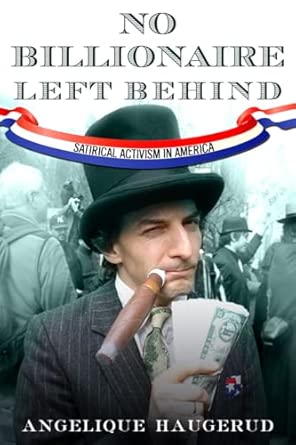
NO BILLIONAIRE LEFT BEHIND
Satirical Activism in America
By Angelique Haugerud
Stanford University Press
Copyright © 2013 Board of Trustees of the Leland Stanford Junior University
All rights reserved.
ISBN: 978-0-8047-8153-4
Contents
List of Figures............................................................viiIntroduction: The Comedy of Wealth?........................................11 Irony, Humor, Spectacle..................................................232 "Times Are Good!" A New Gilded Age.......................................553 Pre-Billionaires: Experiments in Satirical Activism, 1990s...............814 Branded: Billionaires for Bush (and More)................................1095 Humor's Workshop, Humor's Witnesses......................................1356 Media Players............................................................1637 After Satire?............................................................187Acknowledgments............................................................207Appendix: Research Methods.................................................209Notes......................................................................211Works Cited................................................................245Index......................................................................267
Excerpt
CHAPTER 1
Irony, Humor, Spectacle
AVOIDING POSES AS CONTEMPORARY REAL-LIFE BILLIONAIRESsuch as "Star Wars" creator George Lucas, television star OprahWinfrey, or Microsoft cofounder Bill Gates, the satirical Billionaires adopt fictivepersonas such as Phil T. Rich and evoke the elegance of The Great Gatsby'sRoaring Twenties or an even earlier era of robber barons and heiresses. "We'redoing an impersonation of an imaginary subjectivity, something that is alreadythe stuff of fiction and a complicated set of projective identifications ...it's like a parody of a cartoon," remarked Merchant F. Arms (Jeremy Varon). Itis up to spectators then to historicize the present, to perceive the implied linkbetween the early twenty-first century and earlier wealth bubbles: the RoaringTwenties on the eve of the Great Depression, or the late–nineteenth-centuryera that Mark Twain popularized as a Gilded Age of surface glitter and vastunderlying corruption, when the very rich sparkled while many went hungry.
The sheer improbability that actual billionaires of any era would be protestersis the premise of the Billionaires' ironic humor. Yet that very assumptionis undone in real life by the man-bites-dog story of what Newsweek termed a"billionaire backlash"—the multimillionaires and billionaires such as NetflixCEO Reed Hastings, Warren Buffett, George Soros, members of the Rockefellerfamily (and in earlier decades Presidents Franklin D. Roosevelt and TheodoreRoosevelt) who support capitalism but adopt progressive public positions onwealth and taxes that catch many by surprise. Indeed Franklin Roosevelt "athis legendary 1936 Madison Square Garden rally declared that he welcomedthe 'hatred' of his enemies in the realms of 'business and financial monopoly,speculation, reckless banking, class antagonism, sectionalism, war profiteering.'"The message of today's renegade billionaires such as Warren Buffett isunmistakable: our age of excess is so extreme that even some who have gainedthe most are distressed enough to publicly urge reform.
This chapter begins with the double revolt of billionaires (both real andpretend) and a dash through a decade with the satirical Billionaires as theyresponded with quick reflexes to national political shifts. Next, since irony isthe Billionaires' core weapon, I explore theories of ironic humor as politicalinstrument: the danger in the joke, the joke in the social structure, irony asbearer of hope, ironies of ethnographic research, and Billionaire responses tohaving an anthropologist study them. I conclude with comparative discussionof "spectacular dissent" by the Yes Men, Reverend Billy, Stephen Colbert, andother recent satirical innovators.
A Double Revolt of Billionaires
The story's silhouette: in the mid-1980s, a Midwestern man gave away his inheritedfortune at the age of twenty-six. One year before the turn of the millennium,that same gentleman organized a surprise campaign stunt that shineda national media spotlight on his new cocreation, the Billionaires for Forbes,whose tagline was "Because Inequality Is Not Growing Fast Enough." After SteveForbes dropped out of the presidential race, successors to the tongue-in-cheekprotesters turned their attention to both Republican and Democratic presidentialcandidates and during the 2000 campaign called themselves Billionaires forBush (or Gore). They parodied the ultrawealthy, critiqued plutocracy and theoutsized role of money in both major political parties, and multiplied into amedia-friendly grassroots network of fifty-five chapters nationally.
Four years later, bearing a name—Billionaires for Bush—redesigned to suita new presidential campaign, their visibility escalated dramatically as they grewin a few months from a half dozen or so members meeting in a Manhattanapartment to one hundred chapters across the country and a handful abroad.Over ten thousand people joined their online community,6 thanks to a polishedwebsite, media coverage, eye-catching street events, personal networking, andfund-raising parties that attracted celebrities such as Electronica artist Moby(Richard Melville Hall). With a red, white, and blue piggy bank as their logo,the Billionaires for Bush cultivated high production values—protest with polish.They produced music CDs, a tongue-in-cheek book, T-shirts, bumperstickers, and an infomercial (among other products). Their modest fundingcame from sales of such products and from individual donations: "Billionaireproduction values on a shoestring budget."
The Billionaires for Bush won a spot among fifteen finalists selected frommore than 1,500 contestants in a "Bush in 30 Seconds" ad competition sponsoredin November 2003 by MoveOn.org. In early 2004, their media coveragespiked, thanks in part to a spectacular stunt featuring a Karl Rove look-alike.They appeared in the New Yorker and on CNN, ABC, MSNBC, and other televisionnetworks as well as in articles in Newsweek, the New York Times, WashingtonPost, Wall Street Journal, Boston Globe, Los Angeles Times, USA Today,Der Spiegel, and other newspapers and magazines in the United States andabroad. Washington Post associate editor Robert G. Kaiser wrote that "Billionairesfor Bush, no matter what your politics, must be one of the most likableprotest groups ever formed."
Examples of their street actions include the Million Billionaire March duringRepublican and Democratic National Conventions, a ballroom-dancingflashmob12 in New York's Grand Central Station, thanking people outside postoffices as they mail their tax returns on April 15, or auctioning off Social Securityon President Bush's 2005 inauguration day. Their musical troupe "The Follies"produced shows such as "Dick Cheney's Holiday Spectacular." The Billionairesdubbed the U.S. Labor Day holiday "Cheap Labor Day," and displayed bannersproclaiming "No Minimum Wage!...
 Wow! eBook