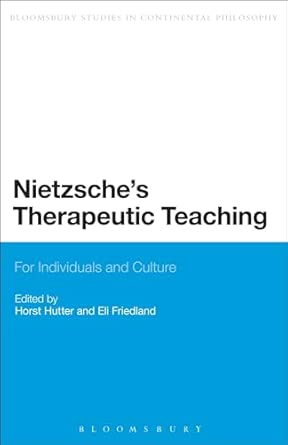
Nietzsche's Therapeutic Teaching: For Individuals and Culture
Author(s): Horst Hutter
Publisher: Bloomsbury Academic
Publication Date: 12 Sept. 2013
Language: English
Print length: 262 pages
ISBN-10: 1441125337
ISBN-13: 9781441125330
Book Description
The theme of the philosopher as therapist dominates Nietzsche’s entire opus, from his earliest writings to the Zarathustra period and beyond. Nietzsche wishes to hasten the coming and future sanctification of a new type of synthetic human being, and his entire teaching is shaped by his own struggles against illness.Yet few Nietzsche scholars have paid this crucial therapeutic element of his thought sufficient attention.
This collection of essays by leading scholars in the field is composed around the Nietzschean insight, which has its roots in the Hippocratic tradition of ancient medicine, that beliefs, behaviours, ideals and patterns of striving are not things for which individuals or even cultures are responsible. Rather, they are symptoms of what an individual or culture is, which symptoms require diagnostic interpretation and evaluation. The book identifies three principal approaches in Nietzsche’s philosophy: diagnostic, prognostic and therapeutic. Each essay takes up this essential insight into Nietzsche’s therapeutic philosophy from a different perspective and collectively they reveal an array of insightful approaches to self-induced enhancement, for both individuals and cultures.
Editorial Reviews
Review
Nietzsche’s Therapeutic Teaching brings needed attention to the centrality of the classical theme of philosophy as medicine for the soul to Nietzsche’s project and its implications for Nietzsche’s philosophical practice. Its rich diversity of essays (by established and younger scholars) makes this a welcome contribution to, and provocative re-orientation of, contemporary Nietzsche studies. — David Owen, Professor of Social & Political Philosophy, University of Southampton, UK Published On: 2013-04-19
About the Author
Horst Hutter is Professor of Political Science at Concordia University, Canada.
Eli Friedland is a doctoral student in Political Science at Concordia University, Canada.
 Wow! eBook