 Wow! eBook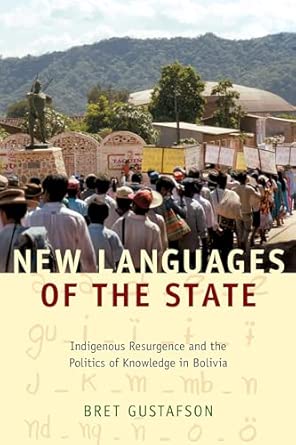
New Languages of the State: Indigenous Resurgence and the Politics of Knowledge in Bolivia
Author(s): Bret Gustafson (Author)
- Publisher: Duke University Press
- Publication Date: 10 July 2009
- Edition: Illustrated
- Language: English
- Print length: 277 pages
- ISBN-10: 0822345293
- ISBN-13: 9780822345299
Book Description
Gustafson shows that bilingual education is an issue that extends far beyond the classroom. Public schools are at the center of a broader battle over territory, power, and knowledge as indigenous movements across Latin America actively defend their languages and knowledge systems. In attempting to decolonize nation-states, the indigenous movements are challenging deep-rooted colonial racism and neoliberal reforms intended to mold public education to serve the market. Meanwhile, market reformers nominally embrace cultural pluralism while implementing political and economic policies that exacerbate inequality. Juxtaposing Guarani life, language, and activism with intimate portraits of reform politics among academics, bureaucrats, and others in and beyond La Paz, Gustafson illuminates the issues, strategic dilemmas, and imperfect alliances behind bilingual intercultural education.
Editorial Reviews
Review
“Bret Gustafson has written a subtle and illuminating ethnography of the interactions and intersections of grassroots and official projects of interculturalism in Bolivia. . . . A core success of the book stems from Gustafson’s ability to push against unidirectional analytic or critical positions without leaving readers stranded on islands of particularism or mired in irreducible complexity.”–Andrew Orta “Journal of Latin American and Caribbean Anthropology”
“Gustafson has written a magisterial book on Indigenous politics in Bolivia that should be required reading for all graduate students interested in Indigenous politics, decolonization, and political ethnography.”–José Antonio Lucero “A Contracorriente”
“Gustafson’s nuanced and dynamic portrait of reform provides a wealth of information and insight for followers of indigenous education and politics. Hopefully, his narrative about this oft-neglected corner of the globe will find an audience not only among fellow anthropologists but among educational activists and policy-makers as well.”–Aurolyn Luykx “Anthropos”
“In
New Languages of the State, Gustafson provides the vivid narrative of EIB from the colonizers’ destruction and violence, which is justified and legitimated by the colonizers, through the Guaraní challenge and resistance to the official lies. Students of bilingual education everywhere will benefit from reading this account because everywhere, bilingual education is about challenging and resisting the hegemony of colonizers and their languages.”–Sheila M. Shannon “Latin American Politics and Society”“While arguably the best ethnography of Guarani country produced in recent years, Gustafson’s book is also situated at the intersections of state-building and social movements; it will therefore be of broad interest to scholars in anthropology, political science, sociology, and beyond. . . . This book is clearly a major contribution to our understanding of contemporary Bolivia, indigenous movements, and the politics of indigenous education. . . . With a keen understanding of the contentious nature of Bolivian society, Gustafson has provided a complex and compelling portrait of new forms of struggle, belonging, and hope. As news of violent conflicts in Bolivia continues to surface, the need for such a message could scarcely be more urgent.”–María Elena Garcí “Current Anthropology”
“[
New Languages of the State] is a spectacularly successful example of how to write multi-sited and multi-scalar ethnography. Divided into three sections with interludes that turn vivid narratives of personal experience into key analytical questions, beautifully crafted writing fuses thick description of people and places with consistently perceptive analysis. The book’s discussion of the problems of challenging the coloniality of power through education has significance beyond Latin America, without sacrifice of careful contextualization.”–John Gledhill “Journal of the Royal Anthropological Institute”“Although the ethnographic lens in
New Languages focuses less on classrooms and schools than on government ministries, development agencies, teachers’ union and Guarani movement spaces, Gustafson skillfully shifts and refocuses his work’s temporal and spatial scope across many sites, capturing these diverse actors’ interventions in education reform. The effect is a rich composite picture of the processes unfolding around education policy in Bolivia. . . . With increasing discussion in Bolivia and beyond about what the ‘decolonization’ of education could look like, New Languages provides a welcome contribution.”–Karl F. Swinehart “Anthropology & Education Quarterly”“A beautifully crafted, magnificently expansive, and inspiring work of engaged historical ethnography! Bret Gustafson traces Bolivia’s heralded experiment in bilingual education by planting it deep in the subsoil of Guaraní culture and politics and by projecting it against the larger canvass of neoliberal reformism in the 1990s. In plotting the choreography of state, NGO, and grassroots struggles over indigenous knowledge and schooling, Gustafson opens up new horizons on Bolivia’s vibrant Guaraní movement and its radicalizing agendas in the early 2000s. This is, quite simply, the work of a seasoned anthropologist and gifted writer.”–
Brooke Larson, author of Trials of Nation Making. Liberalism, Race, and Ethnicity in the Andes, 1810-1910“Much anticipated by anthropologists of Latin America,
New Languages of the State is an entirely new contribution to the ethnography of the Andes, and it speaks to much broader issues about development banks, globalization, indigenous movements, and more. Bret Gustafson makes sense of transnational processes, bureaucratic logics, and ideological formations by moving between diverse locales in Bolivia, from the most remote locations in Chaco, to the upscale professional offices of La Paz, and then on to international meetings in Thailand and the United States.”–Julia Paley, author of Marketing Democracy: Power and Social Movements in Post-Dictatorship ChileFrom the Back Cover
About the Author
Bret Gustafson is Assistant Professor of Anthropology at Washington University in St. Louis.
Excerpt. © Reprinted by permission. All rights reserved.
NEW LANGUAGES of the State
Indigenous Resurgence and the Politics of Knowledge in BoliviaBy BRET GUSTAFSON
Duke University Press
Copyright © 2009 Duke University Press
All right reserved.
ISBN: 978-0-8223-4529-9
Contents
About the Series………………………………………………………………………………..xiAcknowledgments…………………………………………………………………………………xvAcronyms……………………………………………………………………………………….xixIntroduction Ethnographic Articulations in an Age of Pachakuti……………………………………….11. Soldiers, Priests, and Schools: State Building in the Andes and the Guarani Frontier…………………33Interlude To Camiri…………………………………………………………………………….612. Guarani Scribes: Bilingual Education as Indigenous Resurgence……………………………………..65Interlude To Itavera……………………………………………………………………………953. Guarani Katui: Schooling, Knowledge, and Movement in Itavera………………………………………101Interlude To La Paz, via Thailand…………………………………………………………………1354. Network Articulations: EIB from Project to Policy………………………………………………..143Interlude Bolivia or Yugoslavia?…………………………………………………………………1715. Prodding Nerves: Intercultural Disruption and Managerial Control…………………………………..175Interlude La Indiada, como para Dar Miedo…………………………………………………………2096. Insurgent Citizenship: Interculturalism beyond the School…………………………………………215Interlude Interculturalism to Decolonization………………………………………………………2477. Shifting States………………………………………………………………………………285Notes………………………………………………………………………………………….301Glossary……………………………………………………………………………………….303References……………………………………………………………………………………..319
Chapter One
SOLDIERS, PRIESTS, AND SCHOOLS
State Building in the Andes and the Guarani Frontier
In January of 1892, Guarani warriors from a dozen villages in the heart of Guarani country struck back against the colonizers. Guarani captains, including the famous Guirakota, rallied loosely confederated villages against outposts of the karai state, burning ranches, sugar mills, and isolated cattle posts in the bush. Reaching a scale not seen since the Guakaya valley wars of 1874, the Guarani mobilization of 1892 was the last of the guerras de indios against the colonial order. Karai settlers lived in fear of such outbreaks, not so much because of the possibility of their success, but because they were symptoms of deeper disorder and subversion-they were signs of autonomous Guarani action outside the control of frontier state and mission institutions. Though much of Guarani country was by then under the ostensible control of the colonial state, this insurgency emerged in the last semi-autonomous Guarani redoubt in the Ivo region, an area facing the final thrust of karai settlers eager to occupy farmlands on the Bolivian frontier (see map on page 2).
To the Guarani, the karai, Spanish-speaking whites and mestizos, were invaders. To the karai, the Guarani were savages, made useful only by way of the domestication of the whip on the hacienda, or if kept docile under the tutelage of the Franciscan fathers in the missions. Otherwise they represented obstacles to progress that required elimination. Against these “savages,” the karai called themselves nacionales (no longer Spaniards, but subjects identified with the Bolivian nation-state) or cristianos (Christians, loyal to the epistemic and political authority of the Catholic Church), the latter of which is still used today.
Guarani and karai had been engaged in intermittent warfare and exchange for over three hundred years, a period in which the Guarani had often held their own, if not thrived. Yet, as elsewhere in the Americas, the period of global economic expansion in the late nineteenth century boosted state efforts to pacify the frontier. Backed by a wealthier state with new military technology, frontier karai were now on the offensive. Cattle farms and sugar-cane fields that supplied markets in Andean cities were displacing Guarani corn. The Guarani freedom to make and break alliances eroded as their independent land base shrank. Overt armed resistance to the karai invasion was rare (Langer 1994a, b). Most Guarani were surrounded and reduced (reducidos) to dependence on Franciscan missions or to violent subjugation as laborers on karai haciendas. The Bolivian nation-state was superimposed on them in the form of provincial governors, missions, forts, ranches, towns, Catholicism, and the Spanish language. A colonial social, cultural, and political fabric had woven itself into-and in some spaces silenced-Guarani lives, languages, and spaces. The wars of 1892 were the last gasp of armed Guarani resistance to the expanding colonial state.
Guarani war leaders had for some time been quietly mobilizing around a young itinerant shaman called Apiaguaiki Tpa. It was a hefty name. Apiaguaiki had disputed meanings, to which I return below. Yet tpa is the Guarani word for beings or objects of supernatural power, the same word that Jesuits and Franciscans took to refer to the Christian God (Shapiro 1987). A person called Tpa was in effect an elevation of a more mundane figure, the ipaye, a curer or shaman. Ipayes were bastions of counter-hegemonic knowledge that undermined the claims of priests, who considered them agents of the devil. Under certain conditions, leaders with ipaye qualities were transformed into tpa, roughly “person-deity” or “prophet.” The tpaist movements that followed constituted large-scale epistemic, political, and military challenges to colonial authority. Tpaist movements appeared periodically throughout the colonial period. Like messianic movements elsewhere, they relied on local forms of knowledge while mimicking or appropriating symbols of colonial authority (Saignes 1990). These subversive epistemes and practices were invariably met with excesses of colonial violence that pursued order through terror.
The young prophet Apiaguaiki Tpa was even more unsettling because of his traveling companion, an older literate mission Guarani named Juan Ayemot. Ayemot, or, I-Have-Made-Myself-White, learned Spanish and rudimentary literacy under Franciscan tutelage at the Santa Rosa mission. Yet the putative convert Ayemot left the mission to follow Apiaguaiki, reportedly after watching the prophet cure sick Guarani right under the priest’s nose. In the months before the uprising, the pair had become regional news of some concern. In late 1891 the Star of the East, a provincial newspaper in Santa Cruz, two hundred miles north, printed reports of the curious duo. The scribe Ayemot was said to be a “savage of some age,” traveling around the region with a Guarani claiming to be a prophet (Sanabria Fernndez 1972:127). Wielding the subversive knowledge of a Guarani tpa and ipaye was one thing. Yet now bolstered with the control of the karai language and script in the tongue and hands of a supposed Guarani neophyte, the tpa proved doubly subversive. Literacy was supposed to transform savages into governable subjects, if not citizens. Yet here it threatened to operate outside the sovereign control of the church and state. By virtue of their mere existence the pair deeply undermined the colonial dependence on a clear boundary between Guaraniness and the literacy-mediated legitimacy of colonial religio-political authority.
Anglico Martarelli, an Italian Franciscan stationed at the Santa Rosa mission, was also concerned. Apiaguaiki Tpa was calling himself a son of God and gathering followers near Kuruyuki, scarcely ten miles from his mission gates. Guarani were coming to Kuruyuki from throughout the region to see and hear the prophet, further unsettling frontier spatial orders as they left ranches and villages thought under firm karai control. Furthermore, Ayemot had been a charge of Martarelli himself. His own “son,” as it were, had now turned away from his authority and back toward “savagery.” Frontier karai and politicians frequently attacked the church for monopolizing Guarani labor or failing to civilize the indigenous population fast enough, and Ayemot’s reconversion would give fuel to these critics. Martarelli did not hesitate to call for Bolivian militia reinforcements from Monteagudo. Even local karai settlers, themselves no friend of the mission, quickly became nervous and sought refuge there as tension increased. As Martarelli wrote in a later account: “Fanaticism took control of their [Guarani] spirits at the news of the appearance of the Tunpa [Tpa], and a multitude of savages gathered at Guruyuqui [sic. Kuruyuki], whose number was calculated around 5,000, apt for war, without counting women and children…. This unusual movement of Indians toward Curuyuqui naturally generated in the Missionary Fathers and Christians of the region the suspicion of some insurrection that was being planned there” (Martarelli 1918:8-9). Whether an insurrection was really planned remains unknown. Sometime in December of 1891, the tpa, by way of Ayemot, had sent a letter to Martarelli and his fellow father Romualdo D’Ambroggi. They asked to be left in peace, because
the rage [that the tpa] has for the caraises [karai] is because they have been evil to us, but not the fathers who always give food and services in the communities and who do not let the carai [karai] finish us all off as they want. None of ours complain about the fathers, nor does the tunpa [tpa] complain; he says nothing against You, only of those who have taken land from the people and killed for the joy of killing and robbed our things. (qtd. in Sanabria Fernndez 1972:225-27)
Bolstered by the troops from Monteagudo, Martarelli then arranged a parley with the tpa. The latter argued that his only activities as an ipaye were praying for rain, which Martarelli interpreted as stalling for time. The historian Hernando Sanabria Fernndez imagines that Ayemot translated these words to Spanish for the benefit of the karai soldiers, even though the tpa reportedly spoke a bit of Spanish himself, learned from labor as a houseboy on a karai hacienda. Forced to speak in the outsider’s tongue in their own land, the Guarani found that bilingualism, like power, was one-sided. Nonetheless, both parties agreed to meet again on January 4, 1892.
Before this meeting, the assault broke out, yet only after the karai murder of a Guarani woman. During the New Year festivities, a frontier official raped and murdered the woman at uumbite, the karai settlement near the mission. As word spread, the war captains allied with the prophet launched attacks in the early days of January. The insurrectos, as these rebel Guarani were called, eventually massed at Ivo and laid siege to the Santa Rosa mission. With the help of mission Guarani and frontier militiamen, the army detachment repelled the assault. The insurrectos retreated and dug in at Kuruyuki. Bolivian reinforcements from Santa Cruz arrived on January 27. Again assisted by mission Guarani, the Bolivians counterattacked on January 28, the infamous date of what is now called the Massacre of Kuruyuki.
In writing of the violence later, Martarelli wrote of his terror on hearing the cacophony of Guarani flutes and drums and seeing smoke rising from burning settlements. Yet like most colonial violence, the killing and terror was unilateral. According to the military report, eight hundred Guarani men and boys were slaughtered, with only four Bolivian soldiers lost (Sanabria Fernndez 1972). Martarelli celebrated the victory of the “nationals” over the “rebels.” Yet he noted the “valor demonstrated by the savages” and recognized the massacre for what it was: “The clear reality of the tragic spectacle was the horrendous devastation [estrago] that the hailstorm of fire from the rifles had done to the enemy [Guarani] lines; the trenches were full of cadavers” (1918:28).
Bolivian troops and militiamen eager for the spoils of war and the security of order pacified the region through overkill. The troops hunted down Guarani in villages that had reportedly answered the tpa’s call, killing almost two thousand more Guarani men and boys in the following weeks. Insurgent Guarani communities saw their lands and bodies divided up among karai, in what was in effect an ethnic cleansing operation aimed at land and labor seizure. Soldiers carefully tabulated the captured Guarani children and women and noted their distribution as slave labor and war booty to “good Catholic families” in the cities of Sucre, Santa Cruz, and Tarija (Sanabria Fernndez 1972:230; see also Pifarr 1989:385-87; Alb 1990:21-22).
Apiaguaiki Tpa and Ayemot escaped the battle and sought refuge in the bush. Ayemot wandered for two weeks with the war leader Guirakota, until both eventually surrendered near Ivo at Ikarosa, Cold Creek. Bolivian troops took the two to Monteagudo for military trial. Perhaps as a sign of a nervous frontier or as a further staging of absolute control, the two were whipped “to learn of the general plans of the rebels.” The military report added that no information was gained. The report then states dryly that Guirakota and the “camba [injun] Aimonte [Ayemot] who served as treasurer and principal chief of the Tumpa [Tpa]” were executed by a firing squad. In Sanabria’s account, perhaps embellished, Ayemot died at “the roar of the guns” invoking the name of “his” tpa, “after saying something in his native language” (Sanabria Fernndez 1972:213). Six hundred hacienda Guarani laborers from the nearby Ingre valley were paraded past the bodies.
Apiaguaiki Tpa escaped into the Taremakua hills where Guarani warriors of legend had also sought refuge. A few weeks later, a Guarani leader lured him down with promises of shelter, only to hand him over to the soldiers. At Monteagudo, he was also subjected to “various tortures” and “passed before arms” on March 29. Some accounts suggest that he was impaled (sodomized) on a long pike before being killed. This emasculation is echoed in one version of the name by which he is remembered today, Japia oeki, the castrated one. The tpa’s body was displayed for twenty-four hours in the plaza of Monteagudo and then quartered and burned (Sanabria Fernndez 1972). The scorched-earth spectacle and terror of ethnic cleansing was now coupled with a performance that sought to conjure the unquestioned sovereignty of the karai state. Unruly bodies and tongues, as well as claims to epistemic and territorial authority, were silenced, destroyed, and dispersed. The subversion of colonial order had been brought to a halt.
At least for a moment. One hundred years later, the story of the Massacre of Kuruyuki provided an allegory for the resurgence of a different kind of Guarani struggle. In 1987, with the help of NGOS tied to the Catholic Church, Guarani community leaders reemerged to create the Assembly of Guarani People (APG). On the centennial of Kuruyuki (which coincided, randomly, with the 1992 quincentennial), the APG staged a march through the region that culminated near the battlefield at Ivo. Guarani leaders again questioned the racial and political order. Yet by the late 1990s their way of speaking was in part situated in the language of NGO development projects, the intercultural reforms of the state, and global visions of indigenous rights, much like that of other such movements in Latin America (Yashar 2005). The Guarani were not armed. Many were bilingual speakers of Spanish and Guarani. Not a few had converted to Catholicism or Protestantism. Still playing flutes and drums, most wore clothes like those of the rural karai, replacing long, flowing hair with cowboy or baseball hats. Other than their features, woven shoulder bags, and the proud use of their language, little distinguished them from rural peasants.
The gathering at the battlefield inaugurated a massive bilingual literacy campaign for adult Guarani. On one level the literacy campaign represented the expanding apparatus of global development aid. The Guarani attracted funding from sources like UNICEF, UNESCO, and the World Bank because of their status as poor and marginal communities blessed with the exotic allure of indigenous identity and a colorful narrative of heroic struggle. Guarani played this role astutely, gently acknowledging that the karai still feared Guarani mobilization and suggesting that their embrace of education was good for the region. Guarani leaders assured the multiethnic audience at Kuruyuki (which included then Bolivian president Jaime Paz Zamora) that education was their instrument of struggle. “We will fight no more with arrows and clubs,” said the old leader Mateo Chumiray; “now we will fight with pencils and notebooks” (Chumiray 1992).
Yet among Guarani leadership circles the literacy campaign was not just about development, but about political resurgence. Though accepting schooling as a legitimate instrument, Chumiray denounced the violence suffered by the Guarani ancestors at the hands of the karai state, the slavery still practiced on karai haciendas, and the poverty resulting from land dispossession. This was the talk about education and citizenship that made karai nervous. The leaders named the campaign Tataendi for the embers fanned back to life in Guarani fire pits each morning. They said that an eternal flame of sorts-Guarani language, culture, and history-was being rekindled from beneath the ashes and violence of colonialism (APG 1992; Ventiades and Jauregui 1994; Yandura 1996).
(Continues…)
Excerpted from NEW LANGUAGES of the Stateby BRET GUSTAFSON Copyright © 2009 by Duke University Press. Excerpted by permission.
All rights reserved. No part of this excerpt may be reproduced or reprinted without permission in writing from the publisher.
Excerpts are provided by Dial-A-Book Inc. solely for the personal use of visitors to this web site.


