Wow! eBook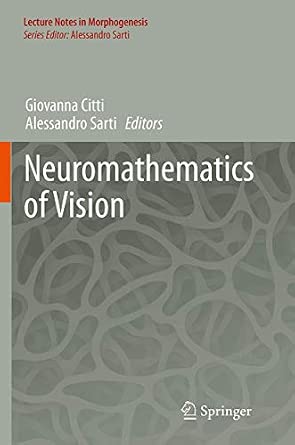
Neuromathematics of Vision Softcover reprint of the original 1st ed. 2014 Edition
Author(s): Giovanna Citti (Editor), Alessandro Sarti
- Publisher: Springer
- Publication Date: 3 Sept. 2016
- Edition: Softcover reprint of the original 1st ed. 2014
- Language: English
- Print length: 385 pages
- ISBN-10: 3662510057
- ISBN-13: 9783662510056
Book Description
Experimental data comes from several domains: neurophysiology, phenomenology of perception and neurocognitive imaging. Imaging techniques like functional MRI and diffusion tensor MRI allow to deepen the study of cortical structures. Due to this variety of experimental data, neuromathematematics deals with modelling both cortical structures and perceptual spaces.
From the mathematical point of view, neuromathematical call for new instruments of pure mathematics: sub-Riemannian geometry models horizontal connectivity, harmonic analysis in non commutative groups allows to understand pinwheels structure, as well as non-linear dimensionality reduction is at the base of many neural morphologies and possibly of the emergence of perceptual units. But at the center of the neurogeometry is the problem of harmonizing contemporary mathematical instruments with neurophysiological findings and phenomenological experiments in an unitary science of vision.
The contributions to this book come from the very founders of the discipline.
Editorial Reviews
Review
“This is one of the best books on cortical sensory modeling with the use of partial differential equations, and statistical reasoning included in multidimensional strategies. … I highly recommend this book as a primary reference to vision scientists, students in vision, postdoctoral fellows and senior scientists in the field of cerebral cortical modeling.” (Joseph J. Grenier, Amazon.com, June, 2015)
“This book takes the novel approach of considering the geometry of image processing by the visual cortex system of the brain. … This book is an essential read for anyone conducting serious research in the field of neurogeometry of visual perception.” (R. Goldberg, Computing Reviews, August, 2014)
From the Back Cover
Experimental data comes from several domains: neurophysiology, phenomenology of perception and neurocognitive imaging. Imaging techniques like functional MRI and diffusion tensor MRI allow to deepen the study of cortical structures. Due to this variety of experimental data, neuromathematematics deals with modelling both cortical structures and perceptual spaces.
From the mathematical point of view, neuromathematical call for new instruments of pure mathematics: sub-Riemannian geometry models horizontal connectivity, harmonic analysis in non commutative groups allows to understand pinwheels structure, as well as non-linear dimensionality reduction is at the base of many neural morphologies and possibly of the emergence of perceptual units. But at the center of the neurogeometry is the problem of harmonizing contemporary mathematical instruments with neurophysiological findings and phenomenological experiments in an unitary science of vision.
The contributions to this book come from the very founders of the discipline.