“In this regard, the present book is undoubtedly a fine posthumous support of the work of this visionary Thinker.” (Regional Studies, 1 November 2011)
“Recommended. All levels/libraries.” (Choice, 1 October 2011)
“The authors are clearly enthusiastic about this technology and its possibilities, yet they do address privacy concerns. Particularly interesting is their discussion of the ways in which net locality impacts political engagement and local government, and how location awareness is effecting other cultures.” (Publishers Weekly , 30 May 2011)
“Net Locality is a superb and thought-provoking guide to the merging of communication, information and location.”
Steve Jones, University of Illinois at Chicago
“If anyone still believes in the death of distance, now there is a definite response. Gordon and de Souza e Silva not only confirm that place continues to matter, they also dismantle the old physical/virtual dichotomy and clarify the relationship between bits and atoms.”
Marcus Foth, Queensland University of Technology
“Services such as Facebook Places, Foursquare, Glympse, Loopt, WikiMe, GeoGraffiti, and Google Maps and dozens of others mean that we can attach information to locations, discover new dimensions to the world around us and engage in social networking via mobile devices, recalibrating our privacy as we go along. Gordon and de Souza e Silva’s work helps us to understand how location-based services will change our daily lives.”
Rich Ling, IT University of Copenhagen
From the Inside Flap
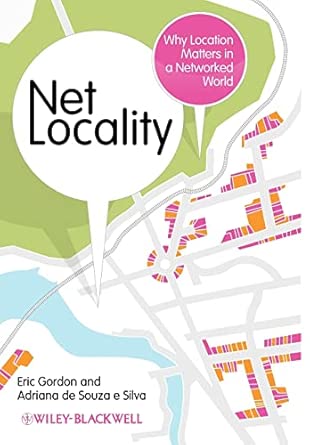
The web is all around us. The use of mobile phones and location-aware technologies and the ability for people to browse information from wherever they may be, means that physical location has become an important factor in how data is categorized and accessed. This book provides an introduction to the new theory of Net Locality, an emerging form of location awareness, a concept becoming central to cultural production and everyday life.
Net locality is crucial to all aspects of digital media, from mobile phones to online maps to location-based social networks and games. This book describes what happens to individuals and societies when virtually everything is located or locatable and what they can do with this awareness, from organizing impromptu political protests to finding nearby friends and resources. It covers the dangers and affordances that these technologies present, from challenging traditional notions of privacy to the reimagining of urban public space.
From the Back Cover
The web is all around us. The use of mobile phones and location-aware technologies and the ability for people to browse information from wherever they may be, means that physical location has become an important factor in how data is categorized and accessed. This book provides an introduction to the new theory of Net Locality, an emerging form of location awareness, a concept becoming central to cultural production and everyday life.
Net locality is crucial to all aspects of digital media, from mobile phones to online maps to location-based social networks and games. This book describes what happens to individuals and societies when virtually everything is located or locatable and what they can do with this awareness, from organizing impromptu political protests to finding nearby friends and resources. It covers the dangers and affordances that these technologies present, from challenging traditional notions of privacy to the reimagining of urban public space.
About the Author
Eric Gordon is Associate Professor of New Media at Emerson College in Boston. He is the author of The Urban Spectator: American Concept-cities from Kodak to Google (2010) and he is the director of the Engagement Game Lab, where he designs and studies digital games that enhance local civic engagement.
Adriana de Souza e Silva is Associate Professor at the IT University of Copenhagen in the Design, Culture, Mobility, and Communication (DCMC) research group, and Associate Professor of Communication at North Carolina State University. She is the co-editor (with Daniel M. Sutko) of the book Digital Cityscapes: Merging Digital and Urban Playspaces (2009) and affiliated faculty with the NCSU Digital Games Research Center.
 Wow! eBook