 Wow! eBook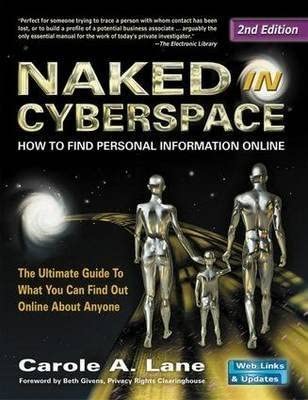
Naked in Cyberspace: How to Find Personal Information Online 2nd Edition
Author(s): Carole A. Lane (Author)
- Publisher: CyberAge Books
- Publication Date: 1 Jun. 2002
- Edition: 2nd
- Language: English
- Print length: 528 pages
- ISBN-10: 0910965501
- ISBN-13: 9780910965507
Book Description
Editorial Reviews
About the Author
Excerpt. © Reprinted by permission. All rights reserved.
Naked in Cyberspace
How to Find Personal Information Online
By Carole A. Lane
Information Today, Inc.
Copyright © 2002 Carole A. Lane
All rights reserved.
ISBN: 978-0-910965-50-7
Contents
Copyright,
Foreword, by Beth Givens,
Acknowledgments,
About the Web Site,
Section I. Personal Records in Cyberspace,
1: Welcome to Cyberspace (Check Your Clothes at the Door),
2: Database Searching,
3: The Internet, Consumer Online Systems, and Personal Information,
4: A Few Sample Searches,
5: A Word About Privacy,
Section II. How Personal Records Are Used,
6: Locating People,
7: Pre-Employment Screening,
8: Recruitment and Job Searching,
9: Tenant Screening,
10: Asset Searches,
11: Competitive Intelligence,
12: Identifying an Expert,
13: Prospect Research (Fundraising),
14: Private Investigation,
Section III. Types of Personal Records,
15: Biographies,
16: General Indices,
17: Telephone Directories,
18: Staff, Professional, and Other Directories,
19: Mailing Lists,
20: News,
21: Photographic Images,
22: Quotations,
23: Bank Records,
24: Business Credit and Company Financial Records,
25: Consumer Credit Records,
26: Criminal Justice Records,
27: Department of Motor Vehicles,
28. Death Records,
29. Tax Records,
30. Medical and Insurance Records,
31. Public Records,
32: Adoption Records,
33: Celebrity Records,
34: Genealogical Records,
35: Political Records,
36: We the People,
Section IV. Where Can I Find More Information?,
Books,
Periodicals,
Organizations,
Appendices,
About the Author,
Index,
CHAPTER 1
Welcome to Cyberspace (Check Your Clothes at the Door)
Oh sweet information superhighway, what bring you me from the depths of cyberspace?
–Crow T. Robot, Mystery Science Theater 3000
Sitting here in my home office, what could I find out about you? What could you learn about me? How deeply could we probe into each other’s private lives? And how many of our own closely held secrets are truly shielded from the prying keyboards of skilled researchers? Those questions are the seeds from which I have grown a busy research firm, tapping the wealth of online data to help my clients learn what they need to know about people, companies, and markets. They also are the seeds from which this book has grown. The answers will probably startle you.
In a few hours, sitting at my computer, beginning with no more than your name and address, I can find out what you do for a living, the names and ages of your spouse and children, what kind of car you drive, the value of your house, and how much you pay in taxes on it. From what I learn about your job, your house, and the demographics of your neighborhood, I can make a good guess at your income. I can uncover that forgotten drug bust in college. In fact, if you are well-known or your name is sufficiently unusual, I can do all this without even knowing your address. And, of course, if you become a skilled researcher, familiar with the online resources available to us all, you will be able to learn much the same things about me, or almost anyone else who piques your curiosity.
Whether you seek information about others or simply want to protect your own privacy, you need to know about finding personal information online, because there is not a lot of real privacy left and what little remains is disappearing fast. Very soon, we will all be “naked in cyberspace.”
For most of us, that is a somewhat scary thought, and no one can be blamed for wishing to keep his or her private life private. Yet the growing availability of personal information has benefits that can be as important as the obvious potential dangers. There are many perfectly valid reasons to seek information about others.
If you have ever been curious about your ancestors or about lost relatives, you are a prime candidate for using some of the most common personal databases, the genealogical records compiled by churches, hobbyists, and historical societies around the world. Many of these archives are still available only as books and paper files. Yet a growing number of them can be obtained online and on CD-ROM. For many people, genealogy provides a fascinating and comparatively easy introduction to the vast universe of online information.
Most parents already know what it is like to help a child find information for a school report. These home information searches usually begin with a few minutes of thumbing through the nearest encyclopedia. This is a good way to start and one that cultivates research skills children will find useful throughout their lives. However, you may often find yourself making an unexpected trip to the library, where you, your child, and a helpful librarian sort laboriously through card files, reference works, and computerized indices to search out relevant books and magazine articles. These days, it can be faster, easier, and far more effective to tap into a few online databases, where the facts are readily available on almost any subject you can name. Professional writers and journalists use these resources daily as the most efficient means of gathering information for their books and articles.
In business, uses for online information abound. If you have applied for a job, sought credit or insurance, tried to rent an apartment or buy a house, or even made a substantial donation to charity, you almost surely have been the subject of many online information searches. Many employers routinely screen job applicants, and computerized databases now supply much of the information employers need. Financial institutions such as banks, credit card companies, and collection agencies use personal records to track assets, debts, and investments; identify potential clients; weigh credit risks; and locate “skips,” debtors who move in the hope that creditors will be unable to find them. Insurance companies use personal records to screen out risky applicants, set rates, process claims, and investigate possible fraud. Landlords use computer and personal records to check out potential tenants. Attorneys use them to locate experts who can testify in civil and criminal trials and to find witnesses to crimes. Charitable organizations even use them to identify likely donors. And, of course, if you run a small business, own a house with a rental apartment, or contribute your free time to raise funds for a local charity, you will find the same personal records just as useful as these organizations did when they checked up on you.
Today most large institutions would be paralyzed without computerized personal records. The medical industry uses them to track and evaluate medical treatment, to match organ donors with patients who need a transplant, and to study illnesses and health risks. Government uses personal records in many thousands of computerized databases to assess taxes, dole out benefits, locate deadbeat parents, and carry out many of its other activities. Law enforcement uses personal records to identify and track criminals and witnesses to crimes. And while privacy laws justifiably restrict access to many of the records used by the medical community, government, and law enforcement, many institutional databases are available for at least limited private use.
It also is possible to make a business of research itself. I have done it. A few of the people who read this book may well join me. You could be one of them. Many information brokers (also known as information professionals or researchers) mine personal records to compile biographical information, gather competitive intelligence, or provide information in support of clients both in industry and in private life. List brokers use personal records to identify new markets, potential investors, or groups of people with common interests or characteristics that mark them as likely customers for specialty retailers. Private investigators use personal records to locate information about people, their assets, and their activities. Often, when someone vanishes “without a trace,” she can be located without ever leaving the office, just by searching through the appropriate databases. By the time you finish this book, you should be able to master the basic skills needed to build a career finding information for clients in any of these fields — and gain the ability to provide for your own information needs.
Whatever your goal in searching for personal records, you will find it much easier to accomplish than it would have been twenty years ago, when most personal records existed only on paper. Your searches probably will be much more productive as well.
One reason is the sheer mass of information that is generated, and that others collect about us, as we pass through life. From the day we’re born, our personal records begin to accumulate — in the hospital, perhaps at an obstetrician’s office. Our birth certificate follows quickly and soon is filed down at City Hall. Then there are Social Security records, supplemented by school records, a driver’s license, tenant records, voter registration, professional licenses, employment records, and tax records. Even the least active life today generates records at every turn.
When we actually do something, still more records appear. Most of us get married, rent a living space, establish some credit, buy a vehicle, subscribe to magazines. Many people get divorced, serve in the armed forces, commit crimes, write for publication, are interviewed, sue someone or are sued by them, join associations, answer ads for free goods or information, start businesses, make investments, or file for bankruptcy. Some, such as politicians and celebrities, spend nearly all of their time in the limelight and have every accomplishment, failure, or even rumor about them documented by the press. It all leaves a paper trail. Even if we remain in the shadows, comfortable within the illusion of our anonymity, almost everything we do can be tracked by almost anyone who chooses to go looking for it.
Today, paper trails have given way to “vapor trails”; far more of our records exist in the memories of computers than in paper files, much less the fallible memories of human beings. The availability of all those computerized databases is the second reason that personal research is so much easier and more productive today.
Before starting my research business, I worked as a systems analyst for many years. My job was to design computerized databases. It did not take me long to recognize that once information is entered into a database, it takes on a strange new life of its own, with benefits for searchers that go far beyond mere convenience. Computerized records are not just easy to call up and read; they can be manipulated, compared, and used to generate information that simply was not available before.
For example, consider a telephone book. When you use the printed version, you look up a person’s name to find his address or phone number. That’s about all there is to it. Put that same information into a computerized database, and suddenly it is transformed. You can still use a person’s name to locate an address and phone number, but it does not end there. Now you can enter an address to find all the people or businesses with a telephone there, along with their phone numbers. If you have only a telephone number, you can enter it to find out whose it is and where they live.
But that is just the beginning. It takes 10,000 or so telephone books to store all the numbers for all the phones in the United States, far more than you would ever want cluttering your home or office. Yet a national telephone directory can be compressed into a few CD-ROMs that take up no more shelf space than a paperback book. If you do not want to buy all of that rapidly changing information, you can use the free national telephone directories available on the Internet without ever storing a single telephone book.
That convenience brings with it opportunities no printed directory can offer. If your search subject has an unusual name, you can search for the surname in a computerized directory and locate possible relatives across town or throughout the country. Much more sophisticated research is just as easy. Once you have found your subject’s address, you can search for a range of addresses on either side and find the names and phone numbers of his or her neighbors. You can use a telephone database to learn how common a surname is within the United States or within a specific region. You can find out how many “Main Streets” there are in the U.S., how many cities are named “Lafayette,” and exactly where to find “Success.” (It’s in Arkansas, of course.) All this from the stodgy old telephone book!
When information gets into a computer database, it can be indexed, searched, compared, summarized, shuffled, sliced, and diced almost any way you want, at lightning speeds and often from a terminal halfway around the world. It is this combination — thousands of vast, all- inclusive databases containing hundreds of millions of personal records, equipped with search facilities no mere book or filing cabinet can equal — that allows us to discover so much about each other without ever leaving our desks.
In the next several hundred pages, you will learn what these exciting, and occasionally troubling, new research tools can do for you. I will show you how to search online databases for the information you want, introduce you to the most important archives of personal records, and provide a reference guide to several thousand databases that can sometimes offer up exactly the information you need.
How This Book Is Organized
The five chapters of Section I are intended to give you a good general background on personal records — what is recorded in the world’s databases and, in brief, how to go about finding it.
Database searching itself is introduced in Chapter 2. This is meant as a primer for those unfamiliar with the process of finding information in a database. In this chapter, you will discover some of the ways in which indices can help you to find the information you need.
Chapter 3 offers a look at the Internet and how it can be used to locate personal records, along with such consumer-oriented systems as CompuServe, America Online, and Prodigy. You will also find that many specific Internet sites are mentioned throughout this book; these references will point you to specific types of personal records that can be accessed on the Internet.
Three typical searches form the substance of Chapter 4. Here, the reader gets into the real-world practice of locating information. You will find that this is a kind of free-form exercise rather than a fixed procedure. At each step, the information found will guide the choice of the next database to try, the next question to ask. Experience also helps in making these choices, of course. As in computer programming, water skiing, or any other skill, you will get better with practice.
A discussion of privacy issues in Chapter 5 rounds out Section I. While not directly related to the “how-to” of searching, this is a subject that will influence many of the searches you perform. Much of the information that could theoretically be found online is off-limits to outside researchers, and there are tough laws to enforce these strictures. Whether they are tough enough, or restrictive enough, is still being debated. You may well see more limits in the future, enacted to control the kind of searching you are about to do.
Although Naked in Cyberspace can be read cover-to-cover, it is not necessary to do so. I recommend that you read Section I in its entirety. Even if you have had a little experience with online databases, these pages provide valuable information specific to searching for personal information. After that, Section II: How Personal Records Are Used supplies details of how to proceed with searches for certain kinds of personal information. The chapters in Section II will refer you to specific types of records to help with your search, which can be found in Section III: Types of Personal Records.
What Type of Research Interests You?
If you are looking for a lost love, a friend, or someone who owes you money, Chapter 6 will help you learn more about locating people.
Chapter 7 will provide the information you need for pre-employment screening, and if you manage a business Chapter 8 will tell you where to find potential employees online. Depending upon the types of positions you hire for, Chapter 12 may also be useful; it can guide you to experts in a wide variety of fields.
If you own or manage rental property, see Chapter 9 for tenant screening.
If you think you’ve already found your “one and only,” but want to check him or her out before giving your heart, soul, and half your assets, see Chapter 10 for information on asset searching and Chapter 14 for private investigation. If you haven’t found Mr. or Ms. Right, and money will influence your choice, Chapter 13: Prospect Research (Fundraising) can be used to figure out who has the money, and Chapter 14 can help you find out whether they are already married.
As a business person, you may need to size up the competition, as well as job applicants. Begin with Chapter 11, which describes how personal records can be used in competitive intelligence research. Chapter 7, on pre-employment screening, can help you to uncover valuable information about potential partners and others with whom you might be considering some type of financial arrangement. So can Chapter 10, on asset searching, and perhaps even Chapter 14, on private investigation, depending upon the situation.
If you are an attorney or involved in a lawsuit, an asset search can help you to decide whether your opponent has enough money to be worth suing or to finance a protracted court battle. See Chapter 10. And if you need an expert’s testimony, Chapter 12 can be of help in finding the right expert witness.
Colleges and universities, nonprofit organizations, and volunteers hoping to raise funds for local charities should read Chapter 13 for information on the use of personal records in prospect research.
Anyone interested in private investigation will find that Chapter 14 provides a solid introduction to how personal records are used in this field. Professional investigators, however, will want to read all the chapters in Section II. Depending upon their clientele and specialties, private investigators may find themselves carrying out an asset search, trying to locate a missing person, seeking an expert, or looking for almost any other kind of personal information.
(Continues…)Excerpted from Naked in Cyberspace by Carole A. Lane. Copyright © 2002 Carole A. Lane. Excerpted by permission of Information Today, Inc..
All rights reserved. No part of this excerpt may be reproduced or reprinted without permission in writing from the publisher.
Excerpts are provided by Dial-A-Book Inc. solely for the personal use of visitors to this web site.


