 Wow! eBook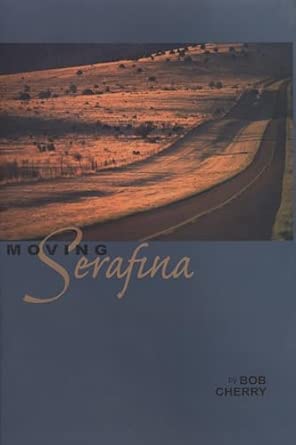
Moving Serafina
Author(s): Bob Cherry (Author)
- Publisher: Texas Christian University Press
- Publication Date: 15 Oct. 2007
- Language: English
- Print length: 354 pages
- ISBN-10: 0875653561
- ISBN-13: 9780875653563
Book Description
Editorial Reviews
About the Author
Excerpt. © Reprinted by permission. All rights reserved.
Moving Serafina
A Novel
By Bob Cherry
TCU Press
Copyright © 2007 Bob Cherry
All rights reserved.
ISBN: 978-0-87565-356-3
CHAPTER 1
Clayton Elliott stopped his old pickup truck and sat for a moment, allowing the wake of dust to boil up and over the cab. Through the haze, he saw the small picket fence he had built around the gravesite of his baby daughter, Serafina, twenty-five years ago. The fence leaned loose at one corner, no surprise to Clay, who had driven the sixteen miles of two-track dirt road snaking southwest from the little town of Solitario to his now-abandoned ranch house. For months he had made this trip each week to feed his old bay horse, Palo, and his few remaining corriente steers and to mend Serafina’s fragile little fence. And to talk with Serafina.
He shut off the engine and stepped out onto the soil, hard and leached. Except for the occasional high desert plant, the terrain ran almost barren all the way to the Rio Grande. He looked to the south, but he could not see the river. He knew it snaked between Texas and Mexico, just five miles from his gutted ranch house. The water ran mirror flat at that point until it reached the abrupt anomaly of Santa Elena Canyon. There it swept through gray rock walls in muddy turmoil for only a short distance. When it exited the canyon, it widened again and once more its mood became senile and serene, all the way to the Gulf of Mexico.
He thought again about that shallow section of river just to the south of where he stood. For decades, that stretch had served as an easy crossing for hundreds of illegal Mexican nationals. Six years of severe drought across the West had diminished the flow of water even further. The United States Border Patrol now focused major attention on this easier part of the river. But the coyotes, these new traffickers in human beings, had simply become more crafty with their methods as they shuffled groups of anxious people across into Texas and to points north, preying on their dreams of unlimited opportunity. Clay and his ranching friends considered this type of coyote far more diabolical than any predator they had ever encountered.
Clay shook his head when he thought about how it had all changed. The old adobe house seemed far more wasted than these past few months of neglect might warrant. But the heat had not changed. Even on this spring day, it quavered up from the rangeland, the temperature already inching above one hundred degrees. “Hot,” Clay said to no one, just a statement of fact. He lifted his hat and ran the back of his hand across his forehead and replaced the hat, just so, a reflex from some long past and impetuous youth.
He turned back to his task and thought about his plan for this special day, this first of May. He glanced inside the cab at the extra cushion on the seat. He knew he would need this pad on the ground next to the grave to protect his wasted knee joints as he knelt. He would also need the baling wire in the bed of the truck to mend Serafina’s little fence as he lingered in the failing light with the white paint and the narrow brush, taking all the time he wanted because he had a special thing to say to Serafina.
Clay stood beside his pickup and listened to the ticking of the engine as it tried to cool. Again, he regarded the old adobe house with its covered patio wrapped around three sides, vacant for months and now vandalized by illegal immigrants or locals on four wheelers or both. All its glass lay in shards on the hard earth and one corner of its porch roof sagged as if it had also given up, just like the little fence guarding Serafina. Farther back stood the small tack shed, also adobe but compact and windowless and double padlocked, though it held nothing of value except to Clay: rusted barbed wire, his worn saddle and a cracked leather wagon harness.
Though it tormented him to do so, Clay thought about the one-horse ranch wagon he could not see behind the tack shed. The obsolete relic rested there with the front axle still propped on a rock, its one loose wheel against the wall where he had leaned it all those years back. The old wagon, passed from his grandfather to his father and in turn, to Clay, who had used it occasionally until it fell into disrepair. But now Clay refused to look at it, or to burn it as he had threatened after Serafina’s death. Even out of sight, it still haunted his memory of that night when Serafina died, and so Clay tried to ignore the fact that the wagon had ever existed, tried to erase it from his memory. Push it back, push it down, leave it!
Clay shifted his attention to his old gelding, Palo, standing stiff, leaning against a protesting corral rail, testing his own boundaries as though he too felt abandoned. The only thing that seemed alive was the stubborn windmill, gap-toothed but cycling above Palo in a small thermal from the afternoon cooling, sending as if by providence intermittent spurts of water into the trough within easy reach of the old horse. Clay and his wife, Adelita, had built the fieldstone trough with their own hands after they erected the windmill but before they had made the house. Before they had made their only child, Serafina.
Adelita had insisted on the trough. “We can pack our own water inside,” she declared. “After our house is built. But our animals can’t wait.”
Clay knew this. But he had said nothing. He loved his wife’s definitive voice, this strong voice with its Spanish accent inherited through Adelita’s own strong grandmother. Clay smiled as he remembered the story Adelita loved to tell. The grandmother was a soldadera from the Mexican revolution, a woman soldier who had endured not only the hardships of that struggle but all the trauma of being a woman amongst hardened Zapatistas, revolutionaries who would have banished her—or worse—had they discovered she was pregnant and would soon be unable to tend a cook fire, much less ride a horse or wield a rifle. The grandmother finally sought the only refuge near her, just across the Rio del Norte, the Rio Grande, thus making her only child, Adelita’s mother, a citizen of the United States when she was born. And as Adelita’s mother had become a citizen, so too had Adelita upon her own birth north of the Rio Grande.
But Adelita was not only a second-generation citizen of the United States; she was a Texan. And at the right moment to the right people and to Clay’s continuing delight, she would quietly proclaim herself as such, and if these people happened to be the occasional band of cow-hardened gringo Texans dropping by, there would for a moment fall a silence over Adelita’s kitchen as thick as the adobe walls, with only the sputtering of rolled tobacco followed by an approving round of nods and murmurings and mugs of Adelita’s strong coffee lifted to her in unison.
But breast cancer knows neither nationality nor border, selects no particular generation. Adelita’s voice, at age sixty-two, weakened and finally fell silent this past March second, despite all the efforts Clay had made. March second, the date in 1836 when Texas had declared its independence from Mexico, the irony of which had not escaped Clayton Elliott.
The cost of moving Adelita to El Paso this past January for radiation and chemo treatment soared to impossible amounts. Shortly after they were told by the specialist that Adelita’s condition was terminal, Clay set about finalizing a contract to sell this same rank ranchland to water developers in order to pay the hospital. These El Paso entrepreneurs had hounded him for years about tapping deep into the West Texas aquifer, far below his parched ground, in order to pipe the water two hundred miles northwest to an expanding and thirsty El Paso and beyond.
It was an impossible and insane scheme and ordinarily Clay laughed, dismissed it, and went on his way. But to pay the bills and move Adelita back to Solitario and make her as comfortable as possible, he needed the money. So he had contracted with these wildcatters, who called their company Agua Hondo, Deep Water, for a handsome down payment. The remainder of the money would follow as soon as the deed transferred. Clay thought about that deadline set in their agreement. It loomed only two weeks away, on midnight of May fifteenth.
Now, just as their daughter had rested silent all these years, Serafina’s mother lay mute below the earth back in the county cemetery at Solitario where Clay was forced to bury Adelita because as soon as the deed transferred, he would no longer own even an inch of this ground on which he now stood. To help assuage his guilt about having to bury Adelita that sixteen-mile distance from Serafina, Clay had splurged with some of the down payment and purchased the expensive crushed white rocks which he spread atop the mound of soil covering Adelita. And though Adelita rested in the town of Solitario, far closer to Serafina than had been Adelita’s medical ordeal in El Paso, they were still miles apart. And this is what Clayton Elliott wanted to speak to Serafina about on this first day of May, on the birthday of this daughter, their only child.
He stretched over into the bed of the pickup and retrieved the can of paint and the brush in one hand and the pliers and wire in the other. When he reached the corner of the old house, he paused for a moment and glanced at an eyeless window. He turned to look inside at the little bedroom that Serafina had used, where at three years of age she had lain, waiting with the fever. Waiting in vain with Adelita for Clay to return.
He stopped and thought about the old wagon again. “No sense in doing this to myself either,” he scolded. “No sense at all.”
When he turned to move away from the house, he thought he heard a sob or some quick and painful intake of breath, or at least a sigh from inside the bedroom. But he did not turn back. Memory can play tricks on an aging man, he thought. He shook his head and blinked memory away and moved on. “No sense at all,” he repeated.
He crossed the fifty feet of rough ground to the gravesite next to the windmill and set down the materials. Then he walked over to the corral where Palo raised his head and scissored his ears, but that was the only movement the old horse made. Clay saw that the hay he had left days ago was scattered but not totally eaten.
“I’ll put some fresh out in the morning anyway,” he said, but the horse did not move. “Yeah, I know.” The horse remained immobile. “You’re lonesome out here, right?” Palo lifted his head a little and Clay reached and cupped his palm over his velvet muzzle and then glanced at Serafina’s grave. “So’s she.”
He swirled a hand inside the water trough and looked into the clear liquid and absently reached for the water dipper, the one he had fabricated years ago from a tomato can and a broken mop handle. He scooped up a can full of the sweet water, drank slowly and then hung it with its lanyard of wire back onto the bottom rung of the ladder that ascended the side of the windmill. Then he walked past the house again without a glance, and, this time, he brought back the cushion from the pickup seat and stood next to the grave.
“A man has only so many times he can kneel,” he mused. “And I’ve abused these knees far too often, Sera.” With the toe of his boot, he smoothed aside the rocks next to the leaning pickets and dropped the cushion. “I don’t think they’re good for much more.”
He bent forward with his hands on his thighs and relaxed his knees as far as he could and finally dropped his thin body the last inches onto the cushion. His face tightened from the pain in the arthritic joints but he allowed himself no sound, nothing that would disturb his daughter on this her special day.
With care, he reached over and righted the little fence and twisted tight a strand of wire at the top corner. He threaded a second piece halfway down the corner pickets and made secure a spiral of wire-against-wire with the pliers, almost to the breaking point.
“There,” he said, and thought about what he planned to tell Serafina. “That’ll hold.” He dropped his hands and let the pliers fall to the ground. “For now, anyway.”
Clay relaxed a little from his upright kneeling, rested his butt against his boot heels in the familiar position for talking at a campfire or scanning the horizon for stingy cloudbanks or stray corriente steers. Or for telling good news or bad news or both. He reached for the paint can, shook it, levered it open with the jaws of the pliers and picked up the brush. Then he dipped it into the paint and stroked the white across the thirsty wood.
“I’m gonna move you, Sera,” he said. He tried to speak these words without any tightening of voice or mumbling or justification for these weeks of procrastination that Clay knew even an adult might not understand. Just flat, not even joy, another statement of fact. “Into Solitario. There with your mama.” He dipped the brush into the paint.
That was all. He did not say her mother had died. This had been impossible to explain to Serafina, or even to articulate aloud to himself, but the unspoken had invaded everything else he had spoken, infected his every action, stalled him all these months to the point of almost total denial. And it seemed better not to speak the other words even now; say only that he would move Serafina so she could be with her mother.
Each of the past three nights he had awakened in the rented apartment on the second floor at the Hotel Solitario where, months earlier, Adelita had weakened and died. He had paced across the creaking oak floor as he practiced how he might finally say all this with great elaboration, telling his baby daughter how he would do it and when. And with whom because Clay knew he could never do it by himself anyway, never release Serafina from twenty-five years of case-hardened soil, not with his bone-on-bone knees and knotted hands. And this too had stalled him. But he would arrange it with whatever help he had to enlist. And now Serafina knew the most important part. He did not need to explain more.
He placed the paintbrush across the lip of the can and studied the backs of his outstretched hands. Wrinkles eroded flesh at each joint and all the way from the knuckles to the wrists, hard lines earned from more than fifty years of tending cattle and horses and barbed wire. He slowly curled his fingers forward into his palms, tried to erase the knots at the joints, tightening the flesh into something smooth. But the wrinkles would not disappear until he squeezed his hands into fists, hard, white at the knuckles. He knew his face was the same, the premature furrows there accentuated in the coming shadows now inching across the rangeland, making silhouettes of the ocotillo, the agave, and the sotol brush. As if in apology for the heat of the day, the dusk also brought with it a cooling zephyr that whispered in his ear.
“Well …” he said. “Sometimes kneeling is necessary. But sometimes it takes a fist.”
He flexed the hands open and closed and thought about how they seemed larger than before, as if they had continued to grow as separate beings at the ends of his arms, even as the remainder of his body seemed to wither over the sixty-four hard years he had abused it, especially these past few in combat with the drought. And now Adelita’s battle.
“But maybe sometimes it doesn’t take a fist either,” he mused. “Maybe just a smile, even though it puts more wrinkles in this face.” He stopped moving his hands and smiled down at the mound of earth, suddenly remembering the game he had played with the little girl all those years past.
“Make the wings, Papa,” she says. “With your hands. Show me.”
Clay brings his hands close to her face, splays his fingers and then locks the thumbs together as a hinge. And then he articulates the hands at the pivot of the thumbs, making bird wings of his hands. He purses his lips and releases small staccato whistling sounds as he flies the bird around her face and then over her kept hair, iridescent as a raven’s wing, and makes the bird disappear behind her head, thus encircling the child inside his arms. He puffs a few whistles into her face, causing Serafina to flutter and then close her eyes. Then he stops whistling, smiles and lifts his eyebrows to widen and distort his own eyes. When the child opens hers, he exposes each hand in turn from behind her head to say, as if by magic, he has made the bird disappear.
Serafina squeals in laughter and attempts to duplicate the action. And Clay laughs also, as does Adelita from across the kitchen.
(Continues…)Excerpted from Moving Serafina by Bob Cherry. Copyright © 2007 Bob Cherry. Excerpted by permission of TCU Press.
All rights reserved. No part of this excerpt may be reproduced or reprinted without permission in writing from the publisher.
Excerpts are provided by Dial-A-Book Inc. solely for the personal use of visitors to this web site.


