Wow! eBook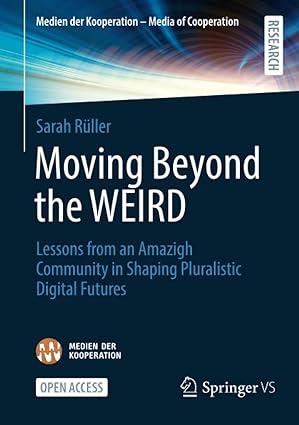
Moving Beyond the WEIRD: Lessons from an Amazigh Community in Shaping Pluralistic Digital Futures (Medien der Kooperation – Media of Cooperation)
by: Sarah Rüller (Author)
Publisher: Springer VS
Publication Date: 2025-04-05
Language: English
Print Length: 236 pages
ISBN-10: 3658475854
ISBN-13: 9783658475857
Book Description
In this open-access book, Sarah Rüller offers a comprehensive exploration of the complexities and nuances of conducting Western digital research in non-Western contexts, focusing on a case study in the High Atlas Mountains of Morocco. The research underscores the importance of addressing the challenges inherent in navigating this intercultural landscape, particularly as Western researchers immersed in ethnographic work. The studies highlight the multifaceted issues surrounding postcolonial frameworks, extractivism, technocapitalism, exploitation, and the evolving paradigms of development and sustainability, and underscores the urgent need for a more pluralistic, site-specific co-design approach. This approach is central to promoting inclusive and just digital futures, mitigating the impact of WEIRD (Western, Educated, Industrialized, Rich, and Democratic) biases, and unraveling the complex interplay of local and rural contexts torn between authenticity and exploitation by information and communication technologies (ICTs). This research delves deeper into a critical analysis of the establishment of a MediaSpace and the different community perspectives on technology access, revealing tensions and contradictions that shape the discourse on development and self-determination.
Editorial Reviews
In this open-access book, Sarah Rüller offers a comprehensive exploration of the complexities and nuances of conducting Western digital research in non-Western contexts, focusing on a case study in the High Atlas Mountains of Morocco. The research underscores the importance of addressing the challenges inherent in navigating this intercultural landscape, particularly as Western researchers immersed in ethnographic work. The studies highlight the multifaceted issues surrounding postcolonial frameworks, extractivism, technocapitalism, exploitation, and the evolving paradigms of development and sustainability, and underscores the urgent need for a more pluralistic, site-specific co-design approach. This approach is central to promoting inclusive and just digital futures, mitigating the impact of WEIRD (Western, Educated, Industrialized, Rich, and Democratic) biases, and unraveling the complex interplay of local and rural contexts torn between authenticity and exploitation by information and communication technologies (ICTs). This research delves deeper into a critical analysis of the establishment of a MediaSpace and the different community perspectives on technology access, revealing tensions and contradictions that shape the discourse on development and self-determination.