 Wow! eBook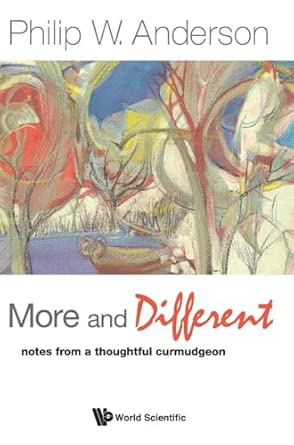
More and Different: Notes from a Thoughtful Curmudgeon
Author(s): P.W. Anderson (Author, Editor)
- Publisher: World Scientific Publishing Co Pte Ltd
- Publication Date: 1 Nov. 2011
- Edition: 1st
- Language: English
- Print length: 400 pages
- ISBN-10: 9814350125
- ISBN-13: 9789814350129
Book Description
Editorial Reviews
Review
–T V Ramakrishnan, Banaras Hindu University, India
Phil Anderson has made many wonderful contributions to physics, often illustrating his favorite theme of how more is different. I am sure readers of diverse interests will enjoy this book and learn much from it. –Edward Witten, Institute for Advanced Study, Princeton
Philip W Anderson is the doyen of present-day condensed matter physics, and has written widely and provocatively on many subjects both within and without the discipline.This collection of his essays is guaranteed to instruct, amuse and in some cases annoy readers irrespective of their specialist backgrounds. –Anthony Leggett, Nobel Laureate
Phil Anderson has made many wonderful contributions to physics, often illustrating his favorite theme of how more is different. I am sure readers of diverse interests will enjoy this book and learn much from it. –Edward Witten, Institute for Advanced Study, Princeton
Philip W Anderson is the doyen of present-day condensed matter physics, and has written widely and provocatively on many subjects both within and without the discipline.This collection of his essays is guaranteed to instruct, amuse and in some cases annoy readers irrespective of their specialist backgrounds. –Anthony Leggett, Nobel Laureate
This is that rare book which may stimulate the reader into seeing the future, present and past of science in a new light. Philip Anderson is not only the most influential and original scientist in the second half of the 20th century in condensed matter physics, but also happens to be one who thinks deeply and broadly, and writes beautifully and vividly. It is of inestimable value especially to those curious about the scientific enterprise and possibly interested in contributing to it. The book title is a twist on an Andersonian phrase which has become a modern mantra. –T V Ramakrishnan Banaras Hindu University, India
Phil Anderson has made many wonderful contributions to physics, often illustrating his favorite theme of how more is different. I am sure readers of diverse interests will enjoy this book and learn much from it. –Edward Witten Institute for Advanced Study, Princeton
From the Back Cover
His work is characterized by mathematical simplicity combined with conceptual depth, and by profound respect for experimental findings. He has explored areas outside his main discipline, the quantum theory of condensed matter (for which he won the 1977 Nobel Prize), on several occasions: his paper on what is now called the “Anderson-Higgs mechanism” was a main source for Peter Higgs’ elucidation of the boson; a crucial insight led to work on the dynamics of neutron stars (pulsars); and his concept of the spin glass led far afield, to developments in practical computer algorithms and in neural nets, and eventually to his involvement in the early years of the Santa Fe Institute and his co-leadership with Kenneth Arrow of two influential workshops on economics at that institution. His writing career started with a much-quoted article in Science titled “More is Different” in 1971; he was an occasional columnist for Physics Today in the 1980s and 1990s. He was more recently a reviewer of science- and science-related books for the Times (London) Higher Education Supplement as well as an occasional contributor to Science, Nature, and other journals.


