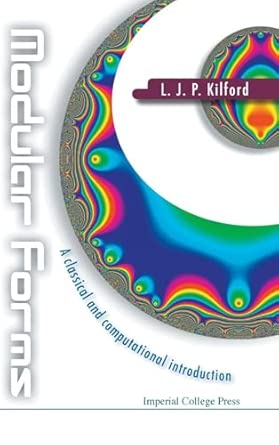
Modular Forms: A Classical and Computational Introduction: A CLASSICAL & COMPUTATIO..
Author(s): L J P Kilford (Author)
Publisher: Imperial College Press
Publication Date: 11 Oct. 2008
Edition: Illustrated
Language: English
Print length: 236 pages
ISBN-10: 1848162138
ISBN-13: 9781848162136
Book Description
This book presents a graduate student-level introduction to the classical theory of modular forms and computations involving modular forms, including modular functions and the theory of Hecke operators. It also includes applications of modular forms to such diverse subjects as the theory of quadratic forms, the proof of Fermat’s last theorem and the approximation of pi. It provides a balanced overview of both the theoretical and computational sides of the subject, allowing a variety of courses to be taught from it.
Editorial Reviews
Review
“This fascinating, contemporaneous, and even now unfolding story of current research in a historically brilliant part of mathematics is told with riveting attention to detail.” —The Mathematical Intelligencer
Modular Forms: A Classical And Computational Introduction
Author(s): Lloyd James Peter Kilford (Author)
Publisher: Icp
Publication Date: 12 Mar. 2015
Language: English
Print length: 252 pages
ISBN-10: 1783265450
ISBN-13: 9781783265459
Book Description
Reviews of the First Edition: “This fascinating, contemporaneous, and even now unfolding story of current research in a historically brilliant part of mathematics is told with riveting attention to detail . . . Almost all aspects one could wish for in the area of holomorphic modular forms are covered, as well as some selected topics about meromorphic modular functions.” The Mathematical Intelligencer “The second and (perhaps) more interesting computational aspect conveyed in this book is the consistent use of explicit computations by hand. For example expressing modular forms in a given space in terms of Eisenstein series, Eta or Delta functions to verify and prove various statements and theorems. This aspect is further encouraged throughout the exercises, which by the way are numerous, relevant and well-written. This kind of very explicit computations are sadly missing in the literature although implicitly stated or used in many places. It is obviously well-known to experts but most students would never be exposed to these ideas unless actually playing around to prove theorems by themselves.” Zentrallblatt Math Modular Forms is a graduate student-level introduction to the classical theory of modular forms and computations involving modular forms, including modular functions and the theory of Hecke operators. It also includes applications of modular forms to various subjects, such as the theory of quadratic forms, the proof of Fermat’s Last Theorem and the approximation of π. The text gives a balanced overview of both the theoretical and computational sides of its subject, allowing a variety of courses to be taught from it. This second edition has been revised and updated. New material on the future of modular forms as well as a chapter about longer-form projects for students has also been added.
 Wow! eBook