This is an outline of the book:
Models.Behaving.Badly
Part I. Models
Chapter 1. A Foolish Consistency
A personal account of my experiences with models that failed.
Models that failed * Capitalism and the Great Financial Crisis * Divining the future: models, theories, and intuition * Time causes desire * Disappointment is inevitable * To be disappointed requires time, desire and a model * Living under apartheid * Growing up in “The Movement” * Tat Tvam Asi
Chapter 2. Metaphors, Models and Theories
The various ways we have of understanding the world and predicting its future. Theories tell you what something is. Models tell you merely what something is like. Intuition is a merging of the understander and the understood.
* Language is a tower of metaphors * The hole in the Dirac sea * Metaphors become real: the discovery of the positron * Absence is a presence * Analytic continuation * Every fact is a theory * Building a model airplane * Why is a model a model? * Why is a theory a theory? * A puzzling case of monocular diplopia * Making the unconscious conscious again
Part II. Models Behaving
Chapter 3. The Absolute
An illustration of a theory: Spinoza’s Theory of the Emotions
* The Tetragrammaton * The Name of the Name of the Name * The Irreducible Nonmetaphor * Spinoza’s Theory of the Emotions * Fiat Money * How to Live in the Realm of the Passions
Chapter 4. The Sublime
Electromagnetism, a perfect theory. The role of intuition.
* The Birds of the Air * The Best Theory in the World * No Logical Path to It
* Electricity and Magnetism * Their Qualities * Their Quantitative Laws * Ampère’s Sympathetic Understanding of the Phenomena * Faraday’s Imaginary Lines of Force * Maxwell’s Factual Field * The Beasts of the Field
The ultimate goal would be: to grasp that everything in the realm of fact is already theory.
Goethe,Maxims and Reflections
Part III. Models Behaving Badly
Chapter 5. The Inadequate
The efficient market model: a model and an analogy but NOT a valid theory.
* Financial models are not the physics of markets * In finance, uncertainty is everywhere * The difference between uncertainty and risk * The Efficient Market Model * The relation between risk and return * Risk is like pleasure * The Black-Scholes Model * CAPM * Alpha and beta * Why the Efficient Market Model fails * The unbearable futility of modeling
There is nothing so terrible as activity without insight.
Goethe,Maxims and Reflections
Chapter 6. Breaking The Cycle
How to cope with the inadequacies of models, via ethics and pragmatism.
* The Perfect Cage * The Mysteries of the World * Models That Failed * How to use financial models * Beware of Idolatry * The Financial Modelers’ Manifesto * Markets and Morals * Tat Tvam Asi
Quants, physicists working on Wall Street as quantitative analysts, have been widely blamed for triggering the recent financial crisis with their complex mathematical models. What made these models, employed to minimize financial risk, so dangerous?
In this penetrating, insider’s look at the recent economic collapse, Emanuel Derman–former head quant at Goldman Sachs and a former physicist–explains the collision between mathematical modeling and economics that has touched every one of us. Though financial models imitate the style of physics and employ the language of mathematics, there is a fundamental difference between the aims and potential achievements of physics and those of finance. In physics, theories aim for a description of reality; in finance, at best, models can shoot only for a simplistic and very limited approximation of reality.
Derman ranges widely over his first-hand experiences in practice and theory, to explain the financial tangles that have paralyzed the economy. With sharp metaphors and tremendous explanatory power,he conveys the essence of these daunting financial models–The Black Scholes Model, The Efficient Market Model, the Capital Asset Pricing Model, etc–in very human terms.
Derman clearly shows us the intrinsic deficiencies of all models and explains why Wall Street, in its love affair with them, has a blindspot that prevents it from recognizing that finance will never be physics and that it will never be possible to write down a model that encapsulates human behavior.
Emanuel Derman is a professor at Columbia University, director of the university’s program in financial engineering, and a principal at Prisma Capital Partners. He was formerly a quant and managing director at Goldman Sachs, and the author of many widely used financial models. He lives in New York City.
From the Back Cover
“Emanuel Derman has written my kind of a book, an elegant combination of memoir, confession, and essay on ethics, philosophy of science and professional practice. He convincingly establishes the difference between model and theory and shows why attempts to model financial markets can never be genuinely scientific. It vindicates those of us who hold that financial modeling is neither practical nor scientific. Exceedingly readable.”
–Nassim N. Taleb, author of The Black Swan
“This is a compelling, accessible and provocative piece of work, that forces us to question many of the assumptions that we work with. As Derman explains so clearly, models are not “bad” in themselves; on the contrary, they are crucial for modern society. However, they have been used in a dangerously sloppy and careless way, with sometimes terrible results. Derman explains this clearly, and draws heavily onhis own lifetime experiences – ranging from growing up in appartheid south africa, working in the scientific field and then as a financial engineer on wall street – to provide a moving and fascinating set of illustrations of these principles. The conclusion is unexpectedly otpimistic – if people choose to listen.”
–Gillian Tett, author of Fool’s Gold
“Models. Behaving. Badly. is an engaging and personal meditation on the limitations of our ability to predict the future, especially–but not only–in the context of financial markets. He is not interested in blame or politics, but in the deeper lessons to be drawn from the financial crisis. As a physicist who was also highly placed in the financial world, he explains clearly the difference between prediction and advice, theory and model and knowledge and wisdom.”
–Lee Smolin, Senior Researcher at Perimeter Institute for Theoretical Physics, author of The Trouble with Physics; Life of the Cosmos, and Three Roads to Quantum Gravity
“I found this book fascinating. Derman has a skill of mixing the personal with the abstract. You will not find another that takes you from the vagaries of the human eye to the vagaries of the stock market with stops at quantum electrodynmics. It is quite a ride.”
–Jeremy Bernstein, author of Quantum Leaps, and Plutonium
“This is a thoughtful book for anyone interested in the overlap between the hard sciences and the soft sciences, from physicists to bankers. But finance academics beware, Professor Derman, with an iron fist in a velvet glove, gives them a good slapping.”
–Paul Wilmott, co-author “Financial Modelers’ Manifesto”
“If you don’t want your models to behave badly, you should study carefully these words of wisdom on the philosophy of quantitative modeling. Emanuel Derman has always been one of the most respected quants on Wall Street. Now he has proven that he is also one of the most thoughtful. Though, in the sequel he should tell us what happened to the large man over the Sudan!”
–Clifford S. Asness, Ph.D., Managing & Founding Principal AQR Capital Management
About the Author
EMANUEL DERMAN is Head of Risk at Prisma Capital Partners and a professor at Columbia University, where he directs their program in financial engineering. He is the author of My Life As A Quant, one of Business Week’s top ten books of the year, in which he introduced the quant world to a wide audience. His latest book is Models.Behaving.Badly: Why Confusing Illusion with Reality Can Lead to Disasters,On Wall Street and in Life.
He was born in South Africa but has lived most of his professional life in Manhattan in New York City, where he has made contributions to several fields. He started out as a theoretical physicist, doing research on unified theories of elementary particle interactions. At AT&T Bell Laboratories in the 1980s he developed programming languages for business modeling. From 1985 to 2002 he worked on Wall Street, running quantitative strategies research groups in fixed income, equities and risk management, and was appointed a managing director at Goldman Sachs & Co. in 1997. The financial models he developed there, the Black-Derman-Toy interest rate model and the Derman-Kani local volatility model, have become widely used industry standards.
In his 1996 article Model Risk Derman pointed out the dangers that inevitably accompany the use of models, a theme he developed in My Life as a Quant. Among his many awards and honors, he was named the SunGard/IAFE Financial Engineer of the Year in 2000. He has a PhD in theoretical physics from Columbia University and is the author of numerous articles in elementary particle physics, computer science, and finance.
He blogs at blogs.reuters.com/emanuelderman/
 Wow! eBook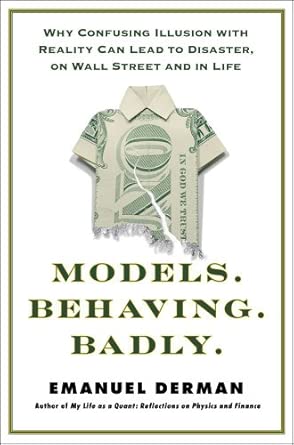
 Build With AI: The Complete Hands-On Guide to AI Agents, Automation, and Real-World Projects for Students & Professionals
 You Are STILL The Brand, Stupid! How To Avoid the Commodity Trap
 Essentials of Marketing Analytics: 2024 Release ISE 2nd Edition
 SAP ABAP 7.5 Optimization for HANA: AMDP, CDS and Native SQL for Peak Performance