Wow! eBook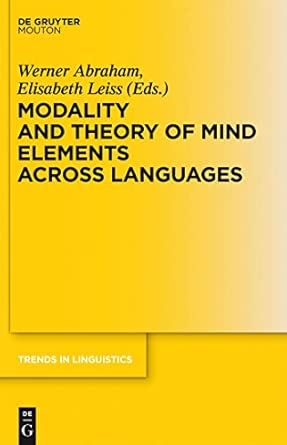
Modality and Theory of Mind Elements across Languages: 243
Author(s): Abraham
- Publisher: De Gruyter
- Publication Date: 18 May 2012
- Edition: 1st
- Language: English
- Print length: 472 pages
- ISBN-10: 3110270196
- ISBN-13: 9783110270198
Book Description
Modality is the way a speaker modifies her declaratives and other speech acts to optimally assess the common ground of knowledge and belief of the addressee with the aim to optimally achieve understanding and an assessment of relevant information exchange. In languages such as German (and other Germanic languages outside of English), this may happen in covert terms. Main categories used for this purpose are modal adverbials (“modal particles”) and modal verbs. Epistemic uses of modal verbs (like German sollen) cover evidential (reportative) information simultaneously providing the source of the information. Methodologically, description and explanation rest on Karl Bühler’s concept of Origo as well as Roman Jakobson’s concept of shifter. Typologically, East Asian languages such as Japanese pursue these semasiological fundaments far more closely than the European languages. In particular, Japanese has to mark the source of a statement in the declarative mode such that the reliability may be assessed by the hearer. The contributions in this collection provide insight into these modal techniques.
Editorial Reviews
About the Author
Werner Abraham, Vienna University, Austria, and Munich University, Germany; Elisabeth Leiss, Munich University, Germany.