 Wow! eBook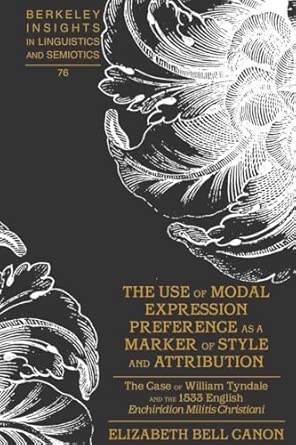
The Use of Modal Expression Preference as a Marker of Style and Attribution: The Case of William Tyndale and the 1533 English "Enchiridion Militis … Insights in Linguistics and Semiotics)
Author(s): Elizabeth Bell Canon (Author)
- Publisher: Peter Lang Publishing Inc
- Publication Date: 17 Jun. 2010
- Edition: New
- Language: English
- Print length: 179 pages
- ISBN-10: 1433108321
- ISBN-13: 9781433108327
Book Description
Can an author’s preference for expressing modality be quantified and then used as a marker of attribution? This book explores the possibility of using the subjunctive mood as an indicator of style and a marker of authorship in Early Modern English texts. Using three works by the sixteenth-century biblical translator and polemicist, William Tyndale, Elizabeth Bell Canon establishes a predictable preference for certain types of modal expression. The theory of subjunctive use as a marker of attribution was then tested on the anonymous 1533 English translation of Erasmus’ Enchiridion Militis Christiani. Also included in this book is a modern English spelling version Tyndale’s The Parable of the Wicked Mammon.
Editorial Reviews
About the Author
The Author: Elizabeth Bell Canon holds a Ph.D. in linguistics from the University of Georgia. She is currently Assistant Professor of Linguistics at the University of Wisconsin at La Crosse.


