Wow! eBook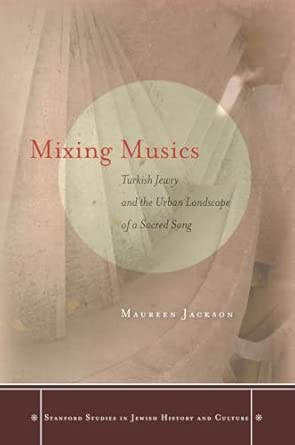
Mixing Musics: Turkish Jewry and the Urban Landscape of a Sacred Song
Author(s): Maureen Jackson (Author)
- Publisher: Stanford University Press
- Publication Date: 24 July 2013
- Edition: 1st
- Language: English
- Print length: 272 pages
- ISBN-10: 0804780153
- ISBN-13: 9780804780155
Book Description
This book traces the mixing of musical forms and practices in Istanbul to illuminate multiethnic music-making and its transformations across the twentieth and twenty-first centuries. It focuses on the Jewish religious repertoire known as the Maftirim, which developed in parallel with “secular” Ottoman court music. Through memoirs, personal interviews, and new archival sources, the book explores areas often left out of those histories of the region that focus primarily on Jewish communities in isolation, political events and actors, or nationalizing narratives. Maureen Jackson foregrounds artistic interactivity, detailing the life-stories of musicians and their musical activities. Her book amply demonstrates the integration of Jewish musicians into a larger art world and traces continuities and ruptures in a nation-building era. Among its richly researched themes, the book explores the synagogue as a multifunctional venue within broader urban space; girls, women, and gender issues in an all-male performance practice; new technologies and oral transmission; and Ottoman musical reconstructions within Jewish life and cultural politics in Turkey today.
Editorial Reviews
Review
“Jackson gracefully weaves together history, politics, ethnography, and her own reflections, so that the audience ultimately feels quite at home in a textually portrayed world that most readers will not know first-hand, or, in the case of those who are familiar, will likely gain new insights and perspectives . . . [T]his is an engrossing, informative, and thought-provoking volume that I enjoyed, learned from, and recommend.”―Dr. Judith R. Cohen,
Sephardic Horizons“This study of Maftirim, a paraliturgical musical suite sung by men in Istanbul synagogues on Saturday afternoons, is a valuable addition to a growing literature on the cultural life of minorities in Ottoman Turkey and the modern Turkish Republic . . . This book is elegantly written, deeply researched, and beautifully illustrated. It achieves a great deal in its five short chapters.”―Martin Stokes,
American Historical Review“By treating the private, discrete narratives of individual figures, this innovative book brings to life the nuances of daily existence and social accommodation in the musical culture of modern Turkish Jews. This refreshing approach provides new insights on topics that have been left unsaid by more conventional narratives about this subject.”―Edwin Seroussi, Hebrew University of Jerusalem
About the Author
Excerpt. © Reprinted by permission. All rights reserved.
Mixing Musics
Turkish Jewry and the Urban Landscape of a Sacred Song
By Maureen Jackson
Stanford University Press
Copyright © 2013 Board of Trustees of the Leland Stanford Junior University
All rights reserved.
ISBN: 978-0-8047-8015-5
Contents
Acknowledgments……………………………………………………ixA Note on Terminology, Transcription, and Translation………………….xiiiIntroduction………………………………………………………11. Mapping Ottoman Music-Making……………………………………..172. Into the Nation: A Musical Landscape in Flux……………………….493. The Girl in the Tree: Gender and Sacred Song……………………….874. Staging Harmony, Guarding Community……………………………….1175. Into the Future: Texts, Technologies, and Tradition…………………141Epilogue………………………………………………………….169Notes…………………………………………………………….179Glossary………………………………………………………….225Discography……………………………………………………….231References………………………………………………………..235Index…………………………………………………………….249
Excerpt
CHAPTER 1
Mapping Ottoman Music-Making
Necdet Yasar (b. 1930), Turkish classical musician and renowned masterof the tanbur (long-necked lute), came to the United States fromIstanbul in the early 1970s to teach in the ethnomusicology program atthe University of Washington in Seattle. There he met the late ReverendSamuel Benaroya, who was born and raised in Ottoman Edirne inthe early twentieth century, emigrated to Seattle through Switzerlandin 1952, and was serving as hazan (prayer leader, or cantor) at one ofthe two Sephardic synagogues in the city. Thirty-four years after theirfirst meeting in Seattle, Necdet Yasar sits at his print shop in the centralneighborhood of Unkapani in Istanbul, and remembers first meetingBenaroya:
He came to the university and introduced himself…. Later I sawhim beat a long usul [rhythm pattern]. He beat devir kebir. I was surprised.He beat long usuls on his knees, Ottoman-style, mesk usuls,and he recited a piece for me. He really surprised me. He beat usulsincredibly well….
He knew [the old makams, or musical modes]. For example, whenI gave my class at the University of Washington, he came to watch…. I was teaching Rast makam to the students; rather, makams fromthat family. I was explaining makams that were like Rast. I’d say thisis Rehavi, the difference is so and so, this is Sazkar, this is Suzidil Ara.He knew the Rast family, that is, the whole family of makams. He wasa good musician, an excellent musician….
[He said] while in Tekirdag [sic] he learned classical Turkish music—longusuls, makams—but I have no idea whom he learned from. Maybea teacher lived in Istanbul. Maybe he learned in Istanbul and went backto Tekirdag [sic] from there, I don’t know.
Necdet Yasar goes on to describe how “Ottoman culture has alanguage. It has a particular old language” that Benaroya also knew.”There are a lot of fine musicians, a lot of talented instrumentalists.But they use only the new language, they use today’s language.” Usingthe linguistic analogy of the Turkish word “to go,” he explains thatin the past, speakers drew from a colorful palate of vocabulary withshades of meaning, such as to go hurriedly, to go and reach a destination,to go by car, train or ferry, to set off early:
To describe something there are five, six, seven, maybe eight differentwords, ten words. This is the richness of a language, but a person coulddescribe their emotions with one word. They could describe them, butthe richness would be lost….
Music is the same…. In the musical and makam system, as well asin improvisation, there is such a thing. There is the same richness….
[Benaroya and I] spoke the same language. He loved me and I alsoloved him. I respected him highly, and he also highly respected me.
According to Necdet Yasar, he and Benaroya shared an Ottomanmusical language, even though Necdet was twenty-two years his junior,was separated for years by geographical distance, and had grownup musically among the Turkish Muslim majority of Istanbul ratherthan within a provincial minority. Strikingly, based on the memoriesof Benaroya’s daughter, Benaroya recalled Necdet with high esteemthroughout the years since their first meeting, conveying an intimacyunfamiliar to her in his other relationships. It may not be surprisingthat two musicians growing up in the same home country (Turkey) andmeeting abroad (Seattle) would be drawn to each other. We can also effectivelybridge their musical age gap by placing both musicians withinthe same late Ottoman musical aesthetics: a student of Mes’ud Cemilin the 1950s, Necdet nonetheless considers the father, tanbur player andcomposer Tanburi Cemil Bey (1871–1916), his “spiritual teacher,” as heassiduously listened to, and strove to understand, his innovative stylein his youth from recordings of the early twentieth century. TanburiCemil Bey was also among the most popular instrumentalists performingand recording at the time of Benaroya’s youth in Edirne.
Even if trained, figuratively speaking, in the same musical period,Necdet Yasar, Samuel Benaroya, and their relationship raise questionsthat bear closer examination: how did two musicians, separated bycommunity, mother tongue, and city of origin, share the same musicallanguage? Whereas Necdet gave public concerts of classical Turkishmusic, locally and internationally, on the tanbur, Benaroya sang only inHebrew for Jewish religious services in synagogues in Edirne, Geneva,and Seattle. As Necdet Yaçar himself asks, how exactly did a youngJewish man like Benaroya, growing up in a provincial city at a distancefrom the imperial center of the arts and performing exclusively in thesynagogue, learn a broader Ottoman musical theory, complete withspecialized terminology, at the advanced and comprehensive level thatNecdet observed? Indeed, Necdet Yasar, recognized in Turkey today asa living master of historical Ottoman makams, musical aesthetics, andthe tanbur, is unquestionably a highly credentialed judge of Benaroya’shigh-level musical skills.
It is common knowledge among ethnomusicologists today that,based on the musicological evidence, Ottoman court music forms interpenetratedthe religious services of non-Muslim Ottoman housesof worship—Jewish synagogues, and Armenian and Greek Orthodoxchurches. Moreover, a measure of published archival evidencetestifies to interreligious contact and palace employment, suggestingpathways of cross-cultural flows. A number of sources, centuriesapart, related to Ottoman Hebrew religious singing, confirm reciprocalmeetings between Jewish and Mevlevi (“whirling dervish”)musicians. Recordings and publications about Jewish, Greek, andArmenian musicians reveal musical lives lived as musicians and composersat the court as well as cantors and religious leaders in their ownsynagogues or churches. One term for such individuals is hahambestekar(haham-composer), alluding to the Jewish and wider realmsthat such composers sometimes worked within.
Drawing on the rich Ottoman-Jewish musical scholarship of thepast, we can enrich our understanding of Necdet Yasar and SamuelBenaroya’s shared musicality by investigating Ottoman music-makingthrough the prism of the historical urban landscape of the music andits practitioners. Among Istanbul’s streets and structures are the preciseplaces, people, and activities involved in artistic cross-fertilizationin the late Ottoman period. In the city, well-documented but isolatedevidence of musical encounters enlarges into patterns of urban circulations,making visible and detailing our commonplace but under-articulatedknowledge of multiethnicity in Ottoman music. Moreover,by tracing both structural and demographic changes in the urban landscapeof Istanbul, we can track the migrations of music and its makersgenerally, and specifically among Ottoman and Turkish Jewry, toelucidate both the ruptures and continuities, however altered, in multiethnicmusic-making in a postimperial, nation-building era. Throughbringing together discipline-specific source material—the ethnomusicologicalwith urban and migration studies—we can “urbanize” themusic-making under consideration and “musicalize” the urban landscapeacross a period of intense social change.
Questions arising from the particular musical friendship of Yasarand Benaroya in the late twentieth century motivate this investigationinto the details of Ottoman musical history in order to conceptualizethe social ethos, economy, and urban configuration—and reconfiguration—oftheir world. How were artistic and social relationshipscultivated between local Jews and musicians of other ethno-linguisticcommunities in the late empire? By extension, how did the well-documentedmusicological linkages between the respective repertoiresdevelop within these diverse communities? What stories does thechanging urban landscape of Istanbul have to tell us about distinctiveresidential soundscapes, patterns of music-making, Jewish practitionersand their migrations within and out of the city across the twentiethand twenty-first centuries?
Focusing on music as a social, collective process, rather than a seriesof artistic products, we will follow a selection of understudied Jewsworking as composers, commercial performers, religious leaders, andhazanim as they circulated in a variety of inclusive urban spaces, somecomposing or performing exclusively for their own communities, othersparticipating in both Ottoman synagogue and court music, includingits popularized forms. The life stories of such late Ottoman Jewish musicians—someof whom were religious leaders—who composed courtmusic forms, be they instrumentals, or Hebrew and Ottoman-Turkishsong, provide valuable evidence from daily life in Ottoman cities to delineatehow court music circulated among Jews and their synagogues,and the ways in which Jews circulated among the music of the court.By analyzing Jewish biographical data in terms of how musicians movedwithin urban space, individual life details cohere into a fuller understandingof interactive urban music-making based in common patternsof musical activity, such as patronage, professional specialization, andapprenticeship. As we encounter distinctive examples of performing,composing, and teaching, we will contextualize particular activities inwider Ottoman music practices, to specify the contemporaneous natureof Jewish musical involvement. A focus on patterns of transmission willilluminate the pathways of the musical interactivity around such repertoiresas the Maftirim. As a whole, the individuality of the biographiestakes us beneath the surface of a seemingly amorphous imperial cosmopolitanismas the apparent source of cultural confluences, expandingon evidence from previous periods toward an understanding of the lateOttoman era. Our musicians’ shifting patterns of residency, moreover,together with the changing musical cityscape of Istanbul will lay thefoundation for investigating the upheavals and survivals in their musicalculture across the Turkish Republic.
A vibrant Ottoman studies scholarship is enriching our understandingof the empire’s social complexities in different locales at differenthistorical junctures. Several studies spanning the empire, from theeighteenth to the twentieth centuries, challenge past assumptions ofethnic divisions of labor and residence, suggesting groupings that includeand cut across ethno-religious communities, such as networksof migrants, shopkeepers, workers, and café-goers. From the outsetthe Ottoman court employed teachers, performers, composers, andtheoreticians from a wide swath of the population, cultivating musicalforms held in common and an Ottoman artistic identity at times separatefrom or opposing one’s religious community. To the growingbody of intercommunal research this chapter contributes a case studyof late Ottoman musicians and their quotidian encounters, activities,and relationships within and beyond the palace.
This is not to say that the musical world or other social and economicrelationships were without ethnic tension, conflict, or evenviolence in the course of the empire’s history. Those making musicmoved within multiple other worlds as well, and were thus affectedby wider sociopolitical currents beyond their particular artistic milieu.As we shall see in Chapter Two, in times of social and political crisis,such as the violent shift from empire to nation, a musician’s affiliationwith the Jewish community became increasingly significant tohis social experience and life choices. As we follow Jewish composersinteracting in shared urban spaces among diverse personages, then,we will see that these same musicians lived amidst distinctively Jewishspaces as well, and their lives, in the end, were shaped by their statusas Jews as much as by their multireligious artistic relationships. It requiredspecific musical, personal, and political advantages, as the followingpages will show, to succeed as a Jewish musician in the TurkishRepublic.
Musicians Circulating in the City
The life stories of four late Ottoman Jewish musicians—Hayim MoseBecerano, Samuel Benaroya, Nesim Sevilya, and Misirli IbrahimEfendi—provide clues about the musical activity and urban ambulationsthat constituted interreligious music-making in the late Ottomanperiod. Two of these musicians composed or performed solelyfor liturgical settings (Becerano and Benaroya), whereas the other twocomposed a largely nonreligious repertoire (Sevilya and Misirli IbrahimEfendi). Three of them were religious functionaries at various levels(Becerano, Benaroya, and Sevilya), and one (Misirli Ibrahim Efendi)worked only in the “secular” music marketplace (piyasa) outside thesynagogue. All four musicians, nonetheless, moved among urbanspaces, both far-reaching and more closely communal, that facilitatedmusical flows between their religious communities and the Ottomanpublic sphere as a whole. On the one hand, individuals performing bothmusical and religious roles, such as Hahambasi (chief rabbi) HayimBecerano, Hazan Samuel Benaroya, and Haham Nesim Sevilya, wouldhave most effectively composed and directly transmitted the court-relatedmusical practices of their time for the benefit of paraliturgical andliturgical synagogue music. The skills necessary for composing implyknowledge of music theory, shared with non-Jewish Ottoman musicians,such as usuls, makams, and compositional genres—skills that,combined with their authoritative religious positions, enabled themto teach contemporaneous court music practices to young men in thesynagogue. A Jewish composer and performer of nonreligious music,on the other hand, did not directly teach Maftirim singers or hazanimto-be,but arguably transmitted music for liturgical use as effectively asmusicians with religious positions. Ud-player (udi) and vocalist MisirliIbrahim Efendi was a prolific composer of songs popular in the Ottomanart music repertoire of the time. By performing and recordingthis genre for mixed urban audiences that included Jews, he contributedto the musical exposures that informed the songs and performancepractices of Maftirim singers. For singers performing a repertoire suchas the Maftirim, which included contrafacta (adaptations) and pieces bycontemporary Jewish composers, the world of entertainment offeredvaluable learning opportunities, even if less traceable by the historianthan documented teachers, pupils, and lessons. The varied involvementof these four musicians in Ottoman music-making and Jewishreligious institutions, then, promotes a greater understanding of theshared social ethos that embraced the synagogue and the pathwaysof transmission through both religiously and less religiously involvedmusical practitioners.
Taken together, the lives of these late-Ottoman musicians offer individualdetail to foreground city spaces structuring and animating theirart worlds. By sketching out these distinctive and overlapping spaces,we bring into view the people, places, and activities of Ottoman music-makingin the late empire and contextualize the less abundant Jewishsource material within the more extensive record of Ottoman musicalpractices in which Jews were involved. Read alongside each other, thelife stories highlight trends significant to Ottoman and Jewish music-makingas well as to dynamics in the lives of Jewish musicians residing,moving, emigrating, or remaining in the postimperial national city.In the case of Becerano and Benaroya, both musicians composed orperformed exclusively religious repertoires in different positions: oneas the chief rabbi of the late empire and early Turkish Republic, theother as hazan at his local provincial synagogue in Edirne and subsequentimmigrant congregations in Europe and the United States.Their comparable and relatively high level of musical competence bystandards of the time, however, testifies not only to their central positioningin a wider music world, but also to the significance of musicalmerit within a wider music-making sphere. Through this pragmaticethic supporting the success of a labor-intensive orally transmitted repertoire,an economically disadvantaged Jewish boy, for example, wasnot excluded from but rather was enabled to excel in Ottoman musicaland Jewish liturgical learning, becoming a teacher and transmitterhimself. By contrast, the lives and compositions of Nesim Sevilyaand Misirli Ibrahim Efendi, both composers of a largely nonreligiousrepertoire, reflect a common, changing Ottoman music scene at theturn of the twentieth century with its growing commercialization anddocumentation of historically oral learning and transmission practices.At the same time, their increasingly religious commitments (Sevilya)and commercial activities (Misirli Ibrahim Efendi) spell out divergentlife trajectories exemplifying larger trends among Istanbul Jewry in theRepublic: dispossessed Jews emigrating from the country, on the onehand, and on the other, upwardly mobile individuals choosing to remain.In the following chapter we will explore how it was that one ofour musicians, Misirli Ibrahim Efendi, not only survived but thrived asa musician during the first decades of the Republic.
(Continues…)Excerpted from Mixing Musics by Maureen Jackson. Copyright © 2013 by Board of Trustees of the Leland Stanford Junior University. Excerpted by permission of Stanford University Press.
All rights reserved. No part of this excerpt may be reproduced or reprinted without permission in writing from the publisher.
Excerpts are provided by Dial-A-Book Inc. solely for the personal use of visitors to this web site.