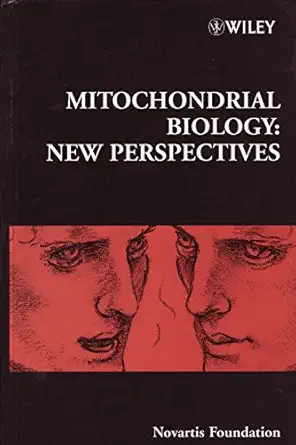
Author(s): Derek J. Chadwick (Editor), Jamie A. Goode
Publisher: Wiley
Publication Date: November 28, 2007
Edition: 1st
Language: English
Print length: 254 pages
ISBN-10: 0470066571
ISBN-13: 9780470066577
Book Description
With the recent renaissance in mitochondrial biology and increasing recognition of their role in many diseases, this book provides a timely summary of the current state-of-the-art in mitochondrial research. The book opens with the regulation of mitochondrial replication and biogenesis and reviews the mechanisms and functional consequences of mitochondrial fission and fusion. Further chapters address mitochondria and oxidative stress and their roles in cell signalling and cell death. The book includes extensive, fascinating discussion of the biochemistry of mitochondrial cell signalling (especially involving calcium) and of oxidative stress. The nature of the proteins engaged in these processes, many only recently discovered, is covered in detail.
Mitochondria have been strongly implicated in neurodegenerative diseases such as Parkinson’s, Huntington’s and amyotrophic lateral sclerosis. They are also affected in cancer, ageing and cardiovascular disease. The final section of the book reviews mitochondrial mutations and their consequences in ageing and other phenotypic manifestations. The authors discuss how mitochondrial proteins might constitute important therapeutic targets and describe initial attempts to develop compounds that can regulate their function.
Editorial Reviews
From the Inside Flap
The field of mitochondrial research has experienced a renaissance in recent years encompassing a complete re-evaluation of mitochondrial biochemistry and biology. It is now clear that mitochondria are not only involved in the business of ATP synthesis, but are also intimately involved in cell signalling and, particularly, in cell death.
Containing contributions from many of the leading laboratories in mitochondrial biology worldwide, this book provides a timely summary of the current state-of-the-art research. It opens with coverage of the regulation of mitochondrial replication and biogenesis and a review of the mechanisms and functional consequences of mitochondrial fission and fusion.
Further chapters address the topic of mitochondria and oxidative stress and their roles in cell signalling and cell death: key steps in the progression of programmed cell death are initiated by mitochondrial signals and key steps in the progression of necrotic cell death start with mitochondrial dysfunction. The nature of the proteins engaged in these processes, many only recently discovered, is covered in detail.
As we learn more about these novel proteins and mechanisms – including the permeability transition pore and ion channels – we begin to see how they may play a role in cell physiology and pathology. Mitochondria have been strongly implicated in neurodegenerative diseases such as Parkinson’s, Huntington’s and amyotrophic lateral sclerosis. They are also affected in cancer, ageing and cardiovascular disease. The final section of the book reviews mitochondrial mutations and their consequences in ageing and other phenotypic manifestations. The authors discuss how mitochondrial proteins might constitute important therapeutic targets and describe initial attempts to develop compounds that can regulate their function.
Mitochondrial Biology: New Perspectives includes extensive and lively discussions amongst the authors and will be of interest to cell and molecular biologists, biochemists, neuroscientists and neurologists working in this fascinating field.
From the Back Cover
The field of mitochondrial research has experienced a renaissance in recent years encompassing a complete re-evaluation of mitochondrial biochemistry and biology. It is now clear that mitochondria are not only involved in the business of ATP synthesis, but are also intimately involved in cell signalling and, particularly, in cell death.
Containing contributions from many of the leading laboratories in mitochondrial biology worldwide, this book provides a timely summary of the current state-of-the-art research. It opens with coverage of the regulation of mitochondrial replication and biogenesis and a review of the mechanisms and functional consequences of mitochondrial fission and fusion.
Further chapters address the topic of mitochondria and oxidative stress and their roles in cell signalling and cell death: key steps in the progression of programmed cell death are initiated by mitochondrial signals and key steps in the progression of necrotic cell death start with mitochondrial dysfunction. The nature of the proteins engaged in these processes, many only recently discovered, is covered in detail.
As we learn more about these novel proteins and mechanisms – including the permeability transition pore and ion channels – we begin to see how they may play a role in cell physiology and pathology. Mitochondria have been strongly implicated in neurodegenerative diseases such as Parkinson’s, Huntington’s and amyotrophic lateral sclerosis. They are also affected in cancer, ageing and cardiovascular disease. The final section of the book reviews mitochondrial mutations and their consequences in ageing and other phenotypic manifestations. The authors discuss how mitochondrial proteins might constitute important therapeutic targets and describe initial attempts to develop compounds that can regulate their function.
Mitochondrial Biology: New Perspectives includes extensive and lively discussions amongst the authors and will be of interest to cell and molecular biologists, biochemists, neuroscientists and neurologists working in this fascinating field.
About the Author
The Novartis Foundation is an international scientific and educational charity which promotes the study and general knowledge of science and in particular encourages international co-operation in scientific research.
Chairman: David G Nicholls, Buck Institute for Age Research, Novato, USA.
 Wow! eBook