Wow! eBook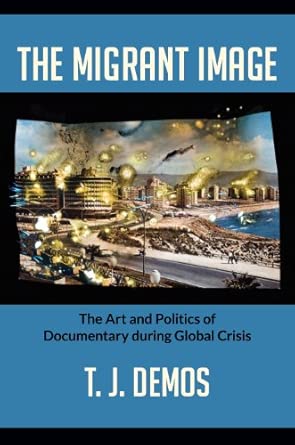
The Migrant Image: The Art and Politics of Documentary during Global Crisis
Author(s): T. J. Demos (Author)
- Publisher: Duke University Press Books
- Publication Date: 4 Mar. 2013
- Edition: Illustrated
- Language: English
- Print length: 368 pages
- ISBN-10: 0822353261
- ISBN-13: 9780822353263
Book Description
Editorial Reviews
Review
“Think of T.J. Demos’s
The Migrant Image as a field guide to art for those interested in the politics of human rights, globalization, migration, and war.” — Ryan Wong ― Hyperallergic“T. J. Demos’s
The Migrant Image is the most comprehensive and in-depth scholarly investigation of the effects that globalization has had on contemporary artistic practice over the past three decades. The scope of Demos’s investigation is impressive, most notably in his unpacking and explication of key terms in global art discourse that have proven problematic, and at times elusive. The effects of globalization on creative and intellectual practices in the arts has been a controversial subject that has eluded easy consensus – and Demos skilfully brings a much needed legibility to a discussion that is as divisive as it is complex.” — Derek Conrad Murray ― Third Text“Demos’s deft criticism means that he is able to bring together a broad range of artwork and argue very persuasively in each case for its effectiveness. . . . His authorial voice rings crystal clear throughout the analysis of this range and mix of artistic practice.” — James Day ―
Art History“Framing contemporary artworks dealing with the theme of migration within the twenty-first century context of ‘crisis globalization,’ Demos engages with a growing and interdisciplinary body of scholarship on neoliberalism and uneven development. The book’s main intervention, however, is within the subfield of global contemporary art history, where it will serve as a very useful text for students, researchers, critics, and curators concerned with the relationship between art and politics in the post–September 11 era.” — Tammer Salah El-Sheikh ―
Arab Studies JournalReview
From the Author
T. J. Demos is Reader in Art History at University College London. He is the author of Dara Birnbaum—Technology/Transformation: Wonder Woman and The Exiles of Marcel Duchamp.
About the Author
T. J. Demos is Reader in Art History at University College London. He is the author of Dara Birnbaum—Technology/Transformation: Wonder Woman and The Exiles of Marcel Duchamp.
Excerpt. © Reprinted by permission. All rights reserved.
THE MIGRANT IMAGE
THE ART AND POLITICS OF DOCUMENTARY DURING GLOBAL CRISIS
By T. J. DEMOS
Duke University Press
Copyright © 2013 Duke University Press
All rights reserved.
ISBN: 978-0-8223-5326-3
Contents
ILLUSTRATIONS……………………………………………………..viiCHECK-IN: A Prelude………………………………………………..xiiiCHARTING A COURSE: Exile, Diaspora, Nomads, Refugees: A Genealogy of Art
and Migration……………………………………………………..1DEPARTURE A MOVING IMAGES OF GLOBALIZATION…………………………..211 Indeterminacy and Bare Life in Steve McQueen’s Western Deep…………..332 “Sabotaging the Future”: The Essay Films of the Otolith Group…………543 Hito Steyerl’s Traveling Images……………………………………74Transit: Politicizing Aesthetics…………………………………….90DEPARTURE B LIFE FULL OF HOLES……………………………………..954 The Art of Emily Jacir: Dislocation and Politicization……………….1035 Recognizing the Unrecognized: The Photographs of Ahlam Shibli…………1246 The Right to Opacity: On the Otolith Group’s Nervus Rerum…………….144Transit: Going Offshore…………………………………………….160DEPARTURE C ZONES OF CONFLICT………………………………………1697 Out of Beirut: Mobile Histories and the Politics of Fiction…………..1778 Video’s Migrant Geography: Ursula Biemann’s Sahara Chronicle………….2019 Means without End: Ayreen Anastas and Rene Gabri’s Camp Campaign………221Destination: The Politics of Aesthetics during Global Crisis……………245ACKNOWLEDGMENTS……………………………………………………251NOTES…………………………………………………………….255BIBLIOGRAPHY………………………………………………………305INDEX…………………………………………………………….323
Excerpt
CHAPTER 1
Indeterminacy and Bare Lifein Steve McQueen’s Western Deep
Steve McQueen’s Western Deep (2002), like his later film Gravesend, isstriking for what it does not show. Documenting the labor conditions ofminers in the TauTona mine near Johannesburg, the deepest gold mine inthe world (also called Western Deep No. 3 Shaft), the film begins unexpectedly,with a long sequence of utter darkness. At first, the shocking soundtrackdominates: piercing mechanical screeches and metallic low-pitchknockings, delivered at an extreme volume, vibrate the exhibition space.These sounds reverberate immediately throughout the visitor’s body, as ifstriking it with unseen force. It is as if we, the viewers, have suddenly foundourselves blind, within the grinding internal organs of some industrial machinery,our bodies turned into drums. This clamor lasts for several minutes,accompanied by flashes of colored lights, which remain ambiguousand disorienting. As estranging as the soundtrack, these fugitive sensationsemerge at a low threshold of visibility. By the time we realize that thecamera has been positioned in an elevator loaded with a group of minersdescending to an infernal depth, a metal grate has been thrown open, thesound has suddenly stopped, and we have been plunged into an environmentthat is as extraordinary for its silence as it is for its bizarre greenishillumination (see figure 13).
For a film that ostensibly documents a South African mining operation,this dark introduction is strategic. Roughly twenty-five minutes longand shot with a super-8 camera, later transferred to video, the film, on theone hand, draws in its audience by thrusting it into a pitch-black environmentand enveloping it with intense aural sensation. That sound is physicallyregistered and opens the body to a series of impacts unexpected inthe virtualized domain of contemporary video installations. In this sense,the film proposes a parallel between its subject and the terms of its reception,creating a multisensory mimicry of the brutal experience within amine. On the other hand, there is the conspicuous refusal to represent inthe visual register, which frustrates the documentary impulse to which thefilm is seemingly pledged (in a way similar to Gravesend). A black holelies at the beginning of a film about a journey into a mine, and this darknessis not simply metaphorical; rather, it says something important aboutthe film’s image conditions. The film begins enticingly with a paradoxstretched between metaphorics and negation, between the virtual and theactual, between documentary reference and cinematic intensity. It presentsus with a form of sensation based on the flickering presence of absence,or conversely on the recognition of a lack of anything like a presence tocapture. Commissioned for Documenta 11 in 2002, Western Deep remainsexemplary for fulfilling the imperatives of the exhibition director, OkwuiEnwezor, for contemporary art, which in retrospect have been paradigm-shiftingfor artistic discourse and practice: to channel postcolonial experienceagainst the forces of a triumphalist globalism, and by doing so, toexpose those zones of economic and political inequality that are normallyand tragically unrepresented within the dominant mainstream institutionsof contemporary art (and indeed, the exhibition has been a crucial point ofreference for this book). For Enwezor, such juxtapositions and geopoliticalrelations provide the crucial counterweight to the myopic reign of capitalism’sglobal empire, with its unfulfilled rhetoric of technological progressand democratizing institutions: “From the moment the postcolonial entersinto the space/time of global calculations and the effects they impose onmodern subjectivity, we are confronted not only with the asymmetry andlimitations of globalism’s materialist assumptions but also with the terriblenearness of distant places that global logic sought to abolish and bring intoone domain of deterritorialized rule.”
That Documenta 11 sought to undertake the “representation of nearnessas the dominant mode of understanding the present condition of globalization”was clear. The exhibition was filled with examples of photography-basedwork that rendered proximate such forgotten geographical areas andforsaken ways of life—many from the global south—that normally fallbelow the radar of dominant mass media and mainstream political representations(as well as that of the popular art press). To mention only aselect few, there were Ravi Agarwal’s documentary images of the daily lifeof India’s landless poor, including images of camped-out, homeless familiesin Gujarat, families stationed with defiant pride before middle-classhousing blocks that harshly exclude them, and David Goldblatt’s photographsof postapartheid South African “intersections” that incisively juxtaposeextreme urban poverty and corporate wealth, showing precariouslybuilt cardboard and plastic shanties constructed on trash heaps before thetowering skyscrapers of the corporate business district that shamefullyoverlooks them (see plate 2 and plate 3). Also included were OlumuyiwaOsifuye’s images that picture the decrepit but lively streets of Lagos, Nigeria,and Ulrike Ottinger’s documentary film of the artist’s passage throughEastern Europe, lyrically revealing the experience of women in the geographicaland temporal periphery of modernization. Far from a unifiedgroup, this handful of selections from the massive show are exemplary inthat all stress a photographic or filmic connection to those shadowy zoneson the margins of the global order. By their inclusion, Documenta offeredwhat Enwezor’s cocurator, Carlos Basualdo, termed a more generous andcomplex geography, one that transformed the exhibition into a more inclusive,transnational public sphere.
In tandem with its geographical rearrangement Documenta 11 carriedout a reordering of the hierarchy of artistic mediums. As several criticshave noted, it elevated above all others documentary modes of representation—photography,video, and film—which assumed a privileged place,ostensibly for their ability to depict Enwezor’s “postcolonial order” withthe accuracy of the camera, and thus to bring visibility and testimony togeographical regions and cultural areas beyond everyday Western sight.It is perhaps these documentary mediums that, based within a paradigmof the “evidentiary,” are seen as best equipped to compete with the hegemonyof mainstream television and Hollywood film—among the centralpurveyors of our vaunted image of a positive, inclusive, democraticglobalization. The documentary turn, however, elicits potential dangers,familiar from critical analyses of earlier waves of politicized and multi-culturalistart advanced decades ago. Current documentary practices, forinstance, may return dangerously to precritical notions of representationthat make problematic assumptions of transparency or neutrality. Thesepractices may also run the risk of proclaiming truthful depictions of a”reality” of authentic subjects living beneath a spectacle of stereotypes, or,again, of unified fields of alterity (the postcolonial “order”?), whether archaicor geographically distant, that exist as if anterior to representation.While politically activist and radical in rhetoric, the proposed transparencyof a political signified may bring with it a paradoxically authoritativeinterpretive structure that forecloses an otherwise open and polyvocalfield of meaning. Yet today, many artists are just as likely to move in theopposite direction, embracing the instability of representation, even itsdecidedly fictional status, to the point where it becomes common, evenfashionable, to announce subjective biases, or to argue for the impossibilityof documentary representation tout court, due to its historically discreditedstatus, even if this clearly was not the case with Documenta 11.For his part, Enwezor argued that his Documenta would render postcolonialmeanings and histories present “either through the media or throughmediatory, spectatorial, and carnivalesque relations of language, communication,images, contact, and resistance within the everyday.” The explicitlysignaled multiplicity of approaches was clear in the inclusions of AllanSekula’s critical realist photography and Jeff Wall’s staged documentaries,Walid Raad’s invented scenarios regarding the Lebanese civil wars andAgarwal’s earnest documents of Indian poverty, among many other suchcomplex, even dissensual groupings.
Neither transparently objective nor openly fictional, Western Deep resistsbeing situated in relation to any simple oppositions (as does the mostcompelling work in this vein). Declining the aesthetics of photographicfiction, McQueen’s film evinces a commitment to documentation, to a witnessingof experience that is neither the result of its own fabrication nora collapse into a modernist fetishization of its conditions of representation.The film’s ambition is to put us in the context of the hellish space ofa gold mine in postapartheid South Africa. But it also refuses the pretenseof transparency, articulated in its initial withdrawal of visuality, which, asit does in Gravesend, expresses the limits of its capture of a reality that exceedsit, and thus rejects any supposition that the “postcolonial” exists assuch, for ultimately that history depends on the representations that structureit and that can also determine it anew. In this regard, the darkness atthe heart of Western Deep proposes the materialization of the very limitbetween representation and reflexivity, locating a threshold wherein weconfront the uncertain relation between the two. There, the film creates azone of open-ended possibility, what Gilles Deleuze terms a shaded centerof indeterminacy. This opening joins cinematic and audience spaces,and it intimates another way to approach the “terrible nearness of distantplaces” of which Enwezor spoke, an approach that requires further exploration.
As such, McQueen’s work forms part of a growing trend in contemporaryart, one that Documenta in part intended to map and continuesto develop today. Artists are carrying out a new modeling of documentaryform, one incredulous about the objective or unmediated representationof a truthful event or experience, even while it refuses to dispensewith the ethical imperative to pose relationships of proximity—if troubledand complex—to those typically excluded or marginalized from the globalorder. McQueen’s project shares this imperative with several of his peers(many of whom were also included in Documenta 11), including WalidRaad, Zarina Bhimji, and Amar Kanwar, especially insofar as such workjoins the exposure of postcolonial experience with an innovative modelingof representation, which in the case of McQueen’s film unleashes an uncertainrelation to time, uproots any secure material site, and opens onto amultiplicity of meanings. Also relevant are the aesthetically experimentalfilms of artists and groups close to McQueen’s formative context in London,such as the Sankofa Film and Video Collective, and the Black AudioFilm Collective, which focused their cameras in the 1980s and early 1990son the politics of British race relations during Thatcherite rule, without assumingthe paradigm of truth and objectivity that have plagued traditionalforms of documentary. Just as those models emphasized a multi-accentedand creolized cinema positioned between the poetic and the documentaryand contested the straightforward representation of politics by stressingthe politics of representation, as discussed above, Western Deep stressesthe uncertainty between the real and the virtual, the documentary and theimaginary.
Following the opening shots of the elevator’s protracted and clanky descentinto the dark abyss of the mine shaft (in reality it takes approximatelyone hour to reach the TauTona mine’s deepest point), Western Deep portraysminers passing ambiguously through obscure subterranean tunnelsand drilling into rocky walls with heavy machinery (see figure 14). Theatmosphere in front of the camera frequently fills with dust, blurring visualaccess with clouds of matter while the soundtrack alternates unexpectedlybetween the deafening screeches of drilling noise and sudden, unexplainedpassages of total silence. Adding to the resulting sensory disorientation,the scenes are recorded in highly restrictive visual fields without horizonsor distant recesses, which contributes to the overall sense of perceptualclaustrophobia that the film exploits for its powerful experiential affect.Significantly, there is no narrative structure, voice-over contextualization,or textual description that might otherwise rescue us from the film’s seeminglyunscripted sensations, which in traditional documentary practicewould connect such chains of shots and endow them with thematic significance.Rather, the film joins visual and aural sequences with uncertain relations,presenting us with a continually modified series of mutating scenesand shots, as if we were wandering about a labyrinth. Passages of dark mineshafts abruptly interrupt silent images of water conduits, shots of minersperforming strange step routines, and scenes of their relaxing in a loungewith a television set perched in the corner. The soundtrack continues tostrike out at us without warning, as sudden bouts of earsplitting drillingheighten the film’s sensory and psychological shock.
Yet while Western Deep offers a powerfully disorienting cinematic immersion—ofvisual claustrophobia, aural disorientation, and narrative disarray—thatplaces us viscerally within the context of the gold mine, it alsobrings about the viewer’s estrangement from that same vicarious experience.The result is a transgressive blurring of interior and exterior spaces,breaking down the clear division between the film’s virtual reconstitutionof the sensory experience of the mine and the audience’s awareness ofbeing situated in the aural-visual environment of a film installation. WesternDeep produces that blurring between perception and representationby, for instance, moving between the excruciating drilling sounds and passagesof silence. During those moments of quiet, one can hear oneselfbreathe, a desired effect, as McQueen points out, that heightens the awarenessand sensitivity of the spectator’s presence in relation to the image. Inaddition to reminding viewers of their bodily existence before the image,the periods of silence establish a cinematic situation in which viewers createtheir own sounds for a film that they themselves partially realize. Acontinual back and forth occurs throughout the piece between powerfulsensations internal to the film and openings onto the self-reflective spaceof an embodied viewership, with audience and film continually joinedand separated. The exaggerated visual effects also create for the viewera somatic encounter, one defined by the perception of intensified colorsand streaks of light, particularly as posed against the gorgeous darkness inwhich so much of the film is cast. As Enwezor observes, “McQueen rendersthe space of cinema into a zone that is simultaneously haptic and optical.”But in doing so, Western Deep does not completely engulf the viewer withinits immersive expanse. Rather, the sudden alternations between soundsand silence, between the haptic and the optical, bring about the audience’soscillating embodiment before the image and its inclusion within it.
It is precisely this alternation that creates a cinematic “center of indeterminacy”between the actual and the virtual, the real and the imaginary,which engages the filmic tendencies that Deleuze tracks in his bookCinema 2: The Time-Image. With reference to the post–World War IIcinema of the French New Wave and the Italian Neorealists, Deleuze observesthat there we encounter the breakdown of classical plots and thecrumbling of classical filmic techniques that link movements to action.With the new cinema of Godard, Resnais, Duras, Antonioni, Fellini, andothers, shots and scenes develop without correlating chronological plotmovement and thematic orchestration, but rather by a principle of the indeterminable:film disarticulates sequential time, crystallizes images intovirtual and actual meanings, and releases the unstructured and nonnarratedpower of visual and sound sensations. As Deleuze explains, cinemaunleashes “a relation between the real and the imaginary, the physical andthe mental, the objective and the subjective, description and narration, theactual and the virtual” where “the two related terms differ in nature, andyet ‘run after each other,’ refer to each other, reflect each other, without itbeing possible to say which is first, and tend ultimately to become confusedby slipping into the same point of indiscernibility.” This descriptionoffers a good approximation of the intertwinements of the film’s visual andsound sensations and the viewer’s perceptual experience as encountered inWestern Deep.
(Continues…)Excerpted from THE MIGRANT IMAGE by T. J. DEMOS. Copyright © 2013 by Duke University Press. Excerpted by permission of DUKE UNIVERSITY PRESS.
All rights reserved. No part of this excerpt may be reproduced or reprinted without permission in writing from the publisher.
Excerpts are provided by Dial-A-Book Inc. solely for the personal use of visitors to this web site.