 Wow! eBook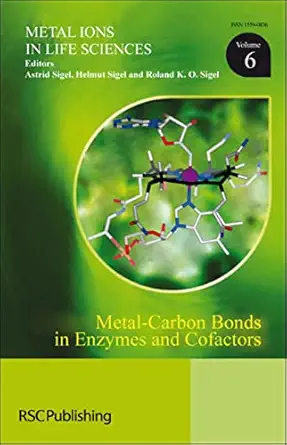
Metal-Carbon Bonds in Enzymes and Cofactors 2009th Edition
Author(s): Astrid Sigel (Editor), Helmut Sigel (Editor), Roland K. O. Sigel (Editor)
- Publisher: Royal Society of Chemistry
- Publication Date: March 9, 2009
- Edition: 2009th
- Language: English
- Print length: 450 pages
- ISBN-10: 1847559158
- ISBN-13: 9781847559159
Book Description
The occurrence of a wide variety of metal-carbon bonds in living organisms, ranging from bacteria to humans, is only recently recognized. Of course, the historical examples are the B12 coenzymes containing cobalt-carbon bonds, but now such bonds are also known for nickel, iron, copper, and other transition metal ions.
There is no other comparable book. Metal-Carbon Bonds in Enzymes and Cofactors, Volume 6, written by 17 experts, summarizes the most recent insights into this fascinating topic.
Editorial Reviews
Review
Mainly coenzyme B12
Metal-Carbon Bonds in Enzymes and Cofactors 2009th Edition
Series: Metal Ions in Life Sciences , Vol. 6
A. Sigel, H. Sigel and R.K.O Sigel (Eds)
RSC Publishing, Cambridge, UK, 2009, 544pp. (HB) ISBN 9781847559159
Reviewed by Kevin Waldron
This, the latest in the excellent Metal ions in life sciences series, focuses on biological molecules that contain a metal-carbon bond. The most familiar molecule of this class is coenzyme B12, whose structural determination in 1956 by Dorothy Hodgkin confirmed the presence of a cobalt-carbon bond. This was the first such example, arguably marking the beginning of the field of bio-organometallic chemistry and contributing to Hodgkin’s achievements recognized with the Nobel prize for chemistry in 1964.
B12 remains well studied today, partly due to the fact that its biosynthesis is achieved only by microorganisms and that dietary deficiency results in pernicious anemia in humans. Indeed, such research is still revealing some molecular surprises, such as the relatively recent discovery of the B12-sensing riboswitch that regulates gene expression in response to available B12 concentration.
After dealing with the organometallic chemistry and enzymatic utilization of B12 in chapters one and two, this book concentrates primarily on the interaction of CO and CN- with metal ions. These latter ligands are usually regarded as solely toxic molecules, but perhaps surprisingly are physiological ligands to Fe and Ni ions in the active sites of hydrogenase enzymes, whereas CO is produced by the activities of metal-dependent enzymes such as haem oxygenase and acetyl coenzyme A synthase. They are also useful as spectroscopic tools to interrogate a range of metal binding sites for chemical and structural information in vitro, covered in later chapters.
As with all books of this series, the combination of cost and subject matter means that this book is predominantly intended as a primary resource for researchers working in the field, but will surely also prove useful for undergraduates as a gateway to the subject with its extensive reference list.
Chemistry World, 2009, 6(11), p. 65
About the Author
Helmut Sigel is Emeritus Professor (2003) of Inorganic Chemistry at the University of Basel, Switzerland, and a previous editor of the MIBS series until Volume 44. He serves on various editorial and advisory boards, published over 300 articles on metal ion complexes of nucleotides, coenzymes, and other ligands of biological relevance, and lectured worldwide. He was named Protagonist in Chemistry (2002) by ICA (issue 39); among further honours are the P. Ray Award (Indian Chemical Society, of which he is also an Honorary Fellow), the Werner Award (Swiss Chemical Society), a Doctor of Science honoris causa degree (Kalyani University, India), appointments as Visiting Professor (e.g. Austria, China, Japan, UK) and Endowed Lectureships.
Roland K O Sigel is Assistant Professor (2003) of Inorganic Chemistry at the University of Zürich, Switzerland, endowed with a Förderungsprofessur of the Swiss National Science Foundation. He received his doctoral degree summa cum laude (1999) from the University of Dortmund, Germany, working with Bernhard Lippert; thereafter he spent nearly three years at Columbia Unversity, New York, USA, in the group of Anna Marie Pyle (now Yale University); during the six years abroad he received several fellowships from various sources. His research focuses on the structural and catalytic role of metal ions in ribozymes, especially group II introns, and on related topics. He was also an editor of Volume 43 and 44 of the MIBS series.


