Wow! eBook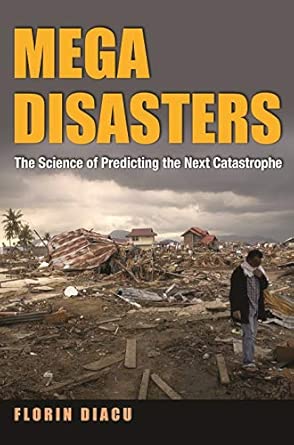
Megadisasters: The Science of Predicting the Next Catastrophe
Author(s): Florin Diacu (Author)
- Publisher: Princeton University Press
- Publication Date: 19 Oct. 2009
- Language: English
- Print length: 240 pages
- ISBN-10: 0691133506
- ISBN-13: 9780691133508
Book Description
The history and science behind efforts to predict major disasters, from tsunamis to stock market crashes
Can we predict cataclysmic disasters such as earthquakes, volcanic eruptions, or stock market crashes? The Indian Ocean tsunami of 2004 claimed more than 200,000 lives. Hurricane Katrina killed over 1,800 people and devastated the city of New Orleans. The recent global financial crisis has cost corporations and ordinary people around the world billions of dollars. Megadisasters is a book that asks why catastrophes such as these catch us by surprise, and reveals the history and groundbreaking science behind efforts to forecast major disasters and minimize their destruction.
Each chapter of this exciting and eye-opening book explores a particular type of cataclysmic event and the research surrounding it, including earthquakes, tsunamis, volcanic eruptions, hurricanes, rapid climate change, collisions with asteroids or comets, pandemics, and financial crashes. Florin Diacu tells the harrowing true stories of people impacted by these terrible events, and of the scientists racing against time to predict when the next big disaster will strike. He describes the mathematical models that are so critical to understanding the laws of nature and foretelling potentially lethal phenomena, the history of modeling and its prospects for success in the future, and the enormous challenges to scientific prediction posed by the chaos phenomenon, which is the high instability that underlies many processes around us.
Yielding new insights into the perils that can touch every one of us, Megadisasters shows how the science of predicting disasters holds the promise of a safer and brighter tomorrow.
Editorial Reviews
Review
“Diacu is a mathematician who uses his professional and outstanding literary skills to provide a remarkable analysis of the ‘science’ of prediction. . . . In an age where the news media and large sections of society seem to feast on dire predictions and the threat of many ‘imminent’ disasters,
Megadisasters should be required reading for all intelligent human beings.”– “Choice”“Diacu’s little histories of predicting eight varieties of disaster are pretty absorbing and informative.”
—Ray Olson, Booklist“He is at his best when discussing matters closest to his own field, celestial mathematics; and he makes a compelling case for developing the means, as the Russians appear to be doing, of batting asteroids out of humanity’s ballpark.”
—Trevor Butterworth, Wall Street Journal“One of Choice’s Outstanding Academic Titles for 2010”
“Our desire to predict the future is certainly an interesting story that has led to some fascinating work, and it is well described here. Diacu takes us for a good tour of the science behind predictions in areas as diverse as mudslides, financial crashes, epidemics and climate change. And there are also exciting stories, like the one about the first people to fly into the eye of a hurricane.”
—David Orrell, Literary Review of Canada“The result is an excellent history of natural disasters and of the science behind understanding and mitigating those disasters. For a who’s who of volcanic eruptions, major earthquakes, big hurricanes, asteroid near-hits or historic pandemics, this book is the place to go.”
—Kristina Bartlett Brody, Science NewsFrom the Inside Flap
“In Megadisasters, Florin Diacu takes the reader on a gripping tour of all the forces of nature that wreak havoc on our species, forcing us all, in the end, to cherish every day that Earth does not manage to kill us.”–Neil deGrasse Tyson, author of The Pluto Files
“Like a scientific detective, Diacu presents a riveting account of spine-chilling megadisasters facing our civilization, ranging from abrupt climate change to killer comets and the collapse of the world’s financial system. This book held me totally spellbound.”–Edward Belbruno, author of Fly Me to the Moon
“Megadisasters tracks the history of our development of knowledge about sudden catastrophes. The book is well conceived and written with considerable clarity. Diacu does a nice job of showing what is predictable and what isn’t.”–William F. Ruddiman, author of Plows, Plagues, and Petroleum: How Humans Took Control of Climate
“This book is timely. The public and even many scientists misunderstand the limits of our ability to predict natural (and some not-so-natural) events. Diacu writes well and effectively integrates the human experience with disasters and provides a historic background for our understanding of a variety of natural phenomena. Megadisasters is a winner.”–Grant Heiken, coauthor ofThe Seven Hills of Rome: A Geological Tour of the Eternal City
From the Back Cover
“In Megadisasters, Florin Diacu takes the reader on a gripping tour of all the forces of nature that wreak havoc on our species, forcing us all, in the end, to cherish every day that Earth does not manage to kill us.”–Neil deGrasse Tyson, author of The Pluto Files
“Like a scientific detective, Diacu presents a riveting account of spine-chilling megadisasters facing our civilization, ranging from abrupt climate change to killer comets and the collapse of the world’s financial system. This book held me totally spellbound.”–Edward Belbruno, author of Fly Me to the Moon
“Megadisasters tracks the history of our development of knowledge about sudden catastrophes. The book is well conceived and written with considerable clarity. Diacu does a nice job of showing what is predictable and what isn’t.”–William F. Ruddiman, author of Plows, Plagues, and Petroleum: How Humans Took Control of Climate
“This book is timely. The public and even many scientists misunderstand the limits of our ability to predict natural (and some not-so-natural) events. Diacu writes well and effectively integrates the human experience with disasters and provides a historic background for our understanding of a variety of natural phenomena. Megadisasters is a winner.”–Grant Heiken, coauthor of The Seven Hills of Rome: A Geological Tour of the Eternal City
About the Author
Excerpt. © Reprinted by permission. All rights reserved.
Megadisasters
The Science of Predicting the Next CatastropheBy Florin Diacus
Princeton University Press
Copyright © 2009 Florin Diacus
All right reserved.
ISBN: 978-0-691-13350-8
Chapter One
WALLS OF WATER
Tsunamis
I got outside my hotel, and saw that the ocean was now level with our island. To my horror, a wall of water- boiling, frothing, angry as hell-was bearing straight down at us, and a strange mist that looked like thick fog blocked out the sun. I stopped breathing…. –Dave Lowe, eyewitness to the 26 December 2004 tsunami on the South Ari Atoll in the Maldives
We relate Christmas to happiness, but no holiday can shield us from grief. On the night of 25 December 2004, some breaking news shook North America. A catastrophe had killed thousands of people in Southeast Asia, many foreign tourists among the dead. The number of reported victims was growing by the hour.
The rim of the Indian Ocean had been hit by a tsunami-also known as a tidal wave-a tremendous shift of water that acts like a deluge. Waves of such force are triggered by marine earthquakes, landslides, and volcanic eruptions, or by large meteoritic impacts. While in deep waters, tsunamis might pass undetected because of their long and gentle shape. But once the seabed shallows, they swell and invade the shore with a force that may flatten the ground.
I will never forget the images shown on television: the incoming wave, the water rushing through the windows of a restaurant, the old man swept away from the terrace of his hotel, the woman trying to cling to the branch of a palm tree, the father and the child running for their lives, the scream of the desperate mother, the indigenous boy rescuing a blond girl from the flood….
There were many stories, most of which I have forgotten-stories of loss, grief, hope, or happy reunion. But one of them, which I heard months later, stayed with me. It was the tale of a survivor, a story told with inner peace and resignation during a Larry King Live show on CNN. This is what I learned from it.
The Model and the Photographer
Petra Nemcova and Simon Atlee spent their Christmas holiday in Khao Lak, a lavish beach resort in southern Thailand. Petra was a Czech supermodel, and Simon a British photographer. They had fallen in love while he was shooting pictures of her for a fashion magazine. But because they traveled on different assignments, they hadn’t seen much of each other during the past few months.
This vacation had been Petra’s idea. She found Thailand amazing-a country with wonderful people, soothing climate, and breathtaking landscapes. The trip was meant to be a surprise for Simon, so she told him about it only shortly before their departure.
Christmas Day went by peacefully. They tanned on the beach and talked about marriage and children. The wedding date was something they had still to set. After dinner they went to their room to watch White Christmas, the 1950s’ musical comedy with Bing Crosby, Danny Kay, Rosemary Clooney, and Vera Ellen. Petra had not seen the movie before, and Simon thought she would like it.
The next morning they woke up early. Their stay at this orchid resort had come to an end, and they wanted to get ready for departure. But first they had breakfast and took a walk along the beach. On returning, Petra started packing. Simon went for a shower. Then tragedy hit with almost no warning.
Through the balcony window Petra saw people running away from the beach. They were screaming in panic as if a noisy marine monster were following them.
“What’s happening?!” Simon shouted from the bathroom.
“I don’t know! An earthquake or something!”
Seconds later the glass window broke. In no time, the tsunami blew up their bungalow and swept them away.
“Petra!! Petra!!” Simon cried.
“Catch the roof!” Petra called out before she was pulled under a swirl of dirty water.
Debris hit her, tore off her clothes, and she felt a strong pain in her pelvis. When she resurfaced, Simon was nowhere to be seen. Then the wave covered her again.
She thought she would die. Hope revived when she came close to a palm tree, but her attempts to cling to it failed. Luckily another tree appeared in her way, and with great effort she grabbed one of its branches. Although debris hit her repeatedly, assailing her naked, battered body, she clung to the trunk. Desperate voices could be heard from neighboring trees.
As the first shock receded, Petra thought of Simon. He was a good swimmer, so she hoped that he had made it to a safe spot. She prayed for him, and she prayed that the tree holding her would stand the force of the stream.
Time passed. Petra often had the illusion that this was just a nightmare from which she would awake soon, but the pain brought her back to reality. Although she felt very tired and her arms had grown numb, she knew that she had to stay put. Between ocean and sky, her life hung in the balance.
Eight hours later, two courageous Thai men rescued her. They had to handle her carefully because every move made her cry. She would go through a lot of pain in the days to come. Fortunately the immediate danger had passed. She spent several weeks in a Thai hospital with internal injuries and a shattered pelvis, and she needed several months to recover completely.
But Petra never saw Simon again. Some human remains found in March 2005 were identified as his. He met the fate of the more than 200,000 people who happened to be in the path of destruction on that godforsaken day. The saddest part of the story is that most of those lives could have been saved.
How It Happened
On 26 December at 6:58 AM local time, an earthquake shook the Indian Ocean, off the Indonesian coast of northern Sumatra, 250 kilometers southeast of Banda Aceh. Initial estimates put its magnitude at 9.0. The shock was felt as far as the Bay of Bengal. The earthquake occurred between the India and Burma plates as the former shifted beneath the latter, raising the ocean’s bottom by 10 meters in some places. This event triggered a tsunami, which hit the beaches bordering the Indian Ocean in Indonesia, Sri Lanka, India, Thailand, Somalia, Myanmar, the Maldives, Mauritius, Malaysia, Tanzania, Seychelles, Kenya, and Bangladesh (fig. 1.1.). No tsunami ever has claimed so many lives.
Some scientists flew to Indonesia to learn more about the cause of the disaster. Others began to analyze the data. Richard Gross, a geophysicist with NASA’s Jet Propulsion Laboratory, reported that a shift of mass toward Earth’s center caused the planet to move one millionth of a second faster and tilted its axis at the poles by an inch. Seismologists Seth Stein and Emile Okal of Northwestern University claimed later that the earthquake had been much larger than initially thought, namely, 9.3 on the moment-magnitude scale, for which a one-point increase corresponds to about a thirtyfold effect.
Such reevaluations are not unusual. The rupture zone had been bigger than reported, the initial estimates ignoring the slower shifts along the fault. To extract these data, Stein and Okal relied on theoretical results they had developed three decades earlier with Robert Geller, now a professor at the University of Tokyo.
Shortly after the earthquake, Sumatra’s coast was hit by a wall of water higher than the coconut palms lining its beaches; the tsunami, however, traveled almost two hours before reaching Thailand, India, and Sri Lanka. A warning procedure, like the ones used in North America and Japan, might have reduced the casualties to a minimum. Alas, such a system was nonexistent in the affected zones.
The ideal scenario would have been to forecast the tsunami and take suitable measures days or hours in advance. But are such predictions possible?
Solitary Waves
To forecast events, we must know how they form and develop and what laws govern them. Tsunamis occur rarely and look like big wind-generated waves, but instead of breaking at the shore, they go inland. Progress toward understanding them has been slow. The nature of tsunamis remained unclear until the end of the nineteenth century. All their possible causes became apparent only several decades ago.
Research on solitary waves began in August 1834 when a young engineer named John Scott Russell conducted some experiments on the Union Canal near Edinburgh in Scotland. The railroad competition threatened the horse-drawn boat business, and Russell had to assess the efficiency of the conversion from horsepower to steam. In his report, he described the following occurrence.
As a rope got entangled in the device used for measurements, the boat suddenly stopped and the water “accumulated round the prow of the vessel in a state of violent agitation, then rolled forward with great velocity, assuming the form of a large solitary elevation-a rounded, smooth and well defined heap of water-which continued its course along the channel without change of form or diminution of speed.”
This wave of translation-as he called it-intrigued him, so he “followed it on horseback, and overtook it still rolling on at a rate of eight or nine miles an hour, preserving its original figure some thirty feet long and a foot to a foot and a half in height,” until he lost it in the meanders of the channel. This event was the start of a struggle to understand an unusual phenomenon and-what would be an even more difficult task-to prove the existence of water waves that could travel forever.
In 1830 he invented a steam carriage, but his undertaking failed because the officials opposed its implementation. Russell had more success with the Union Canal Company, which hired him to study the connection between wave generation and resistance to motion. This opportunity had also been triggered by chance. When a horse dragging a boat on a Glasgow canal took fright and ran off, the vessel’s prow rose and the boat sailed faster. Russell understood that the solitary wave caused the reduced resistance and the rise of the boat, so he focused his research on the wave.
He built a water tank, generated waves of translation by releasing a column of water through a sliding panel, and performed hundreds of experiments, recording the details he observed. Although the wave’s fast speed was remarkable, Russell was more impressed by its persistence. He had expected the wave to shrink after traveling long enough, but the tests proved him wrong. The solitary wave looked more stable than anything he had seen before.
The wave of translation appeared only if the boat reached a critical speed. Below it, the vessel met water resistance; above it, the wave became self-sustained, allowing the boat to move easier. After repeated experiments, Russell concluded that the wave’s velocity depends both on the depth of the water and on the wave’s height.
His result explains why tsunamis move at high speed in midocean but slow down close to the shore, and why boats overcome water resistance in shallow canals as they reach the critical speed. In deep seas, however, ships are slow, moving well below the critical speed, so by trying to move faster they encounter more resistance. Russell solved this problem by designing hollow-lined prows, which part the water without ruffling its surface. He noted that pirates, to whom speed was essential, had built similar prows in the past.
Russell also studied the interaction between waves. Intuition suggests that, at impact, waves traveling in opposite directions break. But this never happens. They meet, merge for an instant, and pass through each other unchanged. This phenomenon shows why the idea to kill a tsunami through a collision with an artificially generated wave doesn’t work.
Apart from conducting some 20,000 experiments with toy models and ships ranging from a few hundred grams to 1,300 tons, Russell spent years analyzing the shape and motion of the translation wave. Among other things, he learned that, unlike wind-generated waves, which involve vertical motion, the solitary wave is a horizontal shift of mass with a shape about six times longer than tall. So instead of moving up and down, as ordinary waves do, a tsunami pushes ahead like a shelf of water.
Russell also had an original idea about tides, which he viewed as very large solitary waves. He divided his tidal theory in two parts, one founded on celestial mechanics, to explain water elevation in seas and oceans, and the other based on hydrodynamics, to account for the swell of small basins, rivers, and canals.
Russell presented his research in several articles, which he submitted to different meetings attended by mathematicians, physicists, engineers, and astronomers interested in fluid dynamics. Among them was George Biddell Airy, who opposed Russell’s results. Airy had a theory of his own, and he deemed the solitary wave impossible.
Meeting Resistance
No fancy idea permeates the scientific world with ease, particularly when a personality opposes it. Airy was no ordinary scientist. He held the Lucasian Professorship at Cambridge, a position Isaac Newton had occupied in the seventeenth century, and had the most envied astronomical job in Britain, that of astronomer royal. He would later preside over the Royal Society and accept a knighthood, but only after declining it three times because he could not afford the fees.
Airy made important contributions to science, from improving the orbital theory of Venus and the Moon to a mathematical study of the rainbow. He preferred applications to theory and was often at odds with his colleagues about the research direction in which important mathematics prizes should go.
Outside his professional work, Airy showed broad interests. He read history and poetry and was keen about architecture, geology, engineering, and religion. He even tried to identify the location of Julius Caesar’s landing in Britain and the place from where the Roman consul departed. But later in life he spent most of his time in administration.
When Russell announced his results, Airy was still very active in research. The astronomer royal had constructed his own theory of waves, which he had initially based on the work of the French mathematician Pierre Simon Laplace. But because Laplace’s equations applied only to shallow waves, Airy came up with some improvements. His goal was to predict the height of tides. Alas, he failed in this endeavor as much as his French predecessor did; their calculations didn’t come even close to reality.
Airy, however, considered his theory suitable for understanding waves. In an article published in 1845, he praised Russell’s experiments because his own theory explained them. But he warned against Russell’s analysis. The equations Airy developed could not account for large shifts of mass, so an everlasting wave made no sense to him.
Although this authoritative judgment failed to shake Russell’s belief in the value of his discovery, the Scottish engineer received another blow soon. In 1846 the new leader of British hydrodynamics, Cambridge mathematician George Gabriel Stokes, published a paper about the state of the field. Stokes’s point was clear: permanent translation waves could not exist.
Further Opposition
Age twenty-seven at that time, Stokes was eleven years younger than Russell, and his paper confirmed his leading role in the field. In 1846, when this report appeared, he could not accept the idea of a sea wave that travels thousands of miles undisturbed. In his opinion, waves of translation had to shrink, and the stability Russell proclaimed was illusory because he had drawn his conclusions from experiments performed in short tanks.
Stokes’s interest in waves faded soon, but he returned to them time and again. In October 1879 he wrote to William Thomson, better known as Lord Kelvin: “I have in mind when I have occasion to go to London to take a run down to Brighton if a rough sea should be telegraphed, that I may study the forms of waves about to break. I have a sort of imperfect memory that swells breaking on a sandy beach became at one phase very approximately wedge-shapes.” When Kelvin invited him “to see and feel the waves” on his yacht, Stokes answered in September 1880: “You ask if I have done anything more about the greatest possible wave. I cannot say that I have, at least anything to mention mathematically. For it is not a very mathematical process taking off my shoes and stockings, tucking up my trousers as high as I could, and wading out into the sea to get in line with the crest of some small waves that were breaking on a sandy beach.”
(Continues…)
Excerpted from Megadisastersby Florin Diacus Copyright © 2009 by Florin Diacus. Excerpted by permission.
All rights reserved. No part of this excerpt may be reproduced or reprinted without permission in writing from the publisher.
Excerpts are provided by Dial-A-Book Inc. solely for the personal use of visitors to this web site.