 Wow! eBook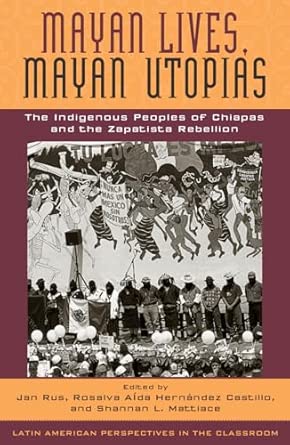
Mayan Lives, Mayan Utopias: The Indigenous Peoples of Chiapas and the Zapatista Rebellion
Author(s): Shannan L. Mattiace (Editor), Rosalva Aída Hernández Castillo (Editor), Jan Rus (Editor)
- Publisher: Rowman & Littlefield Publishers (UK)
- Publication Date: 8 Sept. 2003
- Language: English
- Print length: 328 pages
- ISBN-10: 0742511472
- ISBN-13: 9780742511477
Book Description
Offering a consistent and cohesive vision of the complex evolution of a region and its many cultures and histories, this work is a fundamental source for understanding key issues in nation building. In a unique collaboration, the book brings together recognized authorities who have worked in Chiapas for decades, many linking scholarship with social and political activism. Their combined perspectives, many previously unavailable in English, make this volume the most authoritative, richly detailed, and authentic work available on the people behind the Zapatista movement.
Editorial Reviews
Review
This important set of articles is essential reading for anyone interested in the future of indigenous societies in the midst of the process of globalization. Its integration of the complexities of geography, cultures, and history poses fundamental questions for the future of humanity. By explaining with sympathetic detail the origins of the underlying tensions and the vast array of resources that local communities can mobilize, the authors also pose fundamental questions for students concerned about their own futures… — David Barkin, Universidad Autónoma Metropolitana
From the foreword: It is an extraordinary thing for a book to be born a classic. And yet this is the fate that surely awaits Mayan Lives, Mayan Utopias. This book fills a niche that has until now been empty, that of providing real histories of Chiapas” many indigenous societies―societies that up to now have too often been regarded by outsiders as a monolithic whole, without details or differences. Indispensable―provides a long-needed historical benchmark…. — Samuel Ruiz García, Bishop Emeritus of San Cristóbal de Las Casas, Chiapas, Mexico
A book of deep wisdom; canny insight; trustworthy accounts from the inside; radical honesty from the outside; comprehensive sympathy with its subjects; precise sensitivity to nuance and difference; acute social, political, and cultural analysis; masterlyevaluation; cogent argument; and wonderful clarity in explanation. It is the most authoritative work in any language on Chiapas”s contemporary Mayans, their struggles, and their hopes…. — John Womack Jr., Harvard University
One of the best collections I have seen on the Zapatista Rebellion and its implications for Mexican politics and society. The authors facilitate a multidisciplinary, intimate understanding of the complex causes and consequences of peasant and indigenous rebellion. — Donna Lee Van Cott, University of Tennessee, Knoxville
This important set of articles is essential reading for anyone interested in the future of indigenous societies in the midst ofthe process of globalization. Its integration of the complexities of geography, cultures, and history poses fundamental questions for the future of humanity. By explaining with sympathetic detail the origins of the underlying tensions and the vast array of resources that local communities can mobilize, the authors also pose fundamental questions for students concerned about their own futures. — David Barkin, Universidad Autónoma Metropolitana
From the foreword:It is an extraordinary thing for a book to be born a classic. And yet this is the fate that surely awaits Mayan Lives, Mayan Utopias. This book fills a niche that has until now been empty, that of providing real histories of Chiapas” many indigenous societies―societies that up to now have too often been regarded by outsiders as a monolithic whole, without details or differences. Indispensable―provides a long-needed historical benchmark. — Samuel Ruiz García, Bishop Emeritus of San Cristóbal de Las Casas, Chiapas, Mexico
A book of deep wisdom; canny insight; trustworthy accounts from the inside; radical honesty from the outside; comprehensive sympathy with its subjects; precise sensitivity to nuance and difference; acute social, political, and cultural analysis; masterly evaluation; cogent argument; and wonderful clarity in explanation. It is the most authoritative work in any language on Chiapas”scontemporary Mayans, their struggles, and their hopes. — John Womack Jr., Harvard University
A welcome addition to the literature. . . . The book”s introduction provides a cogent discussion of how, over decades, economic crisis has produced Indian mobilizations and finally rebellion, while the final three essays usefully explore Mexico”s continuing national debate over Indian rights and autonomy. . . . Highly recommended.
An important contribution to our understanding of what has happened in Chiapas, and why. As such, it will be of immense use to anthropologists, historians, sociologists and political scientists interested in the relationship between indigenous peoples and the nation-state in post-colonial societies. It will also appeal to Mexicanists and scholars of Latin America grappling with the social, economic and political legacy of the region”s long history of globalization and the more recent demise of corporate structures of governance.
Mayan Lives, Mayan Utopias brims with factual details and insider knowledge, complemented by original maps of the region and numerous photographs. Even specialists are sure to find new information and insights, while novices will find a compelling introduction to the topic.
This edited collection is essential reading for anyone desiring a historically complex and ethnographically and politically sophisticated understanding of the roots of the Capatista rebellion and its impact on Mayan indigenous communities.Mayan Lives, Mayan Utopies is an outstanding text that offers one of the most complex, honest, and sophisticated analyses of the impact of the Zapatista rebellion on indigenous peoples in Mexico and on the political future of the Mexican nation. — Lynn Stephen, University of Oregon


