Wow! eBook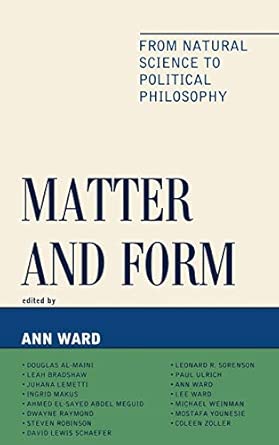
Matter and Form: From Natural Science to Political Philosophy
Author(s): Ann Ward
- Publisher: Lexington Books (UK)
- Publication Date: 10 Nov. 2009
- Language: English
- Print length: 256 pages
- ISBN-10: 0739135686
- ISBN-13: 9780739135686
Book Description
Enlightenment thinkers challenge the natural philosophy of classical and medieval philosophers, ushering in a more liberal political order. For example, for Hobbes, there is no rest in nature as there are no Aristotelian forms or natural places that govern matter. Hobbes applies his mechanistic understanding of material nature to his understanding of human nature: individuals are by nature locked in an endless pursuit of power until death. However, from this mechanistic understanding of humanitys natural condition, Hobbes develops a social contract theory in which civil and political society is constituted from consent. Later thinkers, such as Locke and Rousseau, modify this Hobbesian premise in their pursuit of the protection of rights and a free society. Nevertheless, materialist conceptions of the cosmos have not always given rise to liberal democratic philosophies. Historicist influence on scientific inquiry in the nineteenth century is connected to Darwins theory of evolution; Darwin reasoned that over time the process of natural selection produces ever newer and more highly adapted species. Reflecting a form of social Darwinism, Nietzsche envisions an aristocratic order that draws its inspiration from art rather than the rationalism
Editorial Reviews
Review
This book does indeed take the reader on an amazing journey, from natural science to political philosophy―from the pre-Socratics to the students of Socrates: Plato, Aristotle, Ptolemy, and Averroes―and then back again, exploring the role of modern science in the new liberal politics of Montaigne, Descartes, and especially Hobbes. The contributors deftly explore the various ways that science has figured in the political science of living well. Whether in Locke’s account of substance, or Rousseau’s botanical studies, or Darwin-influenced biopolitics, what can the study of nature reveal about the nature of man and human morality? Editor Ann Ward has ably assembled this mapping of the long-contested terrain of science and politics. — Diana Schaub, Loyola College in Maryland
Ann Ward’s edited volume Matter and Form: From Natural Science to Political Philosophy provides both political philosophers with a keen interest in the natural sciences and scientists with a interest in the larger political and ethical stakes of their discipline with a much needed catalogue of essays dealing with some of the most daring attempts in Western intellectual history to conceive a political philosophy on the basis of a natural philosophy and, albeit to a lesser extent, vice versa.