 Wow! eBook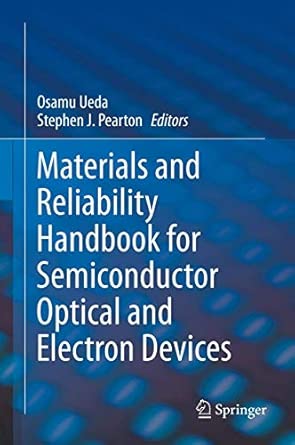
Materials and Reliability Handbook for Semiconductor Optical and Electron Devices 2013th Edition
Author(s): Osamu Ueda (Editor), Stephen J. Pearton
- Publisher: Springer
- Publication Date: 24 Sept. 2012
- Edition: 2013th
- Language: English
- Print length: 632 pages
- ISBN-10: 1461443369
- ISBN-13: 9781461443360
Book Description
Materials and Reliability Handbook for Semiconductor Optical and Electron Devices 2013th Edition provides comprehensive coverage of reliability procedures and approaches for electron and photonic devices. These include lasers and high speed electronics used in cell phones, satellites, data transmission systems and displays. Lifetime predictions for compound semiconductor devices are notoriously inaccurate due to the absence of standard protocols. Manufacturers have relied on extrapolation back to room temperature of accelerated testing at elevated temperature. This technique fails for scaled, high current density devices. Device failure is driven by electric field or current mechanisms or low activation energy processes that are masked by other mechanisms at high temperature.
The Handbook addresses reliability engineering for III-V devices, including materials and electrical characterization, reliability testing, and electronic characterization. These are used to develop new simulation technologies for device operation and reliability, which allow accurate prediction of reliability as well as the design specifically for improved reliability. The Handbook emphasizes physical mechanisms rather than an electrical definition of reliability. Accelerated aging is useful only if the failure mechanism is known. The Handbook also focuses on voltage and current acceleration stress mechanisms.
Editorial Reviews
From the Back Cover
Materials and Reliability Handbook for Semiconductor Optical and Electron Devices 2013th Edition provides comprehensive coverage of reliability procedures and approaches for electron and photonic devices. These include lasers and high speed electronics used in cell phones, satellites, data transmission systems and displays. Lifetime predictions for compound semiconductor devices are notoriously inaccurate due to the absence of standard protocols. Manufacturers have relied on extrapolation back to room temperature of accelerated testing at elevated temperature. This technique fails for scaled, high current density devices. Device failure is driven by electric field or current mechanisms or low activation energy processes that are masked by other mechanisms at high temperature.
The Handbook addresses reliability engineering for III-V devices, including materials and electrical characterization, reliability testing, and electronic characterization. These are used to develop new simulation technologies for device operation and reliability, which allow accurate prediction of reliability as well as the design specifically for improved reliability. The Handbook emphasizes physical mechanisms rather than an electrical definition of reliability. Accelerated aging is useful only if the failure mechanism is known. The Handbook also focuses on voltage and current acceleration stress mechanisms.
Provides the first handbook to cover all aspects of compound semiconductor device reliability
Systematically describes research results on reliability and materials issues of both optical and electron devices developed since 2000
Covers characterization techniques needed to understand failure mechanisms in compound semiconductor devices
Includes experimental approaches in reliability studies
Presents case studies of laser degradation and HEMT degradation
About the Author
Materials and Reliability Handbook for Semiconductor Optical and ElectronDevices provides comprehensive coverage of reliability procedures and approaches for modern electron and photonic devices. These devices include lasers and high speed electronics used in all aspects of our lives, from cell phones to satellites, data transmission systems and displays. Lifetime prediction for compound semiconductor device operation is notoriously inaccurate due to the fragmented efforts in reliability and the absence of standard protocols. Manufacturers have usually relied on accelerated testing at elevated temperature and then extrapolated back to room temperature operation. This technique frequently fails for scaled, high current density devices. Device failure is driven by electric field or current mechanisms or low activation energy processes that are masked by other mechanisms at high temperature. Device degradation can be driven by failure in either active structures or passivation layers.
The Handbook addresses reliability engineering for III-V device structures, including materials and electrical characterization, reliability testing, and electronic characterization. These last techniques are used to develop new simulation technologies for device operation and reliability, which in turn allow accurate prediction of reliability as well as the design of structures specifically for improved reliability of operation. Given that a relatively small percentage of devices will actually show failure, it is critical to both enhance the failure rate through accelerated testing and to treat the resulting reliability data correctly. For this reason, the Handbook emphasizes physical mechanisms rather than an electrical definition of reliability. In other words, accelerated aging is useful only if we know the failure mechanism. Also covered are standard Si reliability approaches to determine the instantaneous failure rate and mean time to failure and therefore the distribution functions of greatest relevance to the specific device technology. Furthermore, the Handbook focuses attention on voltage and current acceleration stress mechanisms.


