 Wow! eBook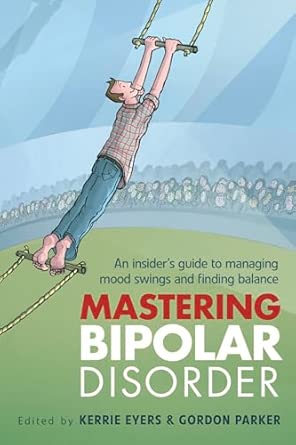
Mastering Bipolar Disorder: An Insider's Guide to Managing Mood Swings and Finding Balance
Author(s): Kerrie Eyers
- Publisher: Allen & Unwin
- Publication Date: 1 July 2008
- Edition: Illustrated
- Language: English
- Print length: 300 pages
- ISBN-10: 9781741755466
- ISBN-13: 9781741755466
Book Description
Editorial Reviews
About the Author
Excerpt. © Reprinted by permission. All rights reserved.
Mastering Bipolar Disorder
An Insider’s Guide to Managing Mood Swings and Finding Balance
By Kerrie Eyers, Gordon Parker
Allen & Unwin
Copyright © 2008 Black Dog Institute
All rights reserved.
ISBN: 978-1-74175-546-6
Contents
Foreword,
On balance: Conjuring the metaphor,
1 Triumphs and tumbles Ups and downs of bipolar disorder,
2 Dazzling and daredevil The spiral of mood elevation,
3 Sparkling in the spotlight Creativity and bipolar disorder,
4 Damage control The fallout from a bipolar high,
5 Down to the wire Responses to diagnosis,
6 Perfecting balance Acting on early warning signs,
7 The show must go on Acceptance of bipolar disorder,
8 Handling the swings Medication and mood balance,
9 Performance partnerships Professionals and risk management,
10 The acrobats’ pyramid Family and friends in formation,
11 Becoming a ring master The discipline of self-management,
12 Practising the art Bipolar disorder and the getting of wisdom,
Appendix 1 Perfecting the routine: More bipolar control techniques,
Appendix 2 The safety net: A wellbeing plan,
References,
CHAPTER 1
Triumphs and tumbles
Ups and downs of bipolar disorder
I was a light bulb in a world full of moths. Carrie Fisher about her mania
This chapter is an overview of the experience of bipolar disorder. Seen through the eyes of those who have had the disorder for many years, these accounts capture the exhilaration, richness and seductive nature of the ‘highs’. It also presents some of the varied techniques that individuals have perfected during their quest to best manage their mood swings.
The following account vividly depicts the seductive and irresistible trapeze swing into an elevated mood. The writer recounts her first episode of bipolar disorder, and her unwitting ascent into the vortex of a manic phase. She has since made excellent use of these experiences and has achieved ongoing stability.
Dancing with the Devil
I’ve always found the word ‘high’ to be a little misleading. Sure the bipolar ‘dance’ begins with self-assurance and delight with the world. However, I’m immediately paired with an uncomfortable restlessness that I can’t shake. It’s pure agitation. I can’t relax. My eyes widen. I make simple errors in my daily tasks, I miss birthdays and struggle to organise myself. Pretty soon, I can’t remember what day it is.
If I let the dance with the Devil continue, you really see some interesting moves.
Next comes the sensory overload. I see colours more vividly, have the urge to express myself in stories, and can lose myself in music for half the day. In fact, I’m not just listening to the music. In this state I have the sensation that I can somehow breathe it in. The music is all through me.
Then the romantic mood spills over into life. Everyone is fascinating to me, and I am to them. It’s amazing how contagious this dance is. Only, things get out of hand. I dance too fast, with too many people, or with the wrong people. I get no sleep. I miss job interviews, or worse still, I show up for them. So now there will be consequences like embarrassment, ruined friendships and lost opportunities.
It becomes a devilishly expensive dance. I lose control over the purse strings. I need a new outfit; it must be black and sultry. I love it so much I don’t take it off for days. And always, the music. I have been known to buy twenty CDs at a time whilst high. All bought randomly, for their cover or some weird connection to something else that I can’t remember in the end. I love books too. And don’t the booksellers love me. I choose books on colour or because they contain quotes I like or maybe they just smell good. I am unable to stop at just one or two. The only thing that distracts me in the bookshop are all the men. All these gorgeous men seem to be shopping with me. I am admiring eyes, necks, beautiful hands, and even their glasses or the way their hair is parted. I have truly become part-woman and part-werewolf. Finally, I am browsing for magazines, luscious magazines with beautiful people and things. Nothing with any connection to my life. Nothing that will help distract me when the bank statement arrives.
The rest of the dance speeds up and is not for the faint-hearted. In fact, I have only continued once. My first dance. My terrible first dance.
Mildly spiritual feelings emerge. I’m suddenly reading star signs and buying books on astrology. I feel a bit unusual and decide to buy a book on the matter. It’s called, Are you getting enlightened or are you going out of your mind? I’m so out of my mind by then that I decide I am getting enlightened. Soon after I am having messianic delusions with a feminist twist (why wouldn’t God come back as a woman?). These are intermingled with delusions of reference (everything in the newspaper is about me), romantic delusions (a married man is in love with me), and grandiose delusions (I’ll be moving to New York to set up a management consulting company). I was having delusions about bombs going off, about people I love getting hurt and eventually persecutory delusions (people are out to get me).
By now I am completely disoriented and terrified. I can’t dance. I can only run. And run I do. From two hospitals, one public, one private. I am on the missing persons list for a time. I sleep in parks, in ‘new’ friends’ houses. I have two trips in the back of police cars, the final one to hospital, where I belong but do not know it.
Having danced ‘all the way’ with my first bipolar high has actually made it easier for me to intervene medically when I sense a high coming. I know how dangerous it can be. I know not to let the high run its course. These days I intervene as soon as I notice changes. I will enjoy one afternoon of mild mania by putting the music on and letting myself ‘breathe it in’. I’ll also let myself buy a couple of CDs, knowing I will probably give them away in a few weeks when my normal taste in music is back. As soon as I take medication, the wonderful effect of music is gone, but I am happy to give that up to stop the dance progressing.
My major warning sign is a change in my sleep pattern. If I start waking up earlier than normal with a feeling of wanting to start organising something, it’s time to act. I might get up at 5 a.m. and sort through paperwork, or re-arrange my photos. My friends joke that I am welcome at their places to organise them when I have this energy. As things progress, I become more talkative, possibly even talking over people or dominating the conversation. I also notice the agitation and a big drop in my ability to concentrate very early on. I can be a bit more hotheaded at these times, and I have to remind myself not to get worked up over small things. These days, this is as far as my mania gets. I feel secure having learnt how to recognise symptoms and intervene early.
The other benefit of intervening early with mania is the effect on the depressions. I am someone who has had four cycles, each with a high and a low. It is true to say that the size of my depressions has basically matched the severity of the high I experienced. Each time, I have learnt how to intervene with the high quicker and each time my depression has been less severe.
Once an episode has started, I will reduce my social activities for a few weeks. I’ll concentrate on gentle, calming activities like swimming or walking. I’ll book a massage or two. I’ll tell friends that I am a little bit high. That way they know I might be more talkative or a little less sensitive, but that it will pass soon.
I protect myself financially by only having access to small amounts of cash. I don’t run credit cards. I protect my friendships by letting everyone know that they have permission to tell me if they notice changes. I do my best to explain the illness to everyone. Sometimes this hasn’t been enough. I think it’s genuinely difficult for some people to separate illness and behaviour, especially those times when you are dealing with a mild episode. I have lost one friendship. I eventually had to accept that bipolar disorder is a devilish illness and sometimes there is mischief made in my life that I cannot undo.
I am not someone who will say that I would choose to have bipolar. There was sizeable damage done by my first episode in particular. It has also taken me eight years and three further episodes to finally feel that I can intervene as required to avert an episode. There were so many times when I wanted to wish the bipolar away.
Then I read a little on bipolar disorder and personality traits. It seems just possible that the things I most like about myself (sociable, lateral thinker, good at linking ideas, verbally confident, ability to see the big picture) are connected to the bipolar genes. So I will say that I can’t really wish away the bipolar disorder, because it’s possible the best bits of me would be wished away with it.
And as for dancing with the Devil, I’m just happy to remember the music. (185)
The following story cleverly conveys the unremarked onset of a mood elevation. Mania or hypomania may approach by stealth, and the individual, caught off guard, can quickly lose insight. The writer has accumulated a repertoire of strategies. Her self-observation and resulting self-management tactics ensure that she is now in control.
Of strategies, paradox and wisdom
Mania (n. mental derangement marked by great excitement and (freq.) violence; craze, passion for)
Becoming manic, learning that one has been manic, is not something that happens quickly. Kay Redfield Jamison (1995, pp. 68ff) explains that she did not wake up one day and just find herself mad but, rather, gradually became aware that her life and mind were going at an ever faster clip until spinning absolutely out of control. She found the acceleration was ‘a slow and beautifully seductive one’. At first everything seemed normal, but ‘the more I tried to slow down my thinking the more I became aware that I couldn’t. My enthusiasms were going into overdrive as well, although there often was some underlying thread of logic in what I was doing. One day, for example, I got into a frenzy of photocopying.’
For me, it didn’t start with photocopying, but looking back that was one of the indicators. I was planning a party for my son’s eighteenth birthday and decided it would be very creative to display large photographs of him in a continuous border at eye height around the room. I chose the photos I wanted and took them to work. Every day after my colleagues had left the office, I enlarged, copied and laminated photos, 200 of them in total, in what I recognised later (after reading Jamison’s book) as a ‘frenzy of photocopying’.
Warn (v.t. give timely notice of impending danger or misfortune, put on guard, caution against; give cautionary notice or advice with regard to actions, conduct, belief, etc.)
Early warning signs of mania include: difficulty falling asleep; racing thoughts; increased activity; increased productivity, energy and rate of speech; talking over the top of people; spending sprees; heightened libido; and irritability.
I waited until the children went to bed. Then I did the folding and the ironing, put a few loads of washing into the machine, hung a few on the line (in the dark), tidied the house and mopped the floor. At ten o’clock I went to bed, but I couldn’t sleep so I got up again. I went to the computer and logged on. When I looked up it was midnight, then 2.30, then 3 a.m. I forced myself to go back to bed, not because I was tired, but because I had to get up at six to get the kids off to school and go to work. It was strange, after weeks of this I should have been exhausted, but quite the opposite, I had lots of energy.
As mania gathers momentum, early warning signs intensify and additional signs emerge, such as obsessiveness, sexual indiscretion, unusual and inappropriate behaviour, risk taking and psychotic thinking.
Insight (n. mental penetration)
Insight is lost.
My birthday was approaching and my husband asked what I wanted for a present. I said I wanted a lime-green Holden Monaro and if I couldn’t have that then I wanted a tattoo. A big one with beautiful flames of red, orange and yellow, flaring up my right arm from my elbow to my shoulder. My husband assumed I was joking but I wasn’t. He said ‘no’ to the Monaro and ‘NO’ to the tattoo. It didn’t matter. I would talk him around, if not about the car then about the tattoo. I had made up my mind. It didn’t matter what he said, if I couldn’t talk him around, I was going to get a tattoo anyway.
Recognising the warning signs means there can be earlier and more effective treatment, harm minimisation, self-management, awareness, understanding, communication, reassurance and relapse prevention. An action plan can also be developed.
Mood (n. state of mind or feeling)
Personality and behaviour when mood is stable: when mood is stable, people usually have regular appetites, sleep patterns and energy levels. They have reasonable decision-making skills, and planning and organisational abilities. Their actions and reactions are appropriate. They feel comfortable with themselves, in their own company and with others. They don’t have obsessive thoughts and, in fact, they are usually not even aware of the state of their mood.
We don’t usually notice how little control we have over the mind, because habits channel psychic energy so well that thoughts seem to follow each other by themselves without a hitch. (Csikszentmihalyi, 2002, p. 119)
Personality and behaviour when mood is manic: when someone is manic, they usually don’t sleep for more than a few hours a night. They are irritable, hyperactive and restless. Theycan be angry and aggressive. Their behaviour is disinhibited and impulsive. They spend money on things that are expensive or things they don’t need. They argue persuasively and passionately rationalise every decision and every action.
When I’m manic, I say …
‘Of course I’m not manic, I’m fine. In fact I’m better than fine. I feel fantastic.’
When I’m manic, I think …
‘There’s absolutely nothing wrong with me. I’m not ill. This medication is going in the bin.’
When I’m manic, I can’t …
Stop moving, sit still, slow down, relax, watch TV, or read a magazine or a book.
When I’m manic, I appear …
Articulate and coherent, logical and organised, persuasive, and determined.
When one is riding the high of bipolar disorder, there comes a point of no return. The mania destroys everything in its path and, when its fury is spent, it is inevitably followed by depression. If there is an upside to mania — and there is — there is absolutely no upside to depression. None. Depression is very often fatal and it causes untold suffering. For that reason alone, everything possible should be done to prevent mania.
Strategy (n. art of war; art of planning and directing larger movements and operations of campaign or war)
Strategies when mood is normal: when my mood stabilised, I found a doctor I had total confidence in. He was the fourth one I went to. I established a good relationship with him, and made and kept regular scheduled appointments. I took my medication religiously. Together we documented a detailed and specific management plan so that my preferences could be respected if I was ever in a situation where I could not advocate for myself. I established a support network of people who could help me when my mood was becoming elevated. Now I maintain regular daily rhythms and routines and am strict with myself about sleep, diet and exercise. Well, I am strict about sleep and diet most of the time and I exercise on the odd occasion.
Strategies when mood elevates: when my mood is becoming elevated, I contact my doctor straightaway and check my medication. I make sure I get enough sleep. I decrease my activities and reduce sensory stimulation. I stay away from shopping centres and other busy, noisy places that have lots of people and fluorescent lighting. I quarantine my credit cards. I see my counsellor and I use the cognitive behaviour skills I learned in group therapy.
Paradox (n. seemingly absurd or self-contradictory though possibly true statement)
Kay Redfield Jamison believes that there is strong scientific, biological and historical data to support the thesis that the mania of bipolar disorder is intrinsically linked to artistic and creative expression. She cautions, however, that this issue is fraught with clinical, ethical and philosophical considerations. While mania can be an ‘exhilarating and powerfully creative force’, it is more often ‘a destructive one’ (Jamison, 1996, p. 240). As another writer says: … the best treatment for [the] ‘wound in human consciousness’ lies in music, painting, literature, and, at its finest, philosophy. Art, unlike ‘the swooning egocentricity of closed-off uncaring hedonism … from which we awake to bitter solitude’, opens us to reality. This … encourages us to find, awaken and employ our latent creative powers. (Farrelly, 2006, p. 28)
I used to write short stories and enter them in competitions.
I spent hours at the computer, sometimes not doing anything else for days and nights on end, hardly eating or sleeping. I approached publishers and agents and attended courses.
I was desperate to be published, to have recognition, to be famous. After my first high I wrote nothing for a very long time. My biggest challenge was to read a book rather than to write one. Then, one day, out of the blue, I sat down at the computer and wrote a short story. Not to be published or for recognition; this time I wrote for the sake of it, because I felt like it, for the love of the words and the beauty of creative expression.
Wisdom (n. being wise; soundness of judgement in matters relating to life and conduct; knowledge, learning) There is great value in specific kinds of adversity. None of us would choose to learn this way … We go forward with courage and with too much wisdom but determined to find what is beautiful. (Solomon, 2001, p. 437) (54)
(Continues…)Excerpted from Mastering Bipolar Disorder by Kerrie Eyers, Gordon Parker. Copyright © 2008 Black Dog Institute. Excerpted by permission of Allen & Unwin.
All rights reserved. No part of this excerpt may be reproduced or reprinted without permission in writing from the publisher.
Excerpts are provided by Dial-A-Book Inc. solely for the personal use of visitors to this web site.


