 Wow! eBook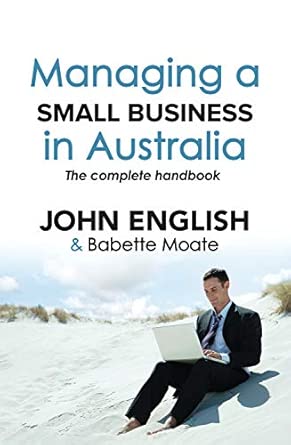
Managing a Small Business in Australia: The Complete Handbook
Author(s): John English (Author)
- Publisher: Allen & Unwin
- Publication Date: 7 Jan. 2010
- Language: English
- Print length: 288 pages
- ISBN-10: 1742373542
- ISBN-13: 9781742373546
Book Description
Editorial Reviews
About the Author
Excerpt. © Reprinted by permission. All rights reserved.
Managing a Small Business in Australia
The Complete Handbook
By John English, Babette Moate
Allen & Unwin
Copyright © 2010 John English and Babette Moate
All rights reserved.
ISBN: 978-1-74237-354-6
Contents
Preface,
Part A Getting started,
1 Pathways to a start-up,
2 Business strategy,
3 Legal obligations,
Part B Getting help,
4 Government assistance,
5 Private sector assistance,
Part C Marketing plan,
6 Marketing strategy,
7 Generating sales,
8 Export marketing,
Part D Operations Plan,
9 Establishing premises,
10 Operating strategy,
11 Employing staff,
Part E Financial plan,
12 Financial information,
13 Working capital,
14 Sources of finance,
15 Taxation,
CHAPTER 1
Pathways to a start-up
Small businesses are frequently in the hands of men and women who are the rebels of the business world. They have a highly developed sense of independence, or at least a strong desire to be independent. They have a strong sense of enterprise, or at least a desire to put their own ideas and capabilities to effective use. And they often have a strong dislike of conformity and routine. There is tremendous diversity in the types of small businesses and even greater diversity in the characteristics and motives of the people who own and operate them. The purpose of this first chapter is to consider the pathways to starting your own business. First, we look at the pros and cons of self-employment and what it takes to get on the launch pad. Then we examine the three main pathways to a start-up including buying a business, buying a franchise and starting from scratch.
Pros and cons of self-employment
Competition is a reality in the Australian business environment, particularly with low barriers to entry for many kinds of small businesses. A consequence of competition is that successful businesses have to be efficient. Customers will patronise efficient businesses rather than their inefficient rivals. The efficient firms flourish and the inefficient ones go out of business. In this way, competition results in success and prosperity going to those firms that best serve their customers. However, engaging in competition means you must honestly face the fact that running a small business can be one of the toughest ways to make a living. Before you decide to take the plunge, think seriously about some of the advantages and disadvantages of self- employment and whether this is a way of life that genuinely appeals to you.
Advantages
You can be your own boss, you can be independent, and you can exercise your own talents and capabilities.
You will have the chance to make money, maybe even a great deal of money, and you will not be dependent on a fixed wage or salary.
You will have the opportunity to achieve a feeling of personal worth, accomplishment and recognition.
You can develop your own ideas, products and services.
You will be able to work at something you enjoy by doing personally satisfying work and perhaps succeeding where others have not.
You may achieve economic security for yourself and your family.
You may be able to provide something of value to the community.
Disadvantages
You can fail and lose your money as well as the money your friends or relatives may have invested in your business.
Many small business operators work long hours, which means that time for family and friends can be difficult to find.
Your income may be uncertain and sometimes it could fluctuate enormously as a result of factors that you cannot control.
You will face the unrelenting pressure of having to make decisions and solve problems that call for expertise that you may not possess.
You will still have a boss — in fact, you will have many bosses including customers, suppliers, government agencies and your banker.
You may eventually hate your business in the same way that other people hate their job, and you may find it difficult to get out of your business without incurring an unacceptable loss.
Getting on the launch pad
The reasons that entice people into a small business vary enormously. However, most individuals typically proceed through a similar sequence of events before launching into business. If you think carefully about each step, it may help you to clarify some of your ideas about becoming self-employed.
Examine your motivation for going into business
Although thousands of new businesses begin each year, owning and operating a small business is not for everyone. The decision to become self-employed needs to be based on a realistic evaluation of your personal objectives, your skills and experience, and your personality. If you go into business without an honest evaluation of your motives, then you run the risk that you will find yourself unhappy and disillusioned.
Choose a business that suits you
The type of business you choose is a highly personal matter. Factors to consider include your skills and experience, your talents and your interests. Experience plays a big part in understanding the market and avoiding costly mistakes. If you have a particular passion, then you may want to choose a business that capitalises on it because it will help to sustain you through the long hours and hard work.
Evaluate the feasibility of your idea
Having examined your personal motivation for going into business and chosen an exciting possibility, you will probably be anxious to get started. However, a common mistake is to blindly rush into business without adequately evaluating the feasibility of your idea. Is there enough demand for what you want to sell? Have you done some market research or are you just guessing? Can the business generate enough cash to pay its expenses and leave you with a profit? How long can you keep going if it doesn’t? Do you have enough money to get started? If not, can you realistically expect to be able to borrow money? What is the worst thing that can happen if the business fails? Can you cope with this possibility if it occurs?
List all your start-up requirements
There are many things that need to be done before you can actually get started. Here are some examples:
Establishing a legal entity and registering an Australian Business Number
Identifying suitable premises and negotiating a lease
Finding out what permits, licences, rules and regulations apply to your business
Locating suitable suppliers and negotiating supply agreements
Determining what type of records you need to comply with the reporting requirements of government agencies, including the Australian Tax Office
Identifying the risks for which you are responsible and what you need to cover by insurance.
Many mistakes can occur during the start-up phase that result from making assumptions rather than researching the facts. Here are some of the errors you should try to avoid:
Thinking that others, like your accountant, mentor or the state small business agency, will do your planning for you
Entering into an informal, verbal partnership that later becomes unworkable because of misunderstandings about money, family interference or disagreements about work responsibilities
Paying licences and other fees or entering into contracts such as a lease before being certain that there is enough money to start the business
Discovering that everything costs more and takes longer than you expected.
Do a business plan
A simple business plan contains your strategy for the development and operation of your business. It is a blueprint for making the transition from your initial idea to a successful enterprise. It results from research, deliberation and a vision about what you want to achieve. It is your strategy for creating a competitive advantage and exploiting it. A business plan identifies the characteristics of the market and the marketing strategies you will employ. It includes plans for the facilities, staffing and procedures to operate the business, together with financial forecasts of the expected profits and cash flow. Having a plan means you have taken the time to think about your business and you are prepared to put it into operation.
Buying a business
When you buy a business, you get what someone else has put together. You are buying the location, premises, equipment, stock, customers, staff and goodwill that have been established by the seller. That can make it much easier for you to get started, or you could be buying a big mistake if the seller’s original decision to start the business was not justified or badly executed.
Advantages and disadvantages
Buying a going concern has the initial advantage that you will not only receive immediate income from sales to existing customers, but you will also save the time and effort needed to equip and stock the business yourself. A successful business will have a proven location, established relationships with suppliers and creditors, and existing employees. Buying a going concern as a package may turn out to be cheaper than trying to assemble all the bits and pieces yourself. It is also simpler to finance a single purchase transaction, and a proven track record will be a significant advantage in persuading a financial backer to support you. When you purchase a business, the risk of failure is significantly less than if you tried to start the same business from scratch.
There are also potential disadvantages if you buy a business. Initially, you are stuck with the previous owner’s bad decisions. For example, the inventory may be unsaleable, the choice of equipment and fixtures may be outmoded, some of the staff may not be suitable, or the location may be poor. You could pay too much for the business if you misjudge its value, and there could be unexpected expenses if the business turns out to be run-down. If the previous owner had a bad reputation, then you are likely to inherit ill will among customers and poor morale among staff. Visit the business a few times before you identify yourself as a potential buyer to check out the operation under normal trading conditions.
Valuation
When you buy a business, the price you pay should be based on its potential to earn a profit in addition to what you could earn by working for someone else. The first step is to ask your accountant to analyse past financial statements and income tax records. Have sales and profits been increasing or decreasing? What will be the return on your investment? You can use the information in Chapters 12 and 13 to help you with an analysis of the seller’s financial information.
If possible, obtain an industry profile for this type of business. A comparison of the seller’s figures with an industry profile will uncover any material discrepancies that need to be explained. This also helps you discover any operating problems that may affect your decision to buy the business or what you are willing to pay for it.
There are two basic methods used to determine the value of a business. The first method is based on expectations of future profit and return on investment. It is called the capitalised value method. The second method consists of valuing the business on the basis of the appraised value of the assets.
CAPITALISED VALUE
Capitalised value is the amount of money you would need to invest at your required rate of return in order to earn an income equal to the profit potential of the business. The required rate of return is called the capitalisation rate. Capitalised value is found by dividing the annual projected profit by the capitalisation rate. For example, suppose a business is capable of earning $50 000 per year after paying all of its expenses including your own salary. If the investment in this business is as safe as a bank deposit, you could use the fixed deposit rate of about 5 per cent to capitalise the profits and arrive at a value for the business of $1 000 000.
Capitalised value = $50 000/5% = $1 000 000
No small business, however, is as safe as a bank deposit. Capitalisation rates ranging from 20 per cent to 50 per cent more realistically recognise the risks in a small business. If we use a capitalisation rate of 25 per cent for this business, then its capitalised value is $200 000.
Two factors are important in determining capitalised value. First, it is very sensitive to the capitalisation rate used. Be sure that you use a capitalisation rate that fully reflects the amount of risk involved in purchasing the business. Second, keep in mind that you are valuing long-term profits. If there is a chance that the profits will not be sustained over the long term, then you need to increase your capitalisation rate to compensate for this risk.
APPRAISED VALUE
Some small businesses are purchased on the basis of the net value of the assets to be transferred. This process consists of establishing what assets are going to be transferred and appraising their current market value. Generally, the assets are inventory, fixtures, equipment and goodwill. If the business sells on credit, you need to consider whether or not you want to take over the accounts receivable. Since none of the assets is likely to be new, take their remaining useful life into consideration when you value them. It is important to be sure that fixtures and equipment are serviceable, inventory is saleable and accounts receivable are collectable.
If the asking price is greater than the value of the assets, the difference is an intangible asset called goodwill. Goodwill represents the ability of the business to earn greater profits than if you started the same business from scratch. The value of goodwill should not be any greater than the difference between the capitalised value of the business and the value of the assets. Agents and vendors are always quick to claim that a business’s goodwill justifies a higher price. However, few small businesses that are put up for sale are genuinely producing extraordinary profits, so the problem of valuing goodwill is not usually a pressing one.
Negotiation
The aim of the negotiation process is to agree on the terms of a formal contract covering the details of the purchase. There are a number of matters over which you and the seller may have differences. For example, the seller is interested in the best price, getting paid as quickly as possible, favourable tax treatment on capital gains from the sale, avoiding any continuing liabilities associated with the business, and avoiding any contract terms that are not in their interest. You are looking for the lowest price, extended payment terms, a favourable tax basis for resale and depreciation, and warranties or guarantees from the seller that give you extra protection.
The central negotiating issue is usually price. What is actually paid for a business can be quite different from what it is worth. In other words, price and value are not the same thing. The price paid reflects the negotiating positions of the parties. If the seller’s desire to sell is stronger than your desire to buy, then the value you receive may be greater than the price you pay. This situation might occur if the seller needs to exit the business quickly because of age, health or financial reasons. On the other hand, if you are unable to raise enough money to purchase the business, the seller may offer to accept deferred payment if you agree to a higher price. In this case, you are paying a price that is greater than the value of the business in order to get vendor finance.
When you find the right business, try not to fall in love at first sight. An emotional decision may cost you dearly. Make sure you know exactly what the vendor is selling before you make an offer. Decide what the business is worth to you and be cold-blooded about negotiating the best price. Go back for a second look and a third look before you make an offer, then be patient and let your offer lay on the table until the vendor shows a willingness to negotiate.
Have your solicitor check to be sure there are no mortgages, back taxes or other creditor claims against the assets you are buying. It is not usually a good idea to assume any of the seller’s liabilities such as outstanding loans. Occasionally, however, these can represent a source of finance for you. If you do assume any of the seller’s liabilities, the amount must be subtracted from the asking price to arrive at a net price for the business.
(Continues…)Excerpted from Managing a Small Business in Australia by John English, Babette Moate. Copyright © 2010 John English and Babette Moate. Excerpted by permission of Allen & Unwin.
All rights reserved. No part of this excerpt may be reproduced or reprinted without permission in writing from the publisher.
Excerpts are provided by Dial-A-Book Inc. solely for the personal use of visitors to this web site.


