 Wow! eBook
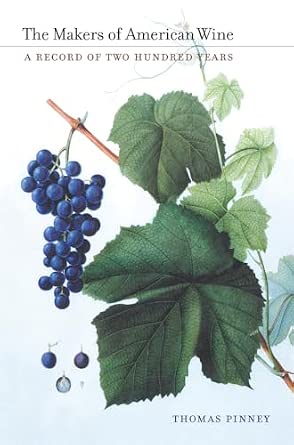
The Makers of American Wine: A Record of Two Hundred Years
Author(s): Thomas Pinney (Author)
- Publisher: University of California Press
- Publication Date: 7 May 2012
- Edition: Illustrated
- Language: English
- Print length: 336 pages
- ISBN-10: 0520269535
- ISBN-13: 9780520269538
Book Description
Editorial Reviews
Review
"Highly recomended."--Hudson Cattell "Wines and Vines" (11/1/2012 12:00:00 AM)
"This book is a major contribution to our understanding of wine history."--Conal Gregory "The Scotsman" (12/15/2012 12:00:00 AM)
"[Makers of American Wine] is a must-read for anyone seriously interested in wine. . . . Well written and easy to read."--George Erdosh "Portland Book Review (2 Copies)" (8/6/2012 12:00:00 AM)
"[Pinney] has succeeded in providing an engaging and well-written account of the very human history of wine in America."--Robert C. Fuller Bradley University "Jrnl Of American History" (1/2/2013 12:00:00 AM)
"Pinney is a master researcher deeply immersed in the minutiae of the primary-source record, and his prose is lively but, more important, clear-eyed. He has written a book that tracks the tastes of the nation through the people who chased and changed them."-- "Wine Spectator" (1/15/2013 12:00:00 AM)
"Thomas Pinney's engaging style, coupled with his meticulous research, make this a volume to savor and enjoy."--Bob Walch "Salinas Californian" (12/1/2012 12:00:00 AM)
From the Inside Flap
Exhaustively researched .invaluable to serious scholars of the grape. Fascinating reading.
San Francisco ChronicleRevealing a sharp eye for detail and a dry, low-key wit, Pinney writes in an engaging style and with remarkable clarity.
Wine SpectatorDefinitive .an important work of historical literature.
Wine & SpiritsAn indispensable view of a remarkable time.
DecanterFrom the Back Cover
“Exhaustively researched….invaluable to serious scholars of the grape. Fascinating reading.” —
San Francisco Chronicle“Revealing a sharp eye for detail and a dry, low-key wit, Pinney writes in an engaging style and with remarkable clarity.” —
Wine Spectator“Definitive….an important work of historical literature.” —
Wine & Spirits“An indispensable view of…a remarkable time.” —
DecanterAbout the Author
Excerpt. © Reprinted by permission. All rights reserved.
The Makers of American Wine
A Record of Two Hundred Years
By Thomas Pinney
UNIVERSITY OF CALIFORNIA PRESS
Copyright © 2012 The Regents of the University of California
All rights reserved.
ISBN: 978-0-520-26953-8
Contents
List of Illustrations, ix,
Acknowledgments, xi,
Introduction, xiii,
1 John James Dufour, or the Uses of Failure: A Man with a Mission, 1,
2 Nicholas Longworth: The Necessary Entrepreneur, 22,
3 George Husmann: A Pure and Lofty Faith, 39,
4 Charles Kohler: Putting California Wines on the Map, 57,
5 Andrea Sbarboro: The Italians Are Coming, 75,
6 Percy T. Morgan and the CWA: Wine as Big Business, 90,
7 Paul Garrett: American Wine for Americans, 107,
8 Ernest and Julio Gallo: Creating New Markets, 127,
9 Frank Schoonmaker: A Master Teacher, 149,
10 Maynard Amerine: Applied Science, 171,
11 Konstantin Frank: Zealot at Work, 195,
12 Robert Mondavi: Aiming for the Top, 215,
13 Cathy Corison: Women Become Winemakers, 236,
Notes, 255,
Sources and Works Cited, 289,
Index, 301,
CHAPTER 1
John James Dufour, or the Uses of Failure
A MAN WITH A MISSION
THE BRIG SALLY, CAPTAIN MITCHELL COMMANDING, arrived at the port of Philadelphia on August 12, 1796, after an uneventful voyage of sixty days from Le Havre. Among its passengers was a Swiss named Jean Jacques Dufour (John James in his American years), no longer in his first youth—he was then thirty-three years old—and remarkable at first glance only for having a left arm that ended at the elbow, probably a congenital defect. Whether he had any English before he left home is uncertain, but no doubt he had learned some on the voyage to add to his native French.
Among the stream of emigrants seeking their fortunes in postrevolutionary America, Dufour had nothing to distinguish him, except for the accident of his arm. But he came to the new republic possessed by a single purpose: to make wine for a wineless country. And the extraordinary fact is that he succeeded. That success was limited, it was of brief duration, and it was largely carried out by others. But without Dufour's determination and his willingness to take advantage of what the country offered, it would not have come about as it did.
Dufour was the eldest son of a family of vinedressers, as the term was then, living in the commune of Chatelard, near Vevey, on the terraced northern slopes of the Lake of Geneva between Lausanne and Montreux. This region, called La Côte in Switzerland, is ancient wine-growing country, the largest single concentration of vines in the country and the source of some of Switzerland's most distinguished white wines. Vevey is also the home of the venerable Fête des Vignerons, a celebration whose recorded history goes back to 1651 but which is probably even older than that.
Dufour would thus have grown up in an atmosphere saturated in wine. But why, one wonders, should he have left a secure and established wine region for the infant United States, where wine growing was effectively unknown? That very fact seems to have been a part of Dufour's reason for making the venture: it had not been done, and he was romantic enough to think that he might be the one to do it (more prosaically, the family historian, Perret Dufour, says simply that the elder Dufour determined that his children should go to America for the sake of opportunity).
John James Dufour himself said that he had been fascinated by the idea of making wine in America from the time he was fourteen years old and read in the papers some reports from French soldiers serving with the American armies in the Revolution complaining about the lack of wine "in the midst of the greatest abundance of everything else." There were all-too-good reasons for the absence of native wine in America, as explained in the introduction. Those reasons, however, remained essentially unknown in Europe, just as they were largely unrecognized still in America itself.
When he consulted a map of the country to which he had determined someday to go, Dufour found that parts of America lay in the latitude of "the best wine countries in the world—like Spain, South of France, Italy, and Greece," and this seemed to him to be a promise of sure success. It is a fact that the northern limit of wine growing in Europe is roughly the fiftieth parallel, and that in America all of the contiguous states lie south of that. New York City and Rome are both on the forty-second parallel; Richmond, Virginia, and Athens are both on the thirty-eighth parallel. These coincidences seduced many an early entrepreneur into believing that wine might be grown as readily in New York or Richmond as in Latium or Attica. But the belief was a delusion; the differences in climate are so extreme as to make the argument from latitude utterly unreliable. Dufour, however, did not yet know that.
When, at the end of his life, Dufour set down his account of his experience in the new world in his American Vine-Dresser's Guide (1826), he took an almost sacramental view of his purpose. By successfully producing wine, he wrote in his loose and difficult sentence style, he would "engage and enable the people of this vast continent to procure for themselves and their children, the blessing intended by the Almighty; that they should enjoy, and not by trade from foreign countries, but by the produce of their own labor, out of the very ground they tread, from a corner of each one's farm, wine thus obtained, first handed from the grand Giver of all good, pure, genuine, and unmixed by avarice, that it may have the effect on his heart and family intended by the Creator." Not only that, native wine would turn Americans away from their habitual use of ardent spirits—whiskey especially—and contribute to making the country temperate and sober. These arguments for the high social value of wine growing were heard from the very beginning of American settlement and form a kind of chorus behind almost every one of the countless attempts to establish it. Dufour was one of a long line in this matter too.
Of course Dufour hoped to make money as well as to confer solid public benefits. He never did get rich, but something of his high expectations may still be heard in his language at the end of his life: "Millions," he wrote, "will accrue to the country at large" from the work he had done. And that, too, is one of the constant themes in the pioneer history of wine growing in this country: temperance, good cheer, and unbounded wealth are all mingled in the vision of America as a wine land. It is still an attractive vision.
His preparation lasted much longer than one would expect. For twenty years or more, after he had formed his resolve to go to America, he was still in Vevey, where he had a wife and a son—hardly evidence of a restless spirit. About the wife nothing is known, except that she would never go to America; the son was an only child, named Daniel Vincent. Dufour was surrounded in Vevey by a large family: his father, also Jean Jacques, was still living, as were seven other children of the father's two marriages. What determined the moment at which John James Dufour finally set out for America can only be guessed, but the anxieties created by the French Revolution and by the Napoleonic Wars that followed are likely to have been among the main reasons. Following the outbreak of the French Revolution in 1789,...


