 Wow! eBook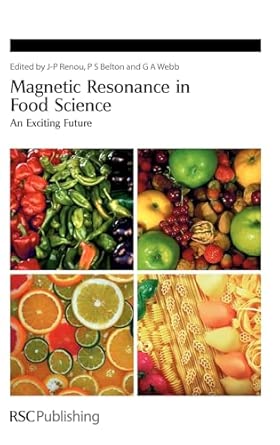
Magnetic Resonance in Food Science: An Exciting Future: Volume 332
Author(s): J-P Renou
- Publisher: Royal Society of Chemistry
- Publication Date: 14 April 2011
- Language: English
- Print length: 212 pages
- ISBN-10: 9781849732338
- ISBN-13: 1849732337
Book Description
Proceedings from the 10th International Conference on the applications of Magnetic Resonance in Food Science to celebrate its 10th anniversary.
Editorial Reviews
Review
Review of previous edition
.”.. it succeeds admirably in updating the researcher with progress in NMR applications for food science, and in opening up further application possibilities.”
Chemistry and Industry
Review of previous edition
The comprehensive, yet specialised nature of this book suggests that it will be of primary interest to academics, material scientists or to forward looking plant managers.
Food Australia 58 (3) – March 2006 (Dr Robert Sleigh)
Reviews of previous edition
A must for all researchers with a genuine and cosmopolitan interest in all aspects of magnetic resonance.
Journal of the Science of Food and Agriculture, July 2004 (I M Morrison)
From the Back Cover
The Clermont-Ferrand-Theix Institut National de la Recherche Agronomique (INRA) was proud to organize the 10th International Conference on the applications of Magnetic Resonance in Food Science to celebrate its 10th anniversary. The conference attracted ninety participants from fourteen countries from all over the world including seven invited lectures, nineteen oral presentations and twenty seven oral poster presentations. The conference was divided into six sessions covering data processing, new developments/food system, new developments/NMR, nutrition, metabolomic and imaging. This book follows the form of the conference.
Celebrating its 10th anniversary this book is the proceedings of the conference, and forms part of the continuing series of proceedings of the biennial conferences on applications of magnetic resonance to food science. Magnetic Resonance in Food Science is a global survey written by leading authorities. It provides readers with an awareness of current activity in the field and potential applications.
About the Author
J-P Renou is currently holds the post of Director of Research, leader of the FGA group, Plant Genomics Research (URGV), France.
P S Belton is Professor of Chemistry at the University of East Anglia and is a former Deputy Director of the Institute of Food Research, UK.
G A Webb is based at the Royal Society of Chemistry in London. He has edited about 130 volumes, mostly concerned with magnetic resonance studies.
Excerpt. © Reprinted by permission. All rights reserved.
Magnetic Resonance in Food Science
An Exciting Future
By J.-P. Renou, P. S. Belton, G. A. Webb
The Royal Society of Chemistry
Copyright © 2011 The Royal Society of Chemistry
All rights reserved.
ISBN: 978-1-84973-233-8
Contents
Magnetic Resonance in Food Science — Twenty Years Forward and Twenty Years Back P. S. Belton, 1,
Data Processing,
Advanced Processing in NMR: Fourier & Laplace Transforms, Modern Software Environment & Data Management M. A. Coutouly and M. A. Delsuc, 11,
Using Parafac Core-Consistency to Estimate the Number of Components in LF-NMR Data – Application to In-Situ Studies of Mechanically Induced Gel Syneresis in Cheese Production C. L. Hansen, F. van den Berg and S.B. Engelsen, 18,
Isotopic Analysis and 1H-NMR Spectroscopy for Traceability and Discrimination of Italian Wines C. Aghemo, A. Albertino and R. Gobetto, 30,
New Developments in Food Systems,
PFG-NMR on Double Emulsions: A Detailed Look into Molecular Processes R. Bernewitz, X. Guan, G. Guthausen, F. Wolf and H. P. Schuchmann, 39,
Quantification of Oligosaccharides from Common Beans by HR-MAS NMR L. M. Lião, E. G. Alves Filho, L. M. A. Silva, R. Choze, G. B. Alcantara, and P. Z. Bassinello, 47,
Study of the Proteolytic and Lipolytic Processes in Manchego Cheese by NMR M. Moreno, A. Moreno, M. V. Gómez, J. M Povéda and L. Cabezas, 54,
Quality Markers of Red Wines from Spanish Region of Castilla-La Mancha Using Nuclear Magnetic Resonance A. Moreno, L. F. Labrador, M. Moreno, M. S. Pérez, M. A. González, E. M. Sánchez-Palomo and J. M. Lemus, 60,
Sodium Ions in Model Cheeses at Molecular and Macroscopic Levels I. Andriot, L. Boisard, C. Vergoignan, C. Salles and E. Guichard, 67,
The Impact of Freeze-Drying on Microstructure and Hydration Properties of Carrot A. Voda, G. van Dalen, J. Nijsse, H Van As and J. van Duynhoven, 71,
New Developments in NMR,
Medium Resolution NMR at 20 MHz: Possibilities and Challenges M. Cudaj, T. Hofe, M. Wilhelm, M. A. Vargas and G. Gunthausen, 83,
Rapid and Validated NMR Quantification Approaches for Complex Metabolite Mixtures B. Braganti, S. Peters, D. M. Jacobs, T. Eymond, M. Klinkenberg and J. van Duynhoven, 92,
Elucidation of Non-Enzymatic Browning Reaction Pathways by Means of the Carbon-Bond Labelling Technique M. Ilse, O. Frank and T. Hofman, 96,
Comparative Study of the Thermal and Microwave Oxidation in Olive Oil. 31P-NMR Quantitative Determination of 1,2 and 1,3-Diglycerides and Other Minor Compounds C. Lucas-Torres, M. Moreno, A. Juan, A. de la Hoz and A. Moreno, 100,
Time Domain 1H-NMR of Arabinoxylans and 1 β-Glucans Films, Models of a Lamellar Organisation in Endosperm Cell Walls of Cereal Grains R. Ying, J. Ruellet and C. Rondeau-Mauro, 105,
Nutrition,
Metabolic Responses to Heat, Anoxia, or Oxidative Stress Elucidated in Muscle Cell Cultures Using 13C NMR Spectroscopy I. K. Straadt, J. F. Young, B. O. Petersen, J. Ø. Duus, N. Gregersen, P. Bross, N. Oksbjerg, and H. C. Bertram, 117,
Assessment of the Performance of an NMR Assay for the Determination of Hydroperoxides in Lipids C. Skiera, P. Steliopoulos, U. Holzgrabe and B. Diehl, 124,
Application of Electron Spin Resonance Spectroscopy to Study Dietary Ingredients and Supplements – Dual Antioxidant and Prooxidant Functions of Retinyl Palmitate J. J. Yin, Q. Xia, H. Lutterodt, W. Warner and P. P. Fu, 126,
Metabolomics,
Nutritional Metabolomics as an Approach to Unravel Metabolic Health Trajectory S. Collino, F-P. J. Martin, S. Kochhar and S. Rezzi, 139,
Normalization is a Necessary Step in NMR Data Processing: Finding the Right Scaling Factors F. Capozzi, A. Ciampa, G. Picone, G. Placucci and F. Savorani, 147,
Towards Identification of Polyphenol Metabolites in Biofluids By SPE-LC-MS-SPE-NMR M. Klinkenberg, N. de Roo, P. Alexandre, I. Mahlous, D.M. Jacobs, H.-G. Janssen and J. van Duynhoven, 161,
Imaging,
Recent Concepts in MRI F. Hennel, S. Ohrel, P. Ullmann, M. Weiger and R. Winkler, 173,
Diffusion-Weighted NMR Micro-Imaging of Lipids: Application to Food Products S. Clerjon and J-M Bonny, 182,
MR Microscopy of Food Freezing and Thawing I. Sera, F. Bajd and A. Sepe, 190,
Subject Index, 198,
CHAPTER 1
MAGNETIC RESONANCE IN FOOD SCIENCE — TWENTY YEARS FORWARD AND TWENTY YEARS BACK
Peter S Belton
School of Chemistry, University of East Anglia, Norwich, NR4 7TJ, UK
1. INTRODUCTION
Any account of the recent past of magnetic resonance and any attempt to look forward must take account of the deeper history of the subject and consider its essential features. A possible starting place is the beginning of the 19th century in England. At that time the Romantic Movement in the arts was beginning to flower and there was increased interest in the phenomena of electricity and magnetism. The writings of Emmanuel Kant were also beginning to be appreciated in England and among his interpreters was the English poet and man of letters Samuel Taylor Coleridge. Coleridge was an influence on a number of scientists at the time and of particular relevance to this paper is his influence on Michael Faraday. The particular idea was Coleridge’s interpretation of Kant’s physics to the effect that “all forces are the same”. This matched well with the interaction between electric and magnetic forces that Faraday was exploring. The discoveries of Faraday led to the work of James Clerk Maxwell who unified the electric and magnetic fields and in so doing created the idea of electromagnetic radiation: a notion which is critical to the understanding of magnetic resonance. However this in itself is insufficient; as of equal importance in understanding the phenomenon is the idea of quantisation introduced by Planck.
The beginning of the 19th century was a ferment of scientific progress. Nothing that was done at that time can be said to be irrelevant to the development of magnetic resonance. But two events are of particular importance: the discovery of the electron by JJ Thompson and the discovery of the nucleus of Ernest Rutherford. These ideas led to the modern concept of the atom, but one more step was need before all the parts were in place. This was the concept of spin quantum numbers as introduced Wolfgang Pauli. Necessarily this idea contained the implication of nuclear and electronic magnetism. It only needed the development of suitable electronics for the demonstration of the phenomenon of electron spin resonance by Bleaney and Zavoisky and nuclear magnetic resonance by Bloch and Purcell.
2. THE BASIS OF MAGNETIC RESONANCE
As indicted above the phenomenon of magnetic resonance arise as consequence of the spins of electrons and nuclei. The spin generates a magnetic dipole which can align parallel or anti parallel to an imposed magnetic field. The parallel orientation being the lower energy one. The energy difference between the two levels and hence and the energy of radiation need to observe resonance is given by:
E = hv = ΓB0 1
Where E is the energy of the photon needed for the transition, h is Planck’s constant Γ is the appropriate constant for the electron or nucleus and B0 is the applied magnetic field strength. Typically Γ for an electron is of the order of 103 times greater than that for a proton. The frequency of resonance varies from typical ranges of 100 to 1000 MegaHertz for proton magnetic resonance and from gigaHertz to hundreds of gigaHertz for electron resonance. This is a very low frequency range compared to the 10-13 to 10-14 Hertz range of infrared spectroscopy, for example, and it has number of consequences. The relative populations in the upper (N) and lower (N0) levels, at temperature T, are governed by the Boltzmann equation:
N=N0 exp(-E/kT) 2
Where k is the Boltzmann constant.
Table 1 shows the population ratio between the levels for a number of different frequencies.
The table shows that in the radio frequency range even at 500 GigaHertz (currently a typical value for spin echo ESR) the ratio of spins in the upper and lower levels is close to 1. Since the observable signal is proportional to the difference in populations of these levels it demonstrates that magnetic resonance is a very weak effect compared to other spectroscopies such as infrared (1014 Hertz) where the difference is very large.
Most textbooks do not discuss the significance of the low energy transition any further but in fact the population difference is the least important aspect of low energy spectroscopy. Low energy quanta are very rare at normal temperatures as is illustrated in Figures 1 and 2. The plots show the radiation intensity at 293K calculated from Planck’s radiation equation. As can be seen from Figure 1 the maximum of the radiation is in the infrared region. At low frequencies the intensity is very low, as shown in Figure 2, where the relative intensity is normalised to the maximum emission. This very low natural density of quanta at the frequencies of interest ensures that background radiation is very low and therefore noise generated from the sample itself and the outside world is very small.
In addition to this weak background, the low frequency of the radiation makes the probabilities of spontaneous transitions low and therefore leads to long relaxation times and narrow resonance lines.
Even this, however, is not the most important aspect of the low energy of the transition: low energy quanta make the generation of very large numbers of quanta possible using relatively low energies. A 100 Watt transmitter operating at 300MHz would generate about 1017 photons per frequency unit
A form of the uncertainty principle can be written as:
[MATHEMATICAL EXPRESSION OMITTED] 3
Where Δn is the uncertainty in the number of photons and Δθ is the uncertainty in the phase. Since the number of photons is very large the phase of the system is controlled by the radiation field. Magnetic resonance is therefore coherence spectroscopy. This means that the phase and amplitude of the signal can be controlled by the experimenter and the number of possible experiments is limited only by the ingenuity of the operator. This is in contrast to most optical spectroscopy where the only possible experiment at normal intensities of irradiation is to observe the incoherent absorption of photons.
3. HISTORICAL DEVELOPMENTS
The 1970’s to the 1990’s saw the general use of pulsed methods in NMR and the consequent exploitation of phase encoding to enable techniques such as 2 dimensional NMR and NMR imaging. It also saw developments in instrumentation with the development of high resolution solid state NMR and larger magnets. The next two decades brought major developments in science which have been reflected in magnetic resonance. These were the massive increase in bioscience, the advent of nanotechnology and the digital revolution. Each of these has impacted in a different way on the field. The response to bioscience has been to the application of magnetic resonance to biological problems. NMR in particular, but also ESR has contributed immensely to our understanding of protein structure and function. The role of NMR in this context has been recognised by the award of a Nobel Prize to Kurt Würtrich. Hyphenated techniques combining NMR and mass spectrometry and applications of proton NMR to metabonomics have reinvented NMR as an analytical technique.
On the whole the development of new magnets has been incremental rather than spectacular: super conducting magnets have increased in field strength and have become more efficient. More innovative developments have been in the application of novel magnets in low field systems. Single sided NMR using the NMR “Mouse” and NMR for online and at line processing using translational relativity through static RF and magnetic fields are interesting and potentially very valuable developments.
The dramatic increase in the availability and capability of digital technology has cause major changes both in the instrumentation and the data analysis. On the instrumental side digital pulse shaping, filtering and oversampling have made advances in experimentation and the quality of data possible. The quality of fast digitisers and other changes have made spin echo ESR a routine, if expensive, technique.
Data analysis may be classified into three different processes:
Extraction: in which data may be manipulated to improve resolution or signal to noise ratios. There may be some selection of subsets of data either on a priori grounds or by a posteri analysis by such methods as principle components. However the data is treated the overall point of the process is to arrive at a set on numbers that are thought to describe the system. A very comprehensive account is given in the book by Douglas Rutledge
Correlation: in which the relationship between data derived parameters is determined by examination of the relationship of data points or data sets under the influence of same variable parameters or parameters. An example of this is the Laplace transform method
Assignment: In which the data sets are classified as belonging to a particular set. A common example of this classification process is the assignment of sample to an authentic or inauthentic set.
Nanotechnology has developed at a very rapid pace. The direct impact of the technology on food has so far been limited but may well become more important in the future. ESR and NMR have been used extensively in the characterisation of systems containing nanostructures but a more intriguing development is the development of nano-scale spectroscopy. Figure 3 shows the set up for atomic force microscope based magnetic resonance detector.
The whole apparatus is placed inside a magnet at about the correct field for the radio frequency source to be at the Larmor frequency. The magnetic tip induces a field gradient which means that only part of the sample is on resonance. The sample itself is attached to the cantilever tip of an atomic force microscope which can detect atomic scale displacements. The principle of detection is by directly detecting the movement induced by the creation of nuclear magnetisation. A periodic inversion of the magnetisation is induced by scanning the radio frequency in and out of resonance. Finally, if required, a map of proton density can be produced by the mechanical movement of the tip in the XY plane. An interesting feature of the technique is the since the sample of spins is very small the stochastic variation in magnetisation is greater than the equilibrium Curie magnetisation and this is the magnetisation that is detected. On the scale required it is not currently, possible to build RF coils so a very small strip of wire is used as radio frequency conductor and the RF frequency is ramped at the resonance frequency of the atomic force microscope cantilever. The result is an adiabatic inversion of the magnetisation at the cantilever resonance frequency which amplifies the effect and allows phase sensitive detection. A system has been described which allows imaging at resolution of 10 nm – a 108 fold improvement in resolution over conventional imaging methods.
It is interesting to compere this technique with similar developments in infrared spectroscopy. Here the use of atomic force microscopy is coupled with a thermal detection system for the absorption of light. This avoids the problem of the diffraction limit for spatial resolution but is limited by the diffusion of heat and the size of the probe. The overall effect of these is that despite infrared being a higher energy spectroscopy the current resolution limit is of the order of I to 5 microns.
4. THE FUTURE
It is a truism that predictions of the future are doomed to failure and that the future turns out to be stranger than any of us can imagine. It is also true that the future is a convenient screen on which to project our wishes and prejudices. With these caveats the suggestions made here should perhaps be best seen as a wish list, but one which is at least based in past and current developments.
There are 4 major areas in which one might hope to see change and innovation these are:
Magnets
The web
Bench top machines
Nano – magnetic resonance
Magnets as normally used in magnetic resonance are large and expensive. This is particularly the case for high resolution NMR. There are two main reasons for this: larger fields result in increased signal to noise ratios and greater dispersion of chemical shift. Higher fields also can simplify second order spectra to first order. This is of considerable value in, for example, protein NMR. However in the increasingly important field of proton NMR for analytical purposes the tendency is to reduce the spectra by “bucketing” in which small regions are co-added to form a histogram. Thus resolution is already deliberately reduced. In the case of low dispersion or poor shimming information about chemical shifts and individual resonances is not lost. It is simply convoluted with a point spread function. Prior knowledge from a single high field experiment may then be used to reconstruct the poorly dispersed spectrum if required. However this may not be necessary, as has been amply demonstrated, by the widespread application of near infrared methods in which spectral resolution of individual absorbances is very rare. There may therefore be a strong case for the use of lower specification and lower field NMR for analytical purposes.
(Continues…)Excerpted from Magnetic Resonance in Food Science by J.-P. Renou, P. S. Belton, G. A. Webb. Copyright © 2011 The Royal Society of Chemistry. Excerpted by permission of The Royal Society of Chemistry.
All rights reserved. No part of this excerpt may be reproduced or reprinted without permission in writing from the publisher.
Excerpts are provided by Dial-A-Book Inc. solely for the personal use of visitors to this web site.


