 Wow! eBook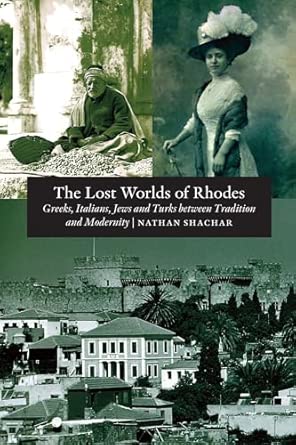
Lost World of Rhodes: Greeks, Italians, Jews and Turks Between Tradition and Modernity
Author(s): Nathan Shachar (Author)
- Publisher: Liverpool University Press
- Publication Date: 23 April 2013
- Language: English
- Print length: 224 pages
- ISBN-10: 1845194551
- ISBN-13: 9781845194550
Book Description
Editorial Reviews
Review
About the Author
Excerpt. © Reprinted by permission. All rights reserved.
The Lost Worlds of Rhodes
Greeks, Italians, Jews, and Turks Between Tradition and Modernity
By Nathan Shachar
Sussex Academic Press
Copyright © 2014 Nathan Shachar
All rights reserved.
ISBN: 978-1-84519-455-0
Contents
List of Illustrations,
Acknowledgements,
1 Hic Rodus, hic salta!,
2 France in Rhodes – Mirage or Promised Land?,
3 The Seeds of War – Italy in 1911,
4 The Road to Psinthos,
5 Fiat Lux! Italy – A Light Unto the Nations?,
6 Incipit vita nova …,
7 Opening Up,
8 Kulturkampf,
9 A New Career – Going Away Forever,
10 Twilight,
11 Greeks and Jews – A Wound Unhealed,
12 Holocaust,
Index,
CHAPTER 1
Hic Rodus, hic salta!
An introduction
When the silhouette of the Old City of Rhodes first pierced the tightrope horizon, and the domes, spires and minarets began to emerge out of the morning haze, I was standing on the deck of an old Baltic ferry, boarded in Cyprus. I had recognized the ship from my childhood, when it had plied the Malmó-Copenhagen route I used to take with my grandfather Salomon on the way to the Copenhagen Zoo. Like many Mediterranean passenger vessels it had been banished out of service by stern Scandinavian safety ordinances, and then given a new lease on life in Classic waters, though signs and lifesaving instructions were all still in Danish.
At Cyprus I had left the Haifa-Athens liner, and set out for Crete, where I would meet my parents. I was on Passover vacation from the Hebrew University in Jerusalem. I went ashore in Rhodes after a spur-of-the-moment decision, sparked by the dictum Hic Rodus, hic salta! which I understood as “Here is Rhodes, jump ship now” – or generally: “Honour thine impulses!” The categorical imperative of my generation was: “Do not succumb to the forces of order and organization.” Long-term life-strategies, in the guise of mortgages, marriages or job-oriented studies, were religiously avoided in my circles. One’s independence should be continuously attested and earned by rash and un-expedient choices. We were proud to travel without an itinerary – even when not on holiday. This attitude set my career, and a few others, back quite some years, but it let me explore the shores of the Mediterranean calmly, relieved of the performance-anxiety that is turning today’s first-year students into sombre little grown-ups.
(I was wrong, however. Hic Rodus, hic salta! – the moral of one of Aesop’s fables – is not a call for bohemian decision-making, but almost the opposite: “Don’t brag about your feats, perform them here and now!”)
I rushed ashore to the harbour-master’s office, where I learned that there would be a wheat-dispatch to Crete via Karpathos that Wednesday, taking ten passengers, which left me more than eighty hours to inspect Rhodes.
I studied ancient philosophy at the time, and doted on things Greek. Our classics’ teacher, a religious Jew from New York, had read to us, with stony disapproval, Josephus Flavius’ account of fawning Herod’s trip to Rhodes in 31 BCE. The old cynic had gone there to pledge allegiance to an even greater one, the future emperor Augustus, who had just crushed Marc Antony’s fleet at Actium and swept all opposition off the board. Of later Rhodian annals I knew little, but I hoped the formidable walled-in bourg of the Crusader knights, its joints creaking with history, with the thinkers’ coast of Asia Minor as its backdrop, would provide the congenial setting for some uplifting repose.
But I soon found out just how unsuitable the town was for romantic devotions. I had once marvelled at black-and-white Rhodian street-scenes in an old library book. The alleys there had been discreetly populated, showing a robed priest here, a solitary donkey there or a decorative black widow against a whitewashed wall. But the thing itself was under a veritable siege of unpicturesque beings, speaking a Babel of un-classic tongues. What really made me shudder was the daily posting of German and Swedish tabloid news-bills outside the kiosks.
Touring the whimsical alleys of Cavalier knights, Ottoman pashas and Spanish Rabbis, now lined with souvenir outlets, one had to crane one’s neck above the throng to get the street-level vanities out of one’s frame of vision, while struggling to stay clear of eager bazaar-men. To pause and meditate in front of an emblazoned portico, or admire a splash of crimson bougainvillea over hoary medieval ramparts, was often physically impossible, so intense was the pressure from hosts of holiday makers – some of them, surely, frustrated Schöngeiste like myself.
After half a mortifying day I had had enough. I jumped on a bus and bought a ticket to the end of the line. But the end of the line was only a short distance away, a sugarloaf hill southwest of town with a pretty postcard view of the charter-flight Sodom below. It was marked Monte Stefano on my old Italian map and is called Mount Smith on newer ones, re-named after the British admiral Sidney Smith, whose fleet transported the Ottoman troops to their defeat at Aboukir.
I scaled up Smith’s hill. Still freshly green, each step through the shrubbery released a tinge of thyme and hyssop. I took in the grand view and shared the feelings of the poet Lamartine, who made a stopover here in 1835, like myself en route from Judea, whose barren rock-heaps and wretched population had disheartened him greatly:
Outside the gates of Jerusalem we really didn’t see a living thing, we encountered the same silence which we would have expected in Pompey or Herculaneum … a total, eternal silence prevails in towns, along the roads, in the countryside … the grave of an entire people.
But the springtime glory of forest-clad Rhodes made a voluptuous impression on the loveable romantic, and he showered it with praise. Here, it seems, unlike in Judea, Turk and native alike held trees in the highest esteem. Plane-trees were planted for coolness, shade and soil-protection and woe to anyone maiming living trees for firewood. Lamartine reports that a Greek, caught cutting a branch off a venerable old plane, was given a cane-hiding by the vali’s commissar. Some decades after Lamartine s visit, however, the Ottoman rail system was launched. It spanned a vast area, from the Danube to the Persian Gulf and from the Caucasus to Sinai. The craving for wooden sleepers took a brutal toll on forests all over the Empire. The Rhodian pine forests of today are almost all Italian reforestation projects.
Where I stood now, on a hillside crisscrossed by goat trails, with budding apricots like cerise dabs in the valley below and busy warblers darting in and out of the thickets, I could only assent with Lamartine’s raving homage to Rhodes and its vegetation. There was no one about, except an old goatherd with a bristle of a moustache and a parched, outdoor face, leaning on his staff some terraces below mine. His charges, a handful of huge rams, rummaged through the shrubland of mastic and pink cliff roses – the local subspecies Cistus creticus is the source of laudanum, an aromatic gum related to opium, used in perfumes and folk drugs, and was harvested by a condominium of Rhodian synagogues in the 17th century.
The slope was powdered with yellow anemones. I took special notice of them since they are not found in the Holy Land. The goats didn’t touch them. The herdsman wore the rag of a brigand around his head and baggy pantaloons à la turque. I hadn’t spoken to a soul since Cyprus, not counting waiters and vendors. The balsamic breeze and the therapeutic stillness had restored my desire for human company. I pulled out my Greek word-list, greeted the old faun and prepared for a barbaric dialogue of nouns and signs. But there was no need for it.
“Capisce italiano?”
We then conducted a passable Spanish-Italian conversation. The good man was not Italian. But during Mussolini’s colonization drive, when paved roads, pumping stations and other blessings were inflicted on the Rhodian campagna, he had been a jobless youngster.
“I worked for them. Three years. Also learned it at school.”
“Tell me about the Italian colonists, how were they?
“They were a confused lot. Some were naïve, some were arrogant. Some fancied themselves as farmers, without knowing the half of farming. But they were propped up by their government.”
“So you learned Italian?”
“Well, they weren’t going to learn any Greek. They thought they were going to turn this into an Italian island. If they hadn’t teamed up with the Germans and lost the war they would have pulled it off. If you wanted their business you learned their language. School-children had to study Italian, even in remote hills! They built whole new settlements for their people, San Benedetto, Campo Chiaro. They’re all deserted now. Or renamed.”
I was astonished by the lessons of modern history imparted by such an unlikely pastoral source. The pleasantly rounded hill on which we stood was really the acropolis of ancient Rhodes, he explained, and later he showed me both the Greek stadion and the Roman odeon – both marvellously intact – unearthed by Mussolini’s archaeologists. He offered me sour green almonds out of his satchel and told me about the Italian agricultural schools, health spas, tourist hotels, casinos and other projects where he had worked, building and serving, during the public works’ spree of the Fascists. He told me about the rounding up of the Jews by the Nazis in the summer of 1944, of the reunion with Greece in 1947 and of the recent onset of unbridled tourism.
Why wasn’t this quick-witted person, with his fluent Italian and his historical insights, more gainfully employed? What was he doing up here, minding outdated capricorns? I couldn’t bring myself to ask – as if I considered the scramble for tourist gold a worthier pursuit. I met him twice more during my short stay and then again during a later visit. Each time he was just as helpful, treating my ignorance with first-aid and saying, about almost everything:
“Well, that is now. It used to be quite different, era molto diverso …”
He told me that nowadays young men from all over Greece would arrive in Rhodes for intense spells of work during the holiday seasons, while in his time the island had lost the flower of its youth to emigration. And then he said, about the changes he’d seen during his lifetime:
“People always speak warmly about tradition and the decent ways of old. But most of them … just give them an option and they’ll forsake tradition for a higher income or less work. You can’t fight it. Quite a few will resist materialism in their hearts, but their sons will resist it much less. Resistance will peter out. Change doesn’t require a majority. All it needs is a few people with energy. Then it rolls on by itself.”
I told the shepherd I was eager to get genuine countryside under my feet. He walked with me for a while, pointing and explaining in all directions, while I kept jotting down the advice on the flap of a book. A pair of marrow-freezing mongrels appeared, to challenge the meek little sheepdog of our flock. The shepherd drove them off with stones and oriental insults.
“It’s a case of me protecting him, really,” he mused, nodding at his pathetic mutt. “What you need is a piece of stick.”
He broke a branch off an almond tree and, in a few minutes, turned it into a robust shepherd’s staff with his jack-knife. I was glad to have it later on. There is nothing like Greek country dogs to keep one alert. In the most Bucolic surroundings growling descendants of Kerberos will appear out of nowhere. It is not even the territorial imperative. They will attack you even if you don’t trespass, as a matter of principle, like the sphinxes and hydras of old, lying in wait by the wayside.
The shepherd told me to walk southward, along the westerly coast of the island, past the airport and then to turn east up the mountains. There I would be able to see the battlegrounds of 1912, the trenches where the Turks had made their last stand. He gave me the name of some acquaintances who would let me sleep in their shed. He wrote down some words on the back of my busticket, as a letter of recommendation, and assured me that most of the highland people knew him personally.
In order to reward native kindness I was carrying a supply of small olive-wood crosses, with the word ‘Hierosolyma’ carved on them, from the Old City of Jerusalem. Usually rural Greeks were overwhelmed by the simple gift, but the shepherd politely turned it down:
“Give it to the old folks on the mountain. They still believe the world was created and saved. I am a freethinker, sono pensatore libero. It won’t do me any good.”
I set out, water-bottle in one hand and Lawrence Durrell’s book on Rhodes, Reflections on a Marine Venus, in the other. I had bought it in Rhodes town. It is a half-biographical essay, a witty, lyrical inventory of ethereal, rustic and modern moods in the recently liberated Rhodes of 1945. I had begun to read it that same morning in the lobby of my hotel. But the eulogies to a poetic island of roses, breast-shaped lemons and sublime, wave-swept torsos seemed bizarre in that atmosphere of clanging pin-ball machines, overflowing ashtrays and mildewed carpets. I felt like reading a bygone ode to a young nymph, while having her present self before my eyes, an aging harlot dragged through the gutter. I couldn’t wait to turn my back on the Rhodes of reality and flee into the Rhodes of old books.
I admired Durrell, more than I do today. He appeared so much at ease, so much at home, in the Mediterranean cosmos where I was trying to get my bearings. But looking back, I wonder if my fervent intake of Durrell, Robert Graves and other admired classicists didn’t delay a correct reading of the territories along my way. Their penchant for regarding the most quotidian phenomena as echoes and reflections of eternal Attic, Etruscan and Minoic harmonies bred a seductive illusion of a Mediterranean firmly moored to its glorious past; of a world where the gestures, habits and arts of present-day farmers, water-carriers and politicians were taken straight from a schoolboy lexicon of mythical, architectural and poetic references. Such a mind-set may become quite a drag on understanding, once you start to wonder about how the societies now spread out over the classical map really function.
Tell yourself, for example, that the Israelis are the descendants of a people who gave the world the concept of universal morality. Then try to get on a bus in Jerusalem, after having been first in line. Try to renew your visa, or to get a stamp on a form in Rome; and remind yourself, during the ensuing calvary, that these are the sons of the procurators and prefects who kept the entire world in the reins of a well-oiled administration. Try to reason about politics – say, the Cyprus issue – with some Athenian coffeehouse clients, and then try to get it into your head that these are the sons of a people who invented both politics and reasoning. And then, after a season by the cradles of awe-inspiring ancient civilizations, return to quiet, polite, orderly Copenhagen and tell yourself that its people are the heirs of wild berserks who kept all of Europe, from Orkney to the banks of the Guadalquivir, trembling at night. Classicism is fun, but it is a drug to enjoy with restraint.
That day, alone in Rhodes, I felt that there was something wrong with Durrell’s book. Reflections on a Marine Venus is a carefree and charming account of how some young desk officers set up operations in Rhodes just after the British conquest. They are transferred from Alexandria to administer the now lordless island, Italian rule having been undone two years earlier by the Germans, who are now the defeated captives. Together with some other inspired and eccentric administrators Durrell sets up his usual charming, high-brow coterie. During their expeditions the uniformed civil servants study soil-erosion, wine-making and the local inventory of folksongs; themes treated knowledgeably, with brisk impressionist strokes slapped effortlessly on a classic backcloth.
I have never regarded literature as a utility. I don’t believe it has to pay its way by making a stand, taking sides or confront ‘issues’. But there are times when the studied avoidance of brute realities becomes bad taste. Of course Durrell finds the island adorably interlaced by artistic currents and trails, new and ancient. But the place has recently seen some hard times, in fact it has been involved in a world war. It is not as if Durrell barred mundane realities from his spirited account: The rubble left from air and sea bombardments, and from the concluding hand-to-hand fighting, is still conspicuous. Civilian casualties during the air-raids have been heavy, and the austere food-regime during the last stand of the northern invaders has driven many islanders away. Emaciated German POWs are now busy hauling away the wreckage, and the Italian minefields, the maps of which have been lost, are a huge headache to the disposal squads. White bread is a stirring novelty. Durrell’s own duty as Information Officer, in charge of the production of three daily papers, one Greek, one Italian and one Turkish keeps reality close at hand.
(Continues…)Excerpted from The Lost Worlds of Rhodes by Nathan Shachar. Copyright © 2014 Nathan Shachar. Excerpted by permission of Sussex Academic Press.
All rights reserved. No part of this excerpt may be reproduced or reprinted without permission in writing from the publisher.
Excerpts are provided by Dial-A-Book Inc. solely for the personal use of visitors to this web site.


