当前位置:Wow! eBook教育与教学 Long Term Socio-Ecological Research: Studies in Society-Nature Interactions Across Spatial and Temporal Scales: 2 2013th Edition
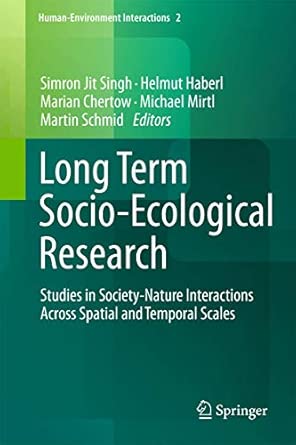
Long Term Socio-Ecological Research: Studies in Society-Nature Interactions Across Spatial and Temporal Scales: 2 2013th Edition
Author(s): Simron Jit Singh (Editor), Helmut Haberl (Editor), Marian Chertow (Editor), Michael Mirtl (Editor), Martin Schmid (Editor)
Publisher: Springer
Publication Date: 12 Nov. 2012
Edition: 2013th
Language: English
Print length: 628 pages
ISBN-10: 940071176X
ISBN-13: 9789400711761
Book Description
The authors in this volume make a case for LTSER’s potential in providing insights, knowledge and experience necessary for a sustainability transition. This expertly edited selection of contributions from Europe and North America reviews the development of LTSER since its inception and assesses its current state, which has evolved to recognize the value of formulating solutions to the host of ecological threats we face. Through many case studies, this book gives the reader a greater sense of where we are and what still needs to be done to engage in and make meaning from long-term, place-based and cross-disciplinary engagements with socio-ecological systems.
Editorial Reviews
From the Back Cover
Over the last half century, exceptional changes in the natural environment attributed to human activities have placed renewed importance on the study of society-nature interactions. Around the globe, ever increasing human demands on ecosystems not only harm the environment, but also induce great potential for social conflict. In this sense sustainability problems are not only ecological but also socio-ecological since the ways societies interact with the environment affects both ecosystems and social systems. The emerging interdisciplinary field of Long-Term Socio-Ecological Research (LTSER) is primarily concerned with questions of global environmental change and sustainability. It aims to conceptualise, observe, analyse, and model changes in coupled socio-ecological (or human-environment) systems over one to several generations. Tracking these dynamics and changes in socio-ecological systems over extended periods is accomplished in research traditions that include social and human ecology, industrial ecology, environmental history, human geography and anthropology. In recognising research that takes a long-term perspective on society nature interactions, conceptually and empirically, as well as approaches that engage society in this quest, LTSER aims to provide a knowledge base that helps reorient socio-economic trajectories towards more sustainable pathways. The authors in this volume make a case for LTSER s potential in providing insights, knowledge and experience necessary for a sustainability transition. This expertly edited selection of contributions from Europe and North America reviews the development of LTSER since its inception and assesses its current state, which has evolved to recognize the value of formulating solutions to the host of ecological threats we face. Through many case studies, this book gives the reader a greater sense of where we are and what still needs to be done to engage in and make meaning from long-term, place-based and cross-disciplinary engagements with socio-ecological systems.
About the Author
Over the last half century, exceptional changes in the natural environment attributed to human activities have placed renewed importance on the study of society-nature interactions. Around the globe, ever increasing human demands on ecosystems not only harm the environment, but also induce great potential for social conflict. In this sense sustainability problems are not only “ecological” but also “socio-ecological” since the ways societies interact with the environment affects both ecosystems and social systems.
The emerging interdisciplinary field of Long-Term Socio-Ecological Research (LTSER) is primarily concerned with questions of global environmental change and sustainability. It aims to conceptualise, observe, analyse, and model changes in coupled socio-ecological (or human-environment) systems over one to several generations. Tracking these dynamics and changes in socio-ecological systems over extended periods is accomplished in research traditions that include social and human ecology, industrial ecology, environmental history, human geography and anthropology. In recognising research that takes a long-term perspective on society–nature interactions, conceptually and empirically, as well as approaches that engage society in this quest, LTSER aims to provide a knowledge base that helps reorient socio-economic trajectories towards more sustainable pathways.
The authors in this volume make a case for LTSER’s potential in providing insights, knowledge and experience necessary for a sustainability transition. This expertly edited selection of contributions from Europe and North America reviews the development of LTSER since its inception and assesses its current state, which has evolved to recognize the value of formulating solutions to the host of ecological threats we face. Through many case studies, this book gives the reader a greater sense of where we are and what still needs to be done to engage in and make meaning fromlong-term, place-based and cross-disciplinary engagements with socio-ecological systems.
 Wow! eBook