 Wow! eBook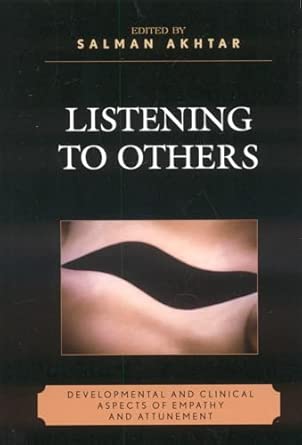
Listening to Others: Developmental and Clinical Aspects of Empathy and Attunement
Author(s): Salman Akhtar
- Publisher: Jason Aronson, Inc. (UK)
- Publication Date: 23 Feb. 2007
- Edition: 1st
- Language: English
- Print length: 112 pages
- ISBN-10: 0765705141
- ISBN-13: 9780765705143
Book Description
Editorial Reviews
Review
Listening to Others is a rare blend of clinical excellence, theoretical clarity, and contemporary relevance. From the tender dyad of the infant and mother to the delicacy and complexity of the analytic situation, readers will get a unique integration of the developmental perspective with current thinking about the "talking and listening cure." Not since Reik''s classic Listening with the Third Ear has such a volume been produced. -- Ira Brenner, M.D., Training and Supervising Analyst, Philadelphia Center of Psychoanalysis and Clinical Professor of Psychiatry, Jefferson Medical
the book is written at a very high level of scholarship and would be an extremely useful adjunct to courses in psychoanalysis and psychoanalytic therapy. It represents leading-edge, postmodern, contemporary thinking as applied to psychoanalytic psychotherapy and is an excellent contribution to the recent psychoanalytic literature.
a book that takes an in-depth look at listening...fresh insight about the role, function and dynamics of listening within the clinical encounter and presents some important ideas which will be of interest to all clinicians.
Salman Akhtar brings his psychoanalytic renaissance sensibilities and prodigious scholarship to the task of composing an inspired group of Margaret Mahler Symposium participants who represent the modern plurality of theories within our discipline. The subject is ''Listening'' ―surely a good thing to promote among all practicing therapists. ''Listening'' itself is not enough, of course, because one must learn from the patient''s talk, practice silence discriminately and try to use what one gleans to broaden one''s own and the patient''s understanding. The patient reciprocally learns to listen to the analyst in order to refute, discover authentic meanings and catalyze his or her surprising unique associations. We are in dialogue during treatments. The analysts in the text too are in dialogue with one another in their commentaries. This volume is replete with all the subtleties surrounding the act of listening, and contains the attitudes and examples of work from some of the best-known analysts of our era. The book will be a wonderful teaching aid. -- Rosemary H. Balsam M.D., associate clinical professor of psychiatry, Yale Medical School; training and supervising analyst, Western New England Institute


