 Wow! eBook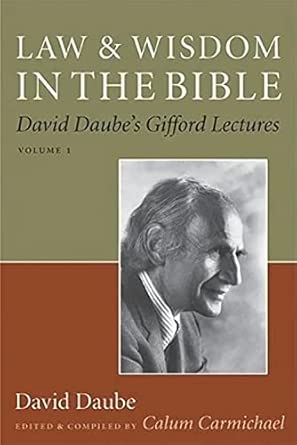
Law and Wisdom in the Bible: David Daube's Gifford Lectures, Volume II First Edition, 1 Edition
Author(s): David Daube (Author), Calum Carmichael
- Publisher: Templeton Foundation Press,U.S.
- Publication Date: 1 Mar. 2010
- Edition: First Edition, 1
- Language: English
- Print length: 248 pages
- ISBN-10: 9781599473451
- ISBN-13: 1599473453
Book Description
“That over forty years after they were delivered these famous but unavailable Gifford Lectures should be published is occasion for celebration. Once again we hear Daube’s voice, patient and probing, as he turns over, tests, pushes fresh inquiries, and finds new insights. No man has had such a subtle sense of scriptural texts matched by such a supple sense of the practices and peculiarities of human beings engaged in the legal process. Law and Wisdom in the Bible is classic Daube.” mdash;John T. Noonan Jr., United States Circuit Judge
David Daube (1909–99) was known for his unique and sophisticated research on Roman law, biblical law, Jewish Law, and medical ethics. In Law and Wisdom in the Bible, the first published collection of his 1964 Gifford Lectures, Daube derives from his complex understanding of biblical texts both ancient and contemporary notions about wisdom, justice, and education.
In addressing these and other profound issues, Daube crosses traditional disciplinary boundaries and bridges the
gap between humanism and religion, especially with regard to Christianity and Judaism. With his sophisticated understanding of Talmudic law and literature, his thinking, which is on full display in these lectures, revolutionized prevailing perceptions about the New Testament.
Editorial Reviews
About the Author
Excerpt. © Reprinted by permission. All rights reserved.
LAW AND WISDOM IN THE BIBLE
David Daube’s Gifford Lectures, Volume 2
By David Daube, Calum Carmichael
TEMPLETON PRESS
Copyright © 2010 Calum Carmichael
All rights reserved.
ISBN: 978-1-59947-345-1
Contents
Preface…………………………………………………………..viiAbbreviations……………………………………………………..xi1. THE FIFTH COMMANDMENT……………………………………………32. DEUTERONOMY…………………………………………………….263. REASONS FOR COMMANDMENTS…………………………………………564. JUSTICE IN THE NARRATIVES………………………………………..665. LEGAL INSTITUTIONS IN WISDOM BOOKS………………………………..856. THE WISE JUDGE………………………………………………….1057. REFORMS OF MACHINERY…………………………………………….1278. THE EXAMPLE OF THE SAGE………………………………………….1449. MYSTIFICATION AND DISCLOSURE……………………………………..16110. THE TORAH……………………………………………………..171Notes…………………………………………………………….181Index of Sources…………………………………………………..203
CHAPTER 1
THE FIFTH COMMANDMENT
I
To those who share Bumble’s view that “the law is an ass,” the title of thisseries will seem ill-chosen. Even they must admit, however, that, ideally, itwould not be a bad thing if law and wisdom did fraternize. In any case, itmay be worthwhile to explore the position in the Bible.
To do so, a preliminary remark on that oscillating term “wisdom” isneeded. Not as if “law” were unambiguous, but most readers will be morepuzzled by the different guises that the former notion will assume in thesechapters. Basically, “wisdom” means a more than ordinary understandingof the nature of things; it is partly a gift, partly the result of experience;and it confers on its possessor superiority in the mastery of life. Its variousmanifestations, however, can be confusing. There is “wisdom” in the senseof “shrewdness,” “cunning,” or even—descending further, if we look at itfrom the point of view of a higher morality—”ability to twist.” It is probablybecause of this lower variety that, in the Hebrew Old Testament, God isnever styled “wise.”
There is “wisdom” in the sense of “excellence in craftsmanship.” Wherethis sense prevails, law—like medicine, cult, prophecy, history, architecture,strategy—is a branch of wisdom, and especially law as a system of detailed,meti culous rules and machinery. Jethro’s advice to Moses in the book of Exodusfurnishes an illustration of wisdom taking charge of, and reforming,law or legal procedure. There is “wisdom” in the sense of “moderation,””restraint,” “give-and-take.” This wisdom may be antithetical to justice, thelatter tending toward radical, one-sided solutions; it favors arbitration andcompromise rather than the strict, legal verdict. There is “wisdom” in thesense of “life-and-death-dealing insight,” a power saving its possessor andthose it approves and destroying its enemies. The sects around New Testamenttimes are much concerned about this wisdom, but it occurs longbefore.
Further varieties exist. That most commonly in mind when Scripture isbeing discussed is no doubt “a grasp of the ways of God, men, and nature,””a comprehension of man’s position in society and the scheme of things,”and “the conduct to be adopted by a person of such understanding.” It isin view of their concentration in wisdom in this sense that certain books ofthe Bible—Job, Proverbs, Ecclesiastes, Ecclesiasticus, even the Psalms—havebeen clas sified as Wisdom, in contradistinction to Law, History, or Prophets.Naturally, much wisdom of this kind is contained in the other books; the figureof Joseph, for example, is largely that of a young sage—toward the endof this chapter we shall advert to a characteristic wise scheme of his—andrecently it has been shown that the book of Esther ought really to be transferredfrom History to Wisdom. On the other hand, wisdom literature isfull of legal, historical, and prophetic matter: the chapters in Ecclesiasticusopening “Let us now praise famous men” are history of a sort.
In the first two chapters, “wisdom” is used chiefly in the familiar sensejust noted. Hence when we speak of law and wisdom, we are thinking of thePentateuch on the one hand and Proverbs and the like on the other—of thePentateuch, with its specific authoritative musts; of Proverbs and the like,with their more general guidance and distillation of good sense for the leadingof a decent, successful life. Despite much overlapping, the two categoriesof rules do dominate different parts of Scripture and do in the main derivefrom different milieus. The relation between them has been investigated bya number of authorities. As a rule, however, it is the influence of law on wisdomto which attention is paid—and indeed, it forms the subject of chapter5. Here we shall say something about the influence of wisdom on law, whichis far greater than is commonly realized.
The Fifth Commandment (according to the numbering with which I grewup) commences with an imperative: “Honor thy father and thy mother thatthy days may be long on the earth which the Lord thy God giveth thee.” Inthe Deuteronomic version there are two brief additions, which we considerin due course. For the moment, what is of relevance is that, with one dubiousexception, this is the only legislative commandment in the Pentateuchto employ the imperative. Commentators slur over the difference from theSabbath Commandment, which begins with an infinitive: “To remember theSabbath day.” Thus Beer remarks on the latter: “Inf. abs. = Imprtv.” But theyare not equal. We indeed argue that the infinitive has a setting closer to theimperative than to the regular form of legislation, the so-called imperfect,”thou shalt do,” “he, ye, they shall do,” or the perfect with the waw consecutive,”and thou shalt do.” Nevertheless, let us be clear that (with one possibleexception) no other law in the Pentateuch is expressed by means of theimperative.
No doubt some laws are accompanied by stereotypical imperatives: “Guard(shemor) that which I command thee, guard thyself (hishshamer) lest thou makea covenant with the inhabitants of the land,” “guard thyself (hishshamer) andguard (shemor) thy soul lest thou forget,” “guard (shemor) and obey thesewords,” “guard thyself (hishshamer) in the plague of leprosy to guard and todo.” But these phrases are not legislative; they are cautionary. They merelyintroduce or close a law in order to inculcate the importance of observing it;but they do not, like “Honor thy father,” express its actual substance—not tomention the fact that, as we shall see, their ultimate provenance is essentiallythe same as that of the substantial imperative, “Honor.”
The Rabbis see in the proclamation of God after creating man, “Be fruitfuland multiply,” a command to marry and beget children. In its originalcon ception, however, this is a blessing: “And God blessed them, Be fruitfuland multiply.” Actually, the same blessing is pronounced over the fishes.Nor are the Rabbis fully in earnest in making a commandment of it: BenAzzai, one of the most distinguished, refused to comply.
There are, of course, numerous imperatives in orders for the individual,present occasion, as when God calls on Abraham, “Go from thy land,” oron Moses, “Speak to the children of Israel,” or when Judah decides to haveTamar put to death, “Bring her forth and she shall be burnt.” These orderscan be of a very comprehensive nature: Abraham is exhorted by God, “Walkbefore me and be perfect.” But this is still not a legislative commandment,addressed to the people at large and valid for future times as well as the present.It has reference exclusively to Abraham’s personal conduct. Here andthere, at first sight, an imperative may look like a law proper, but on closerinspection this turns out not to be the case. An invocation like “Hear”—”Hear,o Israel, the Lord our God is one Lord”—is always in the Pentateuchthought of as confined to the audience of the moment. Or take thepassage: “And now, write ye this song for you and teach it to the children ofIsrael, put it in their mouths, that this song may be a witness for me amongthe children of Israel.” The opening particle “and now” shows that what isbeing enjoined is not continuous transmission throughout the coming generations(as, for example, in the law “and these words which I command theethis day shall be in thine heart, and thou shalt teach them diligently unto thychildren, and thou shalt write them upon the post of thy house.”) What isbeing enjoined is one definite action only. God inspires Moses to a last songwhich he is to set down and pass on. This interpretation is confirmed by asubsequent verse which tells us that the order was executed: “And Moseswrote this song on that day and taught it the children of Israel.”
The only exception occurs earlier on in the same chapter: “At the end ofevery seven years,” says Moses to the priests and elders, “thou shalt read thislaw; gather thy people together that they may hear and learn.” This imperative”gather” does form part of a true legal provision. It is interesting that the portionfrom “gather” onward has been held to be interpolated on quite differentgrounds: it ought logically to come before the commandment to read thelaw. Be this as it may, the imperative may well have been put under the influenceof the “gather” by which Moses asks the priests to assemble the eldersfor his last song—obviously not legislation but a special order. Another passageseems to have contributed: at Horeb, God had said to Moses, “Gatherme the people together that I may let them hear these words that they maylearn.” Moses’ legislative injunction to gather the people every seven yearsis very close. At any rate, it can hardly be maintained that this one precariousparallel renders the Fifth Commandment unremarkable.
We are left, then, with this uniquely (or near uniquely) imperatival law.No doubt the reaction of many scholars will be to try and explain it away.It will be claimed, for instance, that kabbedh could and should be construedas an infinitive, “To honor thy father”—analogous to “To remember theSabbath day.” But, apart from the fact, already hinted at, that the infinitiveitself has a setting very different from “thou shalt do” and much nearer theimperative, this way out will not do. First, it is unfair, simply because I havenoticed the strange character of this commandment, to repudiate the wayeverybody has taken it without the least hesitation up to now. Second, thelegislative infinitive is extremely rare; so rare that, as we saw, Beer accountsfor “To remember” by equating the infinitive with the even rarer imperative,”Honor.” If we discount fixed, introductory phrases like “to remember” (zakhor),”to guard” (shamor), we meet the infinitive about half a dozen times. Itspresence should not be lightly assumed. Third, the law speaks not of “fatherand mother,” but of “thy father and thy mother.” While this is not incompatiblewith an infinitive, “To honor thy father,” it goes better with an imperative,the direct address: “Honor thy father and thy mother.” (The SabbathCommandment starts off impersonally: “To remember the Sabbath day, tokeep it holy.”) Above all, kabbedh recurs in Proverbs, “Honor the Lord withthy substance,” where it is paired off with betah, “Trust in the Lord,” and yera‘,”Fear the Lord”—unmistakable imperatives.
What are we to make of the situation? Two questions really need to beanswered. One: the Pentateuch is full of laws in the direct address, “thoushalt,” “ye shall.” Why is the imperative virtually unknown? As far as laws inthe third person are concerned, “he shall,” “they shall,” they could not, withouta major switch, use the imperative. But those in the direct address could.This question becomes only the more baffling if it is denied that the FifthCommandment commences with an imperative. Two: the imperative beingvirtually unknown, why does it nevertheless occur in the Fifth Commandment?This question remains even if it is considered that there are a fewmore imperatival laws. On any reckoning, they form the tiniest fraction.
As for the virtual absence of the imperative from the codes, one mightperhaps think of the following reason. A large proportion of the laws are prohibitions(alas!). As the Hebrew imperative cannot be negated, it is unsuitablefor these: “do not murder” or “murder not” must become “thou shalt notmurder,” in the imperfect. Accordingly, it might perhaps be thought, there isno scope for the imperative; we must not expect it in—prohibitive—legislation.But this cannot be the explanation. Side by side with the—admittedlyenormous—prohibitive legislation, there are in the Pentateuch very manypositive laws; yet none (but the Fifth Commandment) employs the imperative.”Thou shalt surely tithe thy produce year by year,” “Thou shalt surelyfurnish thy slave when thou releasest him”—no quirk of grammar wouldhave prevented “Tithe thy produce,” “Furnish thy slave.” (In fact, it looks asif the imperative were distinctly avoided. The formulation exemplified by thetwo laws just quoted is rather artificial. Apparently a law cannot be openedby a simple imperfect preceded by a supporting infinitive, literally “To tithethou shalt tithe.” The traditional rendering is by means of “surely”: “Thoushalt surely tithe.”) To give an instance of the verb at the end—”My Sabbathye shall guard and my sanctuaries ye shall fear.” Here, too, an imperativewould have been perfectly feasible. At the close of Ecclesiastes we findprecisely these two verbs following the object and in the imperative: “Godfear and his commandments guard.” The same applies to the perfect withwaw consecutive: “and ye shall offer a lamb,” “and ye shall count from themorrow of the Sabbath,” “and thou shalt love the Lord.” No grammaticalobstacle to an imperative. “Eat of my bread and drink of the wine I have mingled,”we are admonished in Proverbs, “forsake the foolish and live and goin the way of understanding.”
The solution lies in a different direction. Where it is a question of a generalrule (as opposed to an order on a specific occasion), in Hebrew, the imperative,”do so-and-so,” “fear God,” is far weaker than the imperfect or the perfectwith waw consecutive, “thou (and thou) shalt do so-and-so,” “thou (andthou) shalt fear the Lord.” It expresses counsel, recommendation, rather thana compelling law imposed from above. Hence, whereas, except for the FifthCommandment, the imperative plays no part in Pentateuchal legislation, itis a normal form in Wisdom literature. “Refrain thy foot from the path of thesinners,” “Put far from thee perverse lips,” “If thou hast become suretyfor thy neighbor, deliver thyself as a roe from the hunter,” “Go to the ant,thou sluggard” (I had myself called at 6 o’clock this morning), “Go [plural]in the way of understanding,” “Chasten thy son while there is hope,””Fear the Lord and depart from evil,” “Depart from evil and do good”—allthese rules are in the imperative. “My son, hear the instruction of thyfather” stands practically at the head of the directions given in Proverbs.It is plainly directions, educational advice—not legislation, inescapable,divinely ordained. This friendly, advisory nature of the imperative excludes itfrom the laws of the Pentateuch.
Yet it does figure in the Fifth Commandment. This commandment, weconclude, as transmitted in Exodus and Deuteronomy, descends from, hasits original setting in, wisdom. To avoid misunderstandings, let us add atonce, what will become clearer as we go on, that by this we mean neither thatit is necessarily later than the legislative portions of the Pentateuch nor thatit is less imbued with religious spirit. Ancient Oriental wisdom is very oldindeed, and there is no reason to suppose that the Hebrews did not fromearly on share in it and develop their own brand; the relatively late date ofsome or all of the Wisdom collections of the Old Testament in their presentshape is no evidence to the contrary. Again, it has long been seen that itis a mistake to look on wisdom as entirely this-worldly, making light of thewill and intentions of God. Certainly Hebrew wisdom is not of this type; anydoubter might profitably consult Zimmerli’s commentary on Ecclesiastes.
Our result, gained by looking at the form, is confirmed when we contemplatethe substance. Two points may be singled out. First, respect of thechild for the parent, the disciple for the master—I hardly daresay the studentfor the professor—is one of the most prominent themes—perhaps themost prominent one—in ancient Oriental and Old Testament wisdom. Inthe Egyptian teaching of Pta h-hotep we are told, “How beautiful when a sonhearkens to his father.” The sayings of Ahikar open, “Hear, o my son Nadan,and come to the understanding of my self, and be mindful of my words andthe words of God.” At the beginning of Proverbs we find the exhortationalready cited for the imperative: “My son, hear the instruction of thy fatherand forsake not the teaching of thy mother.” The list could be prolongedad libitum. Note also the address “my son,” constantly recurring in wisdominjunctions. The basic relationship of wisdom, between master and disciple,is identified with and expressed as that between father and son. Manifestly,the Fifth Commandment fits well into this background.
Second, a feature to which attention is drawn in the Epistle to the Ephesians:the Fifth Commandment promises a reward. This is typical of wisdom.Indeed, wisdom is keen on precisely this kind of reward: long lifeand—the addition in Deuteronomy—well-being. “He that is wise attainethto old age,” we are assured in a Babylonian book of bilingual proverbs.Above we quoted from Proverbs, “Honor the Lord with thy substance,” withthe same imperative, kabbedh, as the Fifth Commandment; it continues, “soshall thy barns be filled.” In Psalms we read: “What man is he that desirethlife, loveth days to see good? Keep thy tongue from evil, depart from evil anddo good, seek peace and pursue it.” That this section of the psalm at leastcomes from wisdom is clear not only from the form of the admonitions—allin the imperative—but also from the introduction in the preceding verse:”Come, ye children, hearken unto me, I will teach you the fear of the Lord.”
(Continues…)Excerpted from LAW AND WISDOM IN THE BIBLE by David Daube, Calum Carmichael. Copyright © 2010 Calum Carmichael. Excerpted by permission of TEMPLETON PRESS.
All rights reserved. No part of this excerpt may be reproduced or reprinted without permission in writing from the publisher.
Excerpts are provided by Dial-A-Book Inc. solely for the personal use of visitors to this web site.


