 Wow! eBook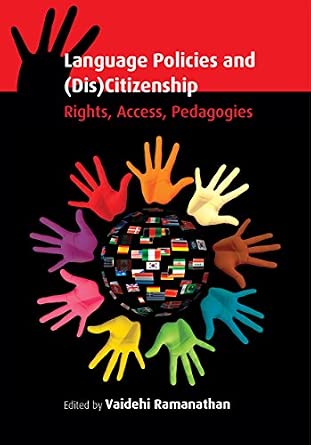
Language Policies and (DIS)citizenship: Rights, Access, Pedagogies
Author(s): Vaidehi Ramanathan (Author, Editor)
- Publisher: Multilingual Matters
- Publication Date: 7 Aug. 2013
- Language: English
- Print length: 312 pages
- ISBN-10: 1783090197
- ISBN-13: 9781783090198
Book Description
Editorial Reviews
Review
Citizenship has become the major bureaucratic mechanism extensively used nowadays to grant and deny basic human rights for education, residence and well being. Whether via language as a condition for reside or visas as the right of children to learn, citizenship has become the controlling device for everyday lives of million of disadvantaged people world wide. In this most stimulating book Professor Vaidehi Ramanathan, along with major distinguished and thoughtful authors, has created a brilliant critical text that documents and analyzes the phenomenon in a multiple range of settings world-wide focusing on ages, pedagogies, policies, languages, gender and access. –Elana Shohamy, Tel Aviv University, Israel
This is an exceptional and refreshing book which presents rigorous and significant research on language policy and citizenship. Authors develop a critical stance to illustrate how the vulnerable continue to be excluded from many institutions while simultaneously offering an uplifting account of how human agency, resistance and struggle can offer vital alternatives. It is relevant to a wide audience and should be compulsory reading for those in the social sciences, education and applied linguistics at both undergraduate and graduate level. –Angela Creese, University of Birmingham, UK
About the Author
Excerpt. © Reprinted by permission. All rights reserved.
Language Policies and (Dis)Citizenship
Rights, Access, Pedagogies
By Vaidehi Ramanathan
Multilingual Matters
Copyright © 2013 Vaidehi Ramanathan
All rights reserved.
ISBN: 978-1-78309-019-8
Contents
Acknowledgements, vii,
1 Language Policies and (Dis)Citizenship: Rights, Access, Pedagogies Vaidehi Ramanathan, 1,
Part 1: Citizenship: Reproducing, Challenging, Transforming Discourses and Ideologies,
2 Language, Gender and Citizenship: Re-framing Citizenship from a Gender Equality Perspective Busi Makoni, 19,
3 Problematizing the Construction of US Americans as Monolingual English Speakers Aya Matsuda and Chatwara Suwannamai Duran, 35,
4 Keywords in Refugee Accounts: Implications for Language Policies Emily Feuerherm, 52,
5 ‘The World Doesn’t End at the Corner of their Street’: Language Ideologies of Chilean English Teachers Julia Menard-Warwick, 73,
6 A Perfect Storm for Undocumented Latino Youth?: Multi-level Marketing, Discourses of Advancement and Language Policy Gemma Punti and Kendall A. King, 92,
7 Education Policy, Citizenship and Linguistic Sovereignty in Native America Teresa L. McCarty, 116,
Part 2: Education and Citizenship: Creating (and Constraining) Spaces for Language, Learning and Belonging,
8 Citizenship as Social, Spiritual and Multilingual Practice: Fostering Visions and Practices in the Nishkam Nursery Project Gopinder Kaur Sagoo, 145,
9 Re-imagining Citizenship: Views from the Classroom Jacqueline Widin and Keiko Yasukawa, 167,
10 Classroom Meanings and Enactments of US Citizenship: An Ethnographic Study Ariel Loring, 188,
11 (Dis)Citizenship or Opportunity? The Importance of Language Education Policy for Access and Full Participation of Emergent Bilinguals in the United States Kate Menken, 209,
12 English Learning without English Teachers? The Rights and Access of Rural Secondary Students in Nicaragua Rosemary Henze and Fabio Oliveira Coelho, 231,
Afterword Vaidehi Ramanathan, 253,
Appendix, 256,
Contributors, 281,
Index, 287,
CHAPTER 1
Language Policies and (Dis)Citizenship: Rights, Access, Pedagogies
Vaidehi Ramanathan
This volume brings together some leading female scholars writing in areas relating to language policies, globalization, citizenship and pedagogic practices. While each of these domains is well researched, only recently has scholarship begun to address them in relational terms, where implications of investigations in one domain spill into and have consequences for the others. My primary aim with bringing these scholars together under the covers of one book is to probe the borders of our collective understandings about ‘citizenship’. Seeking to go beyond viewing ‘citizenship’ in terms of the passport one holds or one’s immigration or visa status, the volume posits that this concept needs to be understood in terms of ‘being able to participate fully’. The fuller implications of this phrase, needless to say, depend on local conditions – policies, pedagogic engagements and borders – that do and do not create equitable conditions. In this sense, then, ‘citizenship’ needs to be understood in very much more than the usual teleological terms – where it is a goal to be attained (to ‘become’ a citizen or acquire citizenship) – to where it gets understood in terms of what it allows one to do, and where it is viewed as a process amidst tensions, fluid contexts and diverse meanings. Doing so means turning our gaze to where everyday instances of teaching practices, institutionalized discourses and rights awareness become more salient, and where our conjoined sense of civic citizenship gets attired differently. It also means becoming acutely alert to ongoing contexts of (dis)citizenship (Pothier & Devlin, 2006).
While applied linguistics has produced scholarship in citizenship testing and nations (McNamara & Roever, 2006; Shohamy & Kanza, 2009; Stroud, 2001; Stroud & Heugh, 2004; Wodak, 1998) and language policies (DeFina & King, 2011; Hornberger, 2008; Lane, 2009; McCarty, 2011; Menken, 2008; Ramanathan, 2005), the concept of ‘(dis)citizenship’ has tended to remain underexplored. The term itself raises a variety of questions: under what local conditions does ‘dis-citizenship’ happen? What roles do language policies and pedagogic practices play? What kinds of margins and borders keep humans from fully participating? Embedded in such questions are concerns about access and rights. With this in mind, it seems fitting to have this volume consist primarily of women scholars, since women, the world over, know ‘dis-citizenship’ or have strong historical understandings of what it means to not be able to participate fully. While the volume does not specifically address issues of gender, it draws on what the female gender across our planet collectively knows, and we bring this varied and complex understanding to how (dis)citizenship gets enacted, reproduced, questioned, and changed in our multivalent realms of engagements (see my Afterword in this volume for more details on gender and (dis)citizenship).
Searching for a More Inter-related Understanding of Citizenship
Passages from feudal, colonized subjects to modern, agentive citizens are the world over muddled and untidy passages, tense with unfinished conversations about rights and obligations, personal and public lives, individual autonomy and group identities. Our various cultures – institutional, local, national and international – promulgate these distinctions in very particular narratives, which tend to elicit only a narrow range of interpretations (Gee, 1990). These narratives are, and ought to be, open to contestation and retellings. How do we conceptualize our current transnational belongings in ways that go beyond paying lip service to calls for international treaties and global solidarity? The corporeal realities of extreme poverty, exclusions and repressions still remain. Our thinking seems to still be stuck at countering these distinctions on their terms.
My search for a path ahead, then, begins from this difficult, sometimes unpalatable benchmark, and seeks to move our cognitions to another plane so as to complicate our current understandings about citizenship. The world is full of so-called ‘undocumented’ people. They are the shadowy masses that we do not want to acknowledge, whose grievances we do not want to hear lest they counter our own narratives, whose existence on the peripheries of fuller participation are threatening to us because we are caught up with our stories of limited resources. If we allow ourselves to think of these ‘shadowy figures’ differently – where histories and languages are foregrounded – a very different picture of citizenship emerges. However, we would need to take a few early steps to re-cognize ourselves. As a start, first we would need to be open to the possibility of a more historicized understanding of our places in the world. We are, each of us, a point in history, with connections to our pasts and a look towards the future. Second, we would need to be open to what translation theory has to offer us about in-between spaces. We are always between languages and meanings. Third, we would have to take account of how language policies in the various realms of our existences serve to draw borders and exclude. At first glance, these might seem like most flimsy guides with which to address citizenship. Yes, you say, of course, we are products of the tellings and retellings of our national histories. Yes, we sometimes need to translate our speech to others who do not speak our tongues. Of course policies marginalize. What does this have to do with (dis)citizenship, globalization and language policies? Everything, I maintain.
Citizenship and globalization
If there is a metanarrative that thrives in applied linguistics today, it is ‘globalization’. Seldom do we attend a conference or turn to an article in an academic journal without encountering some attention to the term, cached as it is in a host of related topics, including ‘western imperialism’, ‘border dissolving’ and ‘interculturality’. In many respects, ‘globalization’ seems to have become the discursive support of identity politics, the conceptualization that underwrites discourses of cross-cultural encounters, tensions about outsourcing jobs or insensitivity to local cultures. As an imaginary appealing to intellectuals, ‘globalization’ is, in many ways, a direct out- growth of colonialism (especially the English language and Great Britain’s former Empire); it is also lodged in ‘nations’, ‘borders’, ‘migrations’ and ‘resettlements’, key words that are at once sacral and most ordinary.
Latent beneath these concepts is, of course, ‘citizenship’, a modernist term often used to refer to, among other things, belonging to a certain geographic space (Flemming & Morgan, 2011). The spatial nuances of the term are apparent when we consider phrases such as ‘the average citizen’ or ‘the tax-paying citizen’ or ‘citizenship test’, where connections to a specific territory on our planet become a way by which we both present ourselves and/or get read by others. But ‘citizenship’ in relation to ‘globalization’ calls for a deeper sociological, historical and philosophical inquiry into the ‘bordered’ character of social membership and the most local of concerns that inhibit fuller participation (Blackledge, 2005; Block, 2002; Blommaert, 2010; Chilton, 2004; Delanty et al., 2011; Ricento, 2006; van Dijk, 1997; Wodak, 2009; Wodak et al., 1998). Open to historicities, memories and postcolonial migrations, identities – our own and others’ – are always crossing borders (Vandrick, 2009). We only need to consider the travel involved in songs that go through phones from Bollywood to San Jose to Chicago to Tokyo and then on to London, Sydney and Dubai, mutating in each city, picking up splinters of each city’s insignia, coming back to us in forms that we instantly misrecognize and recognize. It is in these traversals that we confront the newer syntax of our lives, a syntax consisting of different languages, multiple language policies and the most diverse of learning experiences. These criss-crossings have translation flowing thickly through and between them (more on translations presently). What may be lost in the song as it travels from Mumbai to Sydney either linguistically or in terms of semantic moorings may open up other unanticipated venues. Two-way translations – a language-learning pedagogic practice common in many multilingual parts of our planet – may offer some insight here: there opens up a cultural and temporal space in which all of us are modified and ‘translated’, where mutations and reconfigurations of travelling songs echo back our strains even as they bring in new notes. Border crossings are all about this. The vulnerable at our borders change us as we change them. Citizenship, then, is processual and about becoming.
Citizenship and languages: Issues of translations and histories
Continuing with this point about translations, I turn now to addressing the relevance of translations to histories and thus to citizenship. If we consider the fact that it is through language that we proceed in the world and that we are each bearers of our respective histories in our everyday communications, then the interdependency of history and language becomes clearer. When we are with people whose languages and histories are different from our own, we are called on to ‘translate’ them. By this I do not just mean ‘translate them literally’, where we engage in literally translating their speech (although it does not discount this). I mean that we view them (and us) as translated texts, at once rhizomatic, uprooted and in-between (Ramanathan, 2006). As Benjamin (1968) points out, a translated text is forever ‘in between’; that is, a translated text resides in the gap between the language, culture and history that is translated and the language, culture and history that does the translating. When I translate written or spoken data from Gujarati or Hindi into English, I am uprooting them from their local moorings – geographic and social – and am bringing them into another language (English, say) and another culture. The processes involved are not seamless by any means (see Ramanathan (2006) for a detailed discussion) and go far beyond searching for linguistic equivalents or the ‘right’ approximate word. The processes belie the idea that translations may be transparent with languages reflecting each other in shared, transparent semantic mirrors. Indeed, they are uncertain terrains, with tensions that sometimes make crossovers highly anxiety-ridden (Maryns, 2005).
Take for example the following bits of data. Here are two pages from an English language textbook used in a 5th standard vernacular-medium class in Gujarat, India, where I am from (see Figure 1.1). I have been engaged for many years now on a project regarding English and the vernaculars in India and some of this work has entailed addressing issues relating to pedagogies in different mediums of education.
Several things occur to me as I look at this text and think about bringing it into the West, all of which touch on issues of translations, histories and globalization and policies. I did not use this in my book The English-Vernacular Divide (2005), and I ask myself why I omitted what seems to be a fairly innocuous text to select another (the one in the following section). Among other things, the gender implications in the presentation of the bangle stall (in the lines ‘That is a bangle stall. Who are those girls?’) bothered me. Bangles are not only a distinctive mark of femininity; they are also a mark of wedded life and sexuality in Hinduism (traditionally widows in North India do not generally wear bangles; or at least not those bangles that are typically associated with being married).
My discomfort with this aspect of my culture and my embarrassment at possible elaboration countered my discomfort as a feminist at the omission of the implications. It seemed safe to simply use another text. That is part of the story. The other part was the complexity of the task. If ‘effective translations’ mean also conveying implicit cultural information from the source landscape, then, do readers need to be filled in on some local associations around the children riding on an elephant’s back at the fair? While elephants may be an uncommon sight at a fair in the West, they are not unusual in India where decorated temple elephants occasionally come from house to house to collect donations, or may be used at fairs. Would my use of this text in my writing in the West necessitate my elaborating these pieces of information, and how much of it would be seen as exotica? Further, the use of iddlis (the name of a Tamilian item of food at the bottom of the page marked 55) calls for some explanation about the movement of people from state to state, but more from the south to the north than the other way around. I could see at once from the names of the authors of the book (Nityanandanam) that one of them was a Tamilian. Was the inclusion of iddlis a point of Tamilian assertion, or was it pointing to the undeniable fact that this food item has become pan-Indian over the last 20 years? Where was one to begin or stop? The net result was that this translated text now floats around in my consciousness, not putting down roots anywhere. Embarrassment and complex details that would thicken the description to the point of weariness played their role in selectivity and omission. I chose instead the text that follows, a choice that seemed better from one point of view, but one that now sets me thinking about domesticizing texts.
The Gujarati sections in the piece below, especially points 2, 3 and 4 (see Figure 1.2; on the page marked 20 at the bottom), direct students to:
first repeat after the teacher (where the teacher reads out the preceding sentences – That is a farm, That is a mango tree);
say these sentences aloud by themselves, singly or chorally;
read out vocabulary that the teacher writes on the board, copy this down, and draw animals corresponding to a dog and a cow.
In my previous work, I have drawn on this excerpt (Ramanathan, 2005) to argue against West-based English language teaching practices which have, by and large, critiqued pedagogic practices such as the above (choral recitation, grammar translation) as being generally ineffective because it promotes rote learning. What I did not uncover at the time is that I was making a deliberate choice of a text free(er) of the problems surrounding the other and using a text that could be more easily re-territorialized and domesticated.
These points are directly relevant to the points about histories, translations, globalization and citizenship (Ramanathan, 2011). Moving texts, like moving people (migrants, immigrants and visa-less people) are about de-terriotorializing and re-teritorrializing (and directly impact policies and are indeed impacted by them; more on this presently). What we read of people and what they read of us is partial and selective. Like texts, they are transplanted from their mileu to another, and like texts, written in other languages and emerging from diverse parts of our planet, bringing them into academic arguments in English in the West necessitates some elaboration along with the translation. And as I just pointed out, issues around elaboration are not nearly as straightforward as they may seem.
You are wondering, I’m sure, what all of this points to. What they point to, among other things, are our differences, our perceptions of differences and our language for them. All translations are a way of coming to terms with the foreignness of or differences between languages. Translations – translating ourselves to others and others back to ourselves – involve encounters with ‘alien’ tongues that in turn affect our language and history. A fuller sense of ‘dis-citizenship’, of what in our present contexts inhibits fuller participation can only emerge if we unabashedly usher in history into applied linguistics, and view each person speaking an ‘alien tongue’ as a historicized being, bringing to each encounter their individual connections to their pasts. Crucial here is the need to respect difference and its relevance. Identity, after all, is based on difference: I am who I am because I am not you. Casting it aside and saying it does not matter runs the risk of imposing homogeneity, a ‘one-ness,’ ‘a one size fits all’ orientation that can smack of imperialism. On the other hand, though, the language of difference can go too far and become divisive. It is this double-edged nature of difference that we need to now openly address in our debates about globalization. While ‘globalization’ with its messing up of firm borders is often roundly critiqued (especially by postcolonial scholars) for tending to erase history, it is also a phenomenon that alerts us, now more than ever, to be conscious of history. Translations, histories, and our language of difference, then, are imperative to consider in any and all contexts regarding (dis)citizenship.
(Continues…)Excerpted from Language Policies and (Dis)Citizenship by Vaidehi Ramanathan. Copyright © 2013 Vaidehi Ramanathan. Excerpted by permission of Multilingual Matters.
All rights reserved. No part of this excerpt may be reproduced or reprinted without permission in writing from the publisher.
Excerpts are provided by Dial-A-Book Inc. solely for the personal use of visitors to this web site.


