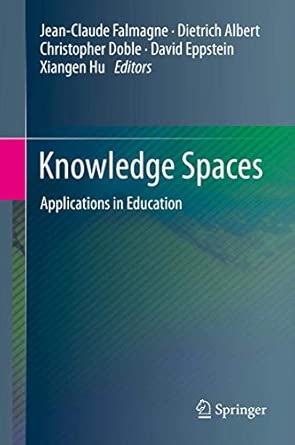
Knowledge Spaces: Applications in Education 2013th Edition
Author(s): Jean-Claude Falmagne (Editor), Dietrich Albert (Editor), Christopher Doble (Editor), David Eppstein (Editor), Xiangen Hu (Editor)
Publisher: Springer
Publication Date: 3 July 2013
Edition: 2013th
Language: English
Print length: 366 pages
ISBN-10: 9783642353284
ISBN-13: 9783642353284
Book Description
The book describes up-to-date applications and relevant theoretical results. These applications come from various places, but the most important one, numerically speaking, is the internet based educational system ALEKS. The ALEKS system is bilingual English-Spanish and covers all of mathematics, from third grade to the end of high school, and chemistry. It is also widely used in higher education because US students are often poorly prepared when they reach the university level. The chapter by Taagepera and Arasasingham deals with the application of knowledge spaces, independent of ALEKS, to the teaching of college chemistry. The four chapters by Albert and his collaborators strive to give cognitive interpretations to the combinatoric structures obtained and used by the ALEKS system. The contribution by Eppstein is technical and develops means of searching the knowledge structure efficiently.
Editorial Reviews
Review
From the reviews:
“The editors of this book have compiled a set of papers that provide insight into knowledge space theory and related practical deployment issues. … anyone involved in a learning discipline will find this book to be a helpful guide to the terms, issues, and theory development of knowledge spaces. I recommend it for researchers and practitioners willing to improve their understanding of current knowledge space theory and the possibilities for its deployment.” (F. J. Ruzic, Computing Reviews, November, 2013)
From the Back Cover
The book describes up-to-date applications and relevant theoretical results. These applications come from various places, but the most important one, numerically speaking, is the internet based educational system ALEKS. The ALEKS system is bilingual English-Spanish and covers all of mathematics, from third grade to the end of high school, and chemistry. It is also widely used in higher education because US students are often poorly prepared when they reach the university level. The chapter by Taagepera and Arasasingham deals with the application of knowledge spaces, independent of ALEKS, to the teaching of college chemistry. The four chapters by Albert and his collaborators strive to give cognitive interpretations to the combinatoric structures obtained and used by the ALEKS system. The contribution by Eppstein is technical and develops means of searching the knowledge structure efficiently.
About the Author
Dietrich Albert is an emeritus professor of Cognitive Psychology at the University of Graz and a senior scientist in Knowledge Management at the Graz University of Technology (Austria, Europe). His R&D interests cover several areas, including learning, memory, decision making, anxiety, knowledge and competences. Chris Doble is the Math Content Development Manager at ALEKS Corporation. Along with his focus on using technology in the teaching and learning of mathematics, he maintains academic interests and publishes in measurement theory and psychophysics. Jean-Claude Falmagne is an emeritus professor of Cognitive Sciences at the University of California, Irvine. His research interests focus on the application of mathematics to educational technology, psychophysics, choice theory, and philosophy of sciences, in particular measurement theory. David Eppstein is a professor of Computer Sciences at the University of California, Irvine. His research focuses on the design and analysis of algorithms, and especially graph algorithms and computational geometry. Xiangen Hu is a professor in the Department of Psychology at The University of Memphis. His research interests include General Processing Tree (GPT) models, categorical data analysis, knowledge representation, computerized tutoring, and advanced distributed learning.
 Wow! eBook