 Wow! eBook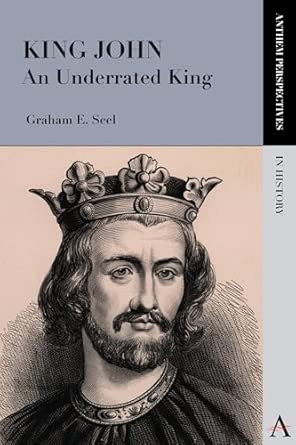
King John: An Underrated King
Author(s): Graham E. Seel (Author)
- Publisher: Anthem Press
- Publication Date: 1 Aug. 2012
- Language: English
- Print length: 244 pages
- ISBN-10: 0857285181
- ISBN-13: 9780857285188
Book Description
Through contextual analysis and by reassessing the chronicle evidence, ‘King John: An Underrated King’ presents a compelling reevaluation of the reign of King John, England’s most maligned sovereign. With its thought-provoking analysis of the key issues of John’s reign, such as the loss of the French territories, British achievement, Magna Carta, relations with the church, and civil war, the volume presents an engaging argument for rehabilitating King John’s reputation. Each chapter features both narrative and contextual analysis, and is prefaced by a timeline outlining the key events of the period. The volume also contains an array of maps and diagrams, as well as a collection of useful study questions.
Editorial Reviews
Review
‘“King John: An Underrated King” is, without a doubt, an excellent introduction to political, social and religious aspects of twelfth and thirteenth century England. The author draws a clear portrait of king John without losing his readers in a labyrinth of family dramas and shifting alliances.” —Geneviève Pigeon, ‘Hortulus: The Online Graduate Journal of Medieval Studies’
Review
‘This is an outstanding new account of King John and his reign: it is very readable and accessible, and it convincingly challenges the traditional, negative view of John. Instead, John emerges as an accomplished and effective ruler who was dogged by ill luck rather than an evil personality. Graham Seel’s book is thoroughly researched and beautifully written: it represents an important addition to the literature on this troubled period.’ —Dr David Smith, Selwyn College, University of Cambridge
About the Author
Graham E. Seel studied history at the University of St Andrews, 1982–1986. From there he proceeded to Cambridge University where he undertook a PGCE, for which he was awarded a Distinction. He has published widely on English history, and he is currently Head of History at St Paul’s School, London.
Excerpt. © Reprinted by permission. All rights reserved.
King John
An Underrated King
By Graham E. Seel
Wimbledon Publishing Company
Copyright © 2012 Graham Seel
All rights reserved.
ISBN: 978-0-85728-518-8
Contents
Acknowledgements,
List of Figures,
Chapter 1: Outline of the Reign,
Chapter 2: John In The Shadows, 1167-1199,
Chapter 3: An ‘Imperial’ Inheritance?,
Chapter 4: War of Succession and the Loss of Continental Territories, 1199–1204,
Chapter 5: Efforts To Regain The French Territories, 1205–1214,
Chapter 6: The British Perspective: Scotland, Ireland and Wales, 1199–1214,
Chapter 7: Sacerdotium and Regnum, 1199–1214,
Chapter 8: Administration, Justice and Finance,
Chapter 9: Civil War: A False Start,1215,
Chapter 10: Civil War Renewed,1215–1216,
Chapter 11: Conclusion: Will The Real King John Please Stand Up?,
Appendix,
Bibliography,
Further Reading,
Questions,
CHAPTER 1
OUTLINE OF THE REIGN
A) An Outline of the Reign of King John, 1199–1216
Foul as it is, Hell itself is defouled by the foulness of John.
— Matthew Paris, Chronica Majora, composed 1235–59
Born in Oxford on Christmas Eve in 1167, John was the youngest son of Henry II and Eleanor of Aquitaine. With three significantly older brothers, John’s prospects of becoming king were remote (see Figure 1, page 2). Indeed, for a time it seemed he would be denied any meaningful inheritance, thereby earning the epithet John Lackland. Nonetheless, chance events meant that gradually the path to the Crown became shorter and straighter: John’s eldest brother Henry died in 1183, followed by Geoffrey in 1186; then, upon the demise of his remaining brother, Richard the Lionheart in 1199, John became king.
John’s inheritance as king was substantial. His father and Richard had governed not only England, but also Normandy and, in addition – though sometimes in name more than in reality – territory covering in total roughly one third of the area of modern France, from Poitou in the north to Gascony in the south. Some historians have referred to this cross-Channel dominion as the Angevin ’empire’ (see Figure 2, page 3; and page 27).
John’s reign had a number of phases, each shaped and defined in particular by foreign policy. The initial phase can be perceived as existing from 1199 to 1203, years in which John fought to secure his inheritance. Arthur, son of Geoffrey and his wife Constance of Brittany, contested John’s claim to the Angevin ’empire’. Born in 1187 and designated by Richard in the Treaty of Messina in 1191 as heir to all the Angevin lands, ‘Arthur was one of the many kings England almost but never had’. Having gained the backing of the French king, Philip Augustus, Arthur put himself at the head of a rebellion directed against the claims of his uncle. He disappears from the pages of history in 1203, some chroniclers asserting that John killed him with his bare hands. A second phase can be delineated from 1203 to 1204, the period in which Normandy and other substantial Angevin territories were lost. Unable successfully to relieve important castles, above all Chateau-Gaillard in Normandy, John returned to England. A third phase covers the years from 1205 to 1214, a period in which John, now residing in England, sought to regain the lost territories. Several proposed expeditions (1205, 1212 and 1213) were aborted, significantly because of baronial recalcitrance, though an expedition of 1206 enjoyed some success. The final military campaign set forth in 1214. This met with defeat at the Battle of Bouvines in July of that year. The failure of reconquest led directly to the final phase of John’s reign, 1215 to 1216. These last years were characterized by civil war and French invasion. John’s plans to regain the lost territories had necessitated the implementation of a fiscally harsh regime in England, the objection to which is articulated loud and clear in Magna Carta. Having lost control of London in 1215 to the rebel barons, John was obliged to accept their demands in the form of Magna Carta, to which royal assent was given in the field at Runnymede in 1215. However, the extreme nature of some of the terms of Magna Carta meant that John gained sufficient support to restart civil war, during which the rebel barons invited Prince Louis, the son of Philip Augustus, to rule in place of John. It was during this stage of the war that John died of natural causes in 1216. His nine-year-old son Henry, who ruled as Henry III until his death in 1272, succeeded him.
A key feature of John’s reign was his often fraught relationship with the church. The origin of what was to become a bitter and protracted struggle lay in the question of who was to succeed Hubert Walter, archbishop of Canterbury. Walter’s death in 1205 made available the most important church office in England, to which John was determined that his nominee, John de Gray, should accede instead of the candidate sponsored by the papacy, Stephen Langton. The stalemate that ensued became progressively acrimonious, with Pope Innocent III pronouncing an interdict in 1208 and then proceeding to excommunicate the king in the following year. John finally submitted to Innocent in 1213.
B) A Maligned King
By the early thirteenth century, literacy existed almost exclusively amongst members of the church, the clergy. Some of these men produced chronicles. The production of chronicles – a record or register of events under the years in which they happened – had by this time become part of the routine business of some religious houses. The authors of these chronicles recorded a mixture of local and national affairs, frequently including important documents in their accounts. John’s relations with the clergy were antagonistic from an early stage in his reign, his demands for money creating a difficult relationship with the Cistercians (see Appendix, Documents 4 and 16). Tensions mounted when the papacy pronounced an interdict (1208) and excommunication (1209) (see Chapter 7). Thus, chronicle material is naturally predisposed to be antagonistic to John. It is where his alleged ill-repute is most loudly articulated.
There are few strictly contemporary chroniclers of John. Among the most important for the early years of John are Richard of Devizes, who ended his chronicle in 1192, and William of Newburgh who ceased writing and died in 1198. Roger of Howden and Ralph of Diceto end their chronicles in 1201 and 1202 respectively. These writers provide evidence that John’s reputation was suffering even before he became king. William of Newburgh, for example, commenting upon John’s treachery towards his brother whilst Richard was absent on crusade, concluded that John was ‘Nature’s Enemy’. Richard of Devizes also presented John as intent upon seizing the throne from Richard I and attributed to him a fearsome temper (see Appendix, Documents 1, 3, 4, 10, 16, 18 and 24). Among the most significant authorities writing while John was king were Ralph of Coggeshall (d. 1218), Gervase of Canterbury (d. 1210) and Gerald of Wales (d. 1223). Until about 1203 Ralph evinces a reasonably balanced opinion of John, but thereafter accuses him, amongst other things, of indecisiveness, duplicity and cowardice – on seeing Louis’ army in 1216, Ralph says that John ‘fled in terror, weeping and lamenting’. Gervase agrees with these judgements, ultimately awarding John the famous epithet of ‘Softsword’. Gerald of Wales believed that John was a ‘tyrannous whelp, who issued from the most bloody tyrants and was the most tyrannous of them all’ (see Appendix, Document 3).
The relative dearth of strictly contemporary chronicles has encouraged historians to rely upon writers who recorded what they knew of John after his death. Of these, The History of William the Marshal is of particular note because it is penned by a secular authority, an unknown poet called John. This biography of William the Marshal, Earl of Pembroke and Striguil, (1146?–1219) emphasizes the chivalric values of its subject, ‘England’s greatest knight’ and a key figure throughout the reign of John and beyond. Assuming the form of 19,214 lines in rhyming couplets, it was composed between 1225 and 1226 and provides the historian with incidental criticisms of King John. In her summary of The History, A. Gransden tells us that ‘the author says that John was blinded by pride and already in 1202 had lost the support of the barons who were disgusted by his cruelty to prisoners. He regards him as faithless, unwarlike and unwise, and gives instances of his meanness, nasty temper and suspicious nature. He remarks that he acted on his own, without taking counsel, and kept the barons at a distance.’ In contrast to the author of The History, the Barnwell chronicler, perhaps writing shortly after the reign, has provided by far the most fair and balanced account of John. Although ultimately judging John as ‘a robber of his people’, the Barnwell chronicler also believed that John was ‘indeed a great prince, but rather an unhappy one, and, like Marius, experienced both good and bad fortune’. However, the measured assessment of the Barnwell chronicler has been out-gunned by the voluminous chronicle material produced by monks at St Albans Abbey, notably by Roger of Wendover and Matthew Paris.
Some ten years after John’s death in 1216, Wendover began his account of the reign. Across the pages of Wendover’s main work, Flowers of History, strides Bad King John – the king who, for example, ordered the crushing to death of Archdeacon Geoffrey under a cope of lead (see Appendix, Document 13); who threatened to slit the noses and to pluck out the eyes of papal emissionaries (see Appendix, Document 10); who lost Normandy because he was enjoying the pleasures of his teenage wife (see Appendix, Document 8). In short, here is John as cowardly, cruel, lecherous, tyrannical, duplicitous and irreligious. When Wendover died in 1235, Paris succeeded him in his role as historiographer, not only continuing the chronicle from 1235 but also reworking Wendover’s account. Frequently writing with a style and flourish that had eluded Wendover, including readily inserting speeches into the mouths of historical figures who had hitherto remained silent, ‘the portrait of King John that emerges is … even further removed from reality than that in Wendover, but it is eminently more readable’. Despite enjoying something of a rehabilitation in the sixteenth century, when Tudor historians sought to portray John’s defiance of the papacy as a sort of dry run for Henry VIII, the improved royal reputation proved short lived. Too vivid to forget, it is the John as portrayed by Wendover and Paris that has entered national consciousness.
For historians writing in the nineteenth century, even if some doubts about the accuracy of Wendover and Paris remained, they were brushed aside. After all, it remained the case that many of those who authored a chronicle were likely to have been well informed about events of national importance. For example, Gerald of Wales accompanied John on his expedition to Ireland in 1185; Roger of Wendover and Matthew Paris were monks in the St Albans Abbey and therefore, residing on a key artery into London, their abbot was likely to have hosted the great and the good from whom Wendover and Paris will have learned much. Scholars working in the nineteenth century, alongside their ongoing reliance upon a revived and reworked Wendover and Paris, articulated views on John that seem to have been conditioned by the suffocating morality espoused by the Victorians. Thus, for the great historian of the day, William Stubbs, John had no redeeming features whatsoever: the king ‘was a mean reproduction of all the vices and of the few pettinesses of his family … [a king for whom] we have no word of pity as we have had none of sympathy’ (see Appendix, Document 36). In a book first published in 1874 and which went on to become a long-term best seller, finding itself carried to the loneliest places of the Empire, J. R. Green concluded that ‘John was the worst outcome of the Angevins’ (see Appendix, Document 37).
This nineteenth-century representation of John, standing firmly on the shoulders of the chroniclers, continued to manifest itself in the twentieth century. Kate Norgate, in her biography of John published in 1902, referred to the king’s ‘almost superhuman wickedness’; and Sir James Ramsey, writing in 1903, considered John ‘a selfish cruel tyrant of the worst type’. In his book called The Plantagenets published in 1948, John Harvey described thus the tomb effigy of John in Worcester Cathedral: ‘The face has a sly wolfish cast, with slanting eyes faintly amused at the righteousness of better men, and a sensual mouth slightly drawn into the doglike grin distinctive of the cynic born.’
The image of King John as an evil tyrant has been perpetuated in twentieth-century popular culture also, such as Marriott Edgar’s rhyme Magna Carta and A. A. Milne’s poem King John’s Christmas, in which nearly every verse begins with the refrain ‘King John was not a good man.’ The 1968 film The Lion in Winter, starring Peter O’Toole as Henry II and Katherine Hepburn as Eleanor of Aquitaine, won three Oscars. In the words of one reviewer, it portrays John as ‘a rumpled, drooling, inane man-child impossibly spoiled as the King’s favorite, played to pathetic amusement by a terrific Nigel Terry’. Meanwhile, scores of Robin Hood films produced over the course of the past one hundred years have frequently presented John either as the principal villain or an effeminate coward, the latter tendency assuming an extreme form in Disney’s 1973 animated film in which the king is portrayed as a thumb-sucking lion. In the 1990s Channel 4 made a series of documentaries called The Most Evil Men in History in which John took his place alongside the likes of Attila the Hun, Vlad the Impaler and Adolf Hitler. John found himself once again rubbing shoulders with history’s most evil men and women in Simon Sebag Montefiore’s book entitled Monsters, produced in 2008. In June 2010 the BBC History Magazine carried on its front cover the headline ‘Bad King John – how he saved England from a French invasion … by dying’.
The vilification of John thus not only has deep roots but also has grown vigorously. Nonetheless, the systematic and extensive maligning of John has induced a reaction, encouraging representations of John as able but flawed. For instance, C. Warren Hollister, echoing the Barnwell chronicler, concluded his research by proclaiming that ‘despite a certain amount of rehabilitation on the part of recent historians, John remains a curiously twisted and enigmatic figure, a man who possessed great talents in certain areas but was afflicted with fatal shortcomings in others’. W. L. Warren, in his biography first published in 1961, argued that John ‘had the mental abilities of a great king but the inclinations of a petty tyrant’. John’s most recent biographer, R. V. Turner, concluded that the king ‘appears not as a monster of superhuman evil, but merely as a twisted and complex personality, yet a man with ability and potential for greatness whose own flaws prevented him from living up to the reputations of his brother, Richard I, or his rival, Philip Augustus’.
These more positive interpretations of John have been obtained in three main ways. First, those researching into John have applied a more critical approach to the contemporary and near-contemporary source material and thereby, in effect, catching up with the vicious representations of John that ‘have gone echoing down the long corridors of History’. Of course, historians have always been cognizant of the fact that John’s antagonistic relationship with the church resulted in prejudiced comment in chronicle sources, but it would not be going too far to say that some recent work has been newly critical. V. H. Galbraith spearheaded this approach in an important lecture given in 1944. He told his listeners that ‘there can be little doubt that the picture [Wendover] gives us of John is already something of a legend [i.e. unreal]. For if we look closely – and I don’t think historians have – we shall find that the picture he gives us is a very savage one, so savage as to be suspect.’ In the same lecture Galbraith also observed that whereas ‘Wendover gives us an impossible shadow, Paris converts it into a living portrait – though the portrait is not one of John … I conclude that Paris’ additions to Wendover for this reign are not merely worthless, but very misleading.’ Similarly, to those making use of The History of William the Marshal, D. Crouch reminds us that ‘we must treat it carefully. Apart from its obvious bias towards its subject [who had a number of protracted arguments with John], it is written in a literary tradition that must have distorted its truth.’ Facilitating this more critical approach to the sources, historians have also become better aware of the fact that the start of John’s reign appears to be the moment from which the secretariat of government – Chancery – begins to keep a systematic record of its business, thus providing an administrative footprint of John’s governance (see Chapter 8). This so-called record evidence suggests that John was a dedicated and energetic ruler and, since these documents were attested by John, they have allowed historians to create an itinerary showing the king’s movements throughout his reign (see Appendix, Document 35). From this material it is ‘almost impossible to doubt that the king was actually present at the place where he expressly states himself to have been on a particular day’, throwing into question the veracity of some chronicle material which asserts that John was elsewhere (see Chapter 8). This is the broad context in which V. H. Galbraith judges the whole of Wendover’s Flowers of History to be ‘full of errors and inaccuracies’ and in which Warren laments that ‘it is a pity that [Wendover’s] blooms turn out to be artificial’. Second, some historians – controversially – have tried to rehabilitate John by viewing his actions against the backcloth of their own time. Thus, R. V. Turner notes that when John is viewed from the perspective of the twentieth century, ‘compared to Hitler, Stalin or Pol Pot, he seems quite tame’. Similarly, J. T. Appelby cautions that ‘we in these present days have seen such depths of human depravity that we cannot consider [John] as the unrelieved villain that he once appeared to be. It is faint praise to say that he was not so bad as he might have been, yet when we consider what men with absolute power have done in later days we are forced almost to admire John’s restraint.’ Such methodology is perhaps questionable and can, of course, produce the opposite outcome – after all, as seen in the writing of Stubbs, John’s reputation does not benefit when measured against nineteenth century morality. Arguably, however, a robust rehabilitation is achieved when John’s actions are evaluated against the context and expectations of his own day (for instance, see Chapters 4 and 6 for a discussion of the morality of John’s second marriage and his habit of taking hostages; and see Chapter 9 for an assessment of how John’s reputation has suffered because of the inappropriate totemic status achieved by Magna Carta of 1215). More broadly still, John’s reputation benefits from an appreciation of the fact that his reign coincided with what most historians agree were two peculiarly resilient and clever adversaries in the form of Philip Augustus and Innocent III, and from a sense amongst some historians that popular estimates of the reign of Richard I are overblown. Third, judgements about John’s achievement become more positive once the nature of his inheritance has been evaluated. Some economic historians, for example, have pointed out that John’s reign coincided with ‘an especially rapid, substantial and, as far as we can tell, fairly general rise in prices’, a development which justified many of John’s money-raising expedients described in Chapter 8. Other historians have suggested that there were structural forces at work which meant that the Angevin ’empire’ – the cross-Channel territories inherited by John in 1199 shown in Figure 2 – was on the point of collapse in 1199 (see Chapter 3). Echoing the opinion of the Barnwell chronicler, who regarded the loss of Normandy as an inevitable necessity, W. L. Warren, asserts that ‘It is difficult to see how John could have averted disaster.’
(Continues…)Excerpted from King John by Graham E. Seel. Copyright © 2012 Graham Seel. Excerpted by permission of Wimbledon Publishing Company.
All rights reserved. No part of this excerpt may be reproduced or reprinted without permission in writing from the publisher.
Excerpts are provided by Dial-A-Book Inc. solely for the personal use of visitors to this web site.


