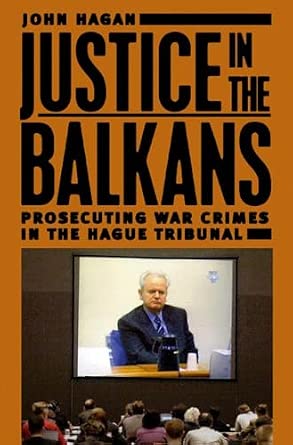
Justice in the Balkans
Prosecuting War Crimes in the Hague TribunalBy John Hagan
University of Chicago Press
Copyright © 2003 John Hagan
All right reserved.
ISBN: 0226312283
CHAPTER ONE - From Nuremberg
Collectively, Louise Arbour remarked as chief prosecutor at The Hague, were linked to Nuremberg. We mention its name every single day. It was characteristic of the Canadian Arbour to begin a public statement about the tribunal with a reference to a shared experience. Robert Jackson was the charismatic U.S. Supreme Court justice who prosecuted the Nazi leadership at Nuremberg. His efforts to stay the hand of vengeance helped make Nuremberg the lasting in?uence Arbour described. Yet Jackson also shared prevailing prejudices of his day, and he notes in his oral history that I had a great deal of argument and dif?culty about the staff, particularly with Jewish people. This bias coincided with an insulartendency in Jacksons leadership.
Jackson reasoned that having too many Jewish lawyers at the Nuremberg trial would undermine its objectivity. He acknowledged that we had a good many Jewish persons on the staff and that some of them did excellent work. He rationalized, however, that most of them felt . . . they ought to do theirwork in the background and not be put forward into places of great prominence in order to avoid the impression that it was a Jewish enterprise. This kind of attitude made Jack-sons leadership appear more singular than collective in character.
Jacksons views are the more striking today given that Louise Arbour in part was selected as prosecutor at The Hague because her gender was thought to be an asset in responding to rape as a war crime. In any case, a result of Jacksons attitude is an underappreciation of the roles played by others at Nuremberg who contributed to the collective creation of his charismatic image. Among the lesser-known Jewish contributors are the former Harvard University law professor Sheldon Glueck and his student Ben Ferencz. Glueck was the prescient author of War Criminals: Their Prosecution and Punishment, and Ferencz assisted Glueck as a law student before going off to war and later becoming a Nuremberg prosecutor. Their experiences are instructive with regard to international legal activism and its early development at Nuremberg.
FROM WAR TO WAR CRIMES
Fresh out of law school, Ferencz arrived on the beaches of Normandy immediately after D-Day. The Germans had retreated and he at ?rst was perched on a hill, manning a machine gun to guard against attack from the rear. This may have been the last time Ferencz looked back in a lifelong struggle for international criminal justice that has stretched from Nuremberg into the new millennium. I pulled Ferencz away from his computer late one evening. After updating me on his schedule, he lamented, My wife says I have no time to live. I say I have no time to die.
Ferencz served under General Patton. If the Germans had counterattacked, we had relatively little way of repelling them, but they didnt, so off we went. They chased the retreating Germans across France, Luxembourg, Belgium, and then Germany.
Back at Harvard, in the winter of 1944, Sheldon Glueck got a call from Washington asking him to suggest someone to work in a new war crimes program that preceded the Nuremberg trials. Promises were being made to do something about the execution of downed Allied ?yers. Jewish victims of the Holocaust were still of less urgent concern. Glueck recommended Ferencz, and he was transferred to a new Judge Advocate section, where a colonel informed him, Weve been instructed to set up a war crimes branch and your name has been forwarded to us as a man who knows about this. The colonel knew nothing about war crimes, and Ferenczs ?rst job was to brief him. I swear to you, Ferencz recalls, thats exactly how the war crimes program started in the United States Army.
Ferencz knew the topic from his work on Gluecks book. I had read everything that had been written about war crimes . . . and my job was to make summaries. Perhaps more signi?cant, however, Ferencz also had read reports Glueck received about what had happened to the Jews in Poland beginning in 1939. We knew that the Jews were being rounded up and sent to camps where they were being exterminated. Now he would observe the results at ?rst hand.
The new unit had ?ve colonels, and Ferencz was the only enlisted man. None of the others were lawyers. Soon one Private Nowitz arrived, covered in mud from building a bridge but bringing the encouraging news that he was a Yale law graduate. Latera few other enlisted men with law degrees, never more than a half dozen in total, joined Ferencz and Nowitz. As Ferencz put it, we were the war crimes team. Ferencz and Nowitz were the nucleus of a nascent investigation and eventual trial team whose form is still today recognizable as the dominant organizational nexus of war crimes work at the Hague tribunal.
The work was grim enough at ?rst when it involved ?nding bodies of downed Allied ?yers. Then they began to encounter the concentration camps. Buchenwald was the ?rst, but they soon were moving through a horrifying succession of camps. A report would come into headquarters that a tank division was approaching or had just overrun an area and had come upon people who looked very strange, they were wearing pajamas, all looking like skeletons. Ferencz or Nowitz would jump into a jeep and join the unit going into the camp. They soon learned that to be most effective, two things are required before all others: the evidence and the perpetrators. The best chance of getting both was to be on the scene as quickly as possible. This was the importance of real-time war crimes investigation, a priority in Louise Arbours later efforts at the Hague tribunal.
The scenes Ferencz encountered in the German concentration camps have been with him ever since. The memories come in a torrent: Well, Im sure that everybody by this time has seen the photographs of what the camp looked like and bodies lying in the dust, naked, a little item of clothing on, many of them not moving, some of them stirring, mostly bones; human beings, men weighing 50, 60 pounds. . . . And then, of course, the piles in front of the crematoria, stacked up like cordwood, and on the carts that were dragging them to the crematoria, these open carts just loaded with bodies, hands and arms hanging out on the sides. Ferencz found that one defense against these horrendous images was to concentrate on the legal requirements of his job.
Conditions in the camps were chaotic. The American soldiers as well as the inmates would often vent their emotions by destroying everything, including those who ran the camps and their records. It was bedlam, chaos everywhere, everything was destroyed, the inmates would go crazy, they would catch the guards and kill them, beat them up, burn them alive. Ive seen all that, and so you have to move very fast . . . as soon as I got the evidence that I thought I needed I got out of the camp. From there it was on to the next camp. We were moving fast . . . from one to the next, Abenzie and Muthausen and a whole string of camps. Ferencz noted that it usually took two to three days to get the material they needed.
In his movement through the camps, Ferencz also met up with Russian soldiers who wondered why he bothered with evidence. They asked incredulously, Whats the matter with you Americansare you crazy? You know what they did, why do you ask them what they did? Youre crazy! Kill em. Kill...
 Wow! eBook