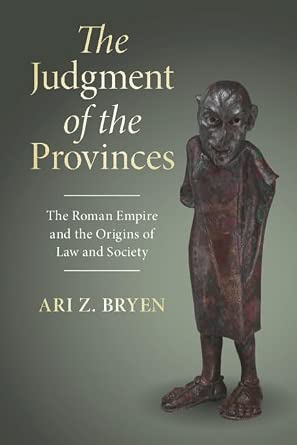
The Judgment of the Provinces: The Roman Empire and the Origins of Law and Society
Author(s): Ari Z. Bryen (Author)
Publisher: Cambridge University Press
Publication Date: April 9 2026
Language: English
Print length: 450 pages
ISBN-10: 1009730371
ISBN-13: 9781009730372
Book Description
Roman law is justly famous, but what was its relationship to governing an empire? In this book, Ari Z. Bryen argues that law, as the learned practice that we know today, emerged from the challenge of governing a diverse and fractious set of imperial subjects. Through analysis of these subjects’ political and legal ideologies, Bryen reveals how law became the central topic of political contest in the Roman Empire. Law offered a means of testing legitimacy and evaluating government, as well as a language for asking fundamental political questions. But these political claims did not go unchallenged. Elites resisted them, and jurists, in collaboration with emperors, reimagined law as a system that excluded the voices of the governed. The result was to separate, for the first time, ‘law’ from ‘society’ more broadly, and to define law as a primarily literate and learned practice, rather than the stuff of everyday life.
Editorial Reviews
Review
‘This is an extraordinary book. It combines a keen sense of what specific kinds of texts can reveal about the milieux in which they were produced with a remarkable narrative of law and society. Bryen describes a society in which law served as a field of negotiation over belonging, place, and justice, and narrates its transformation into a world of rules. This is achieved via a stunning control of the sources for ancient history writ large. I recommend it to all.’ Clifford Ando, University of Chicago
‘The Judgement of the Provinces offers a rich and sophisticated account of how the interactions between Rome and the provinces helped shape Roman law. Bryen makes an important contribution not only to Roman history but also to the sociology of law.’ Adriaan Lanni, Touroff-Glueck Professor of Law, Harvard Law School
‘A brilliant account of the slowly changing place of law in Roman imperial society, from a lively and contested space of the imagination, in which all subjects could participate, to a closed system of juristic expertise and state power.’ Carlos F. Noreña, University of California, Berkeley
‘A masterful contribution on a topic of fundamental importance in Western history. Bryen paints an astonishingly vivid portrait of the law in ordinary Roman lives in the first centuries of the Empire, then shows how post-classical Roman law assumed the form in which we know it today: a law made by lawyers.’ James Whitman, Yale Law School
Book Description
A new study of ancient legal politics that asks us to re-think the history of law and society.
About the Author
Ari Z. Bryen is Associate Professor in the Department of History and the Department of Classical and Mediterranean Studies at Vanderbilt University. He is the author of Violence in Roman Egypt: A Study in Legal Interpretation (2013).
 Wow! eBook