This masterful and wide-ranging exploration of an ‘ordinary’ city in the postsocialist world – an area which has been largely overlooked by theorists of modernity and postmodernity – brings important and unexpected insights into the nature of contemporary urbanism and the postmodern cultural condition more generally. Timely, interesting and extremely engaging, the book also stands out for its skilful and seamless integration of a wealth of detailed observation with a strongly theoretical approach.
―Ekaterina Makarova, University of Virginia
Drawing from deep personal insight as well as 100 interviews, Hirt describes a shift from “bland to brass,” sheds light upon privatism as a cultural condition, and reveals prospects for rejuvenating the public realm in the global context. This compelling and passionate account about why the post-wall world is so busy building walls fills a gaping hole in the literature on urbanism.
―Nan Ellin, University of Utah
From the Inside Flap
The fall of state socialism in Eastern Europe and the Soviet Union was arguably the most significant political event of the late 20th century. For many, this dramatic historic shift was symbolized by the tearing down of the Berlin Wall, an iconic emblem of fear and division. Yet only twenty years later, many new walls—both physical and imaginary—have been erected across Eastern Europe, including redrawn state borders, partitioned cities, and myriad walled-off urban spaces.
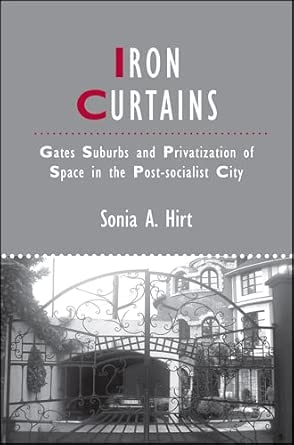
Iron Curtains: Gates, Suburbs, and Privatization of Space in the Post-socialist City explores the human dimension of new city-building that has emerged in East Europe. Utilizing firsthand research culled from more than 100 interviews conducted primarily in the Bulgarian capital of Sofia—a city whose public spaces have unraveled over the last two decades—Sonia Hirt examines the ways people live and experience the new, post-socialist urbanism. Also addressed are what these new spaces tell us about their builders, users, and inhabitants. Embracing an explicitly cultural approach, the author suggests that disappointment with socialist and post-socialist conditions has led to mass skepticism toward the public domain, further resulting in a radical de-construction of public spaces. Iron Curtains offers provocative insights into the complex relationship between society and space during times of fundamental change.
From the Back Cover
The fall of state socialism in Eastern Europe and the Soviet Union was arguably the most significant political event of the late 20th century. For many, this dramatic historic shift was symbolized by the tearing down of the Berlin Wall, an iconic emblem of fear and division. Yet only twenty years later, many new walls―both physical and imaginary―have been erected across Eastern Europe, including redrawn state borders, partitioned cities, and myriad walled-off urban spaces.
Iron Curtains: Gates, Suburbs, and Privatization of Space in the Post-socialist City explores the human dimension of new city-building that has emerged in East Europe. Utilizing firsthand research culled from more than 100 interviews conducted primarily in the Bulgarian capital of Sofia―a city whose public spaces have unraveled over the last two decades―Sonia Hirt examines the ways people live and experience the new, post-socialist urbanism. Also addressed are what these new spaces tell us about their builders, users, and inhabitants. Embracing an explicitly cultural approach, the author suggests that disappointment with socialist and post-socialist conditions has led to mass skepticism toward the public domain, further resulting in a radical de-construction of public spaces. Iron Curtains offers provocative insights into the complex relationship between society and space during times of fundamental change.
About the Author
Sonia Hirt is Associate Professor of Urban Affairs and Planning at the School of Public and International Affairs and the College of Architecture and Urban Studies at Virginia Tech, and was recently Visiting Associate Professor of Urban Planning at the Graduate School of Design at Harvard University. Hirt is the author of over 40 publications on urban forms, planning and design and is co-author of Twenty Years of Transition: The Evolution of Urban Planning in Eastern Europe and the Former Soviet Union, 1989-2009 (2009; with Kiril Stanilov).
 Wow! eBook