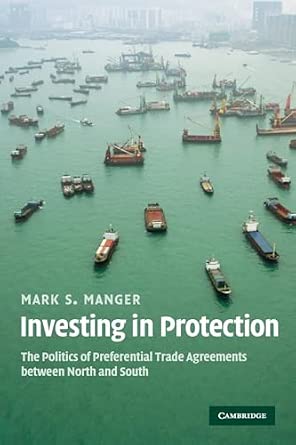
Investing in Protection: The Politics of Preferential Trade Agreements between North and South
Author(s): Mark S. Manger (Author)
Publisher: Cambridge University Press
Publication Date: 3 Sept. 2009
Language: English
Print length: 284 pages
ISBN-10: 0521748704
ISBN-13: 9780521748704
Book Description
Since the early 1990s the world has seen an explosion of preferential trade agreements (PTAs) between North and South. Mark Manger argues that current North-South PTAs are not primarily about liberalizing exports as is usually assumed. Rather, they are driven by the needs of foreign direct investment. The interests of multinational firms in investing in developing countries converge with the desires of the host countries to attract foreign capital. Yet to be politically feasible in the developed country, North-South PTAs must discriminate against third countries. PTAs thus create a competitive dynamic between countries, as excluded firms lobby their governments to restore access to important investment locations, leading to yet more preferential agreements. Based on extensive research in Europe, Japan, and the Americas and interviews with decision-makers in governments and the private sector, this book offers a new perspective on the roles of the state and corporations in international trade.
Editorial Reviews
Review
‘Manger skilfully illuminates how foreign direct investment and services – two critical dimensions of globalization greatly neglected in the political economy literature to date – have driven the profusion of preferential trading arrangements. His detailed case studies persuasively demonstrate how North-South preferential arrangements raise new barriers to cross-regional trade and investment, sidelining the cause of further trade liberalization in the World Trade Organization.’ Kerry A. Chase, Brandeis University
‘Mark Manger presents an intriguing analysis of the proliferation of preferential trade agreements (PTAs) between rich and poor nations. He argues that an important source of such PTAs is the role of multinational corporations from the developed world who see the agreements as a way of getting privileged access to attractive investments in the developing nations. His argument is clear and convincing, and the examples used to illustrate it – drawn largely from the United States, Japan, and countries in Latin America – are most illuminating. Investing in Protection will be valuable to scholars and students of international trade generally, and of trade relations between developed and developing nations in particular.’ Jeff Frieden, Harvard University
‘Mark Manger has gotten a jump-start with this compelling analysis of the numerous preferential trade agreements that have been negotiated between developed and developing countries since the setting of this benchmark by the North American Free Trade Agreement launched in 1994. Manger does not shy away from asking today’s big questions: what is the impetus for these PTAs from both sides of the negotiating table? Are they trade-creating or trade-diverting? What effect are they having on trade negotiations in the multilateral arena? This book will be the key academic reference on this subject, as well as a rich resource for legislators and policymakers who seek to negotiate such agreements.’ Carol Wise, University of Southern California
‘Investing in Protection … is an excellent piece of scholarship, as it deftly provides unique macro-level theoretical insights and supports them with illustrative micro-level case analysis. … Manger’s book will be of great interest to those scholars who wish to further their understanding of the negotiating dynamics of North-South PTAs specifically, or the proliferation of these types of PTAs more generally. Given the well known findings on the impact of PTAs on reducing conflict, promoting democracy, and increasing trade, improving our understanding of the dynamics that lead to their creation becomes all the more important. With Investing in Protection, I believe Mark Manger has done just that.’ Scott J. Cook, Review of International Organizations
‘Mark Manger has added a high-quality, original contribution to this literature and one with clear policy relevance.’ John Odell, University of Southern California
Book Description
Offers a new perspective on the roles of the state and multilateral corporations in changing patterns of international trade.
About the Author
Mark S. Manger is Lecturer in the Department of International Relations at the London School of Economics. His work has been published in the Review of International Political Economy and World Development.
 Wow! eBook