 Wow! eBook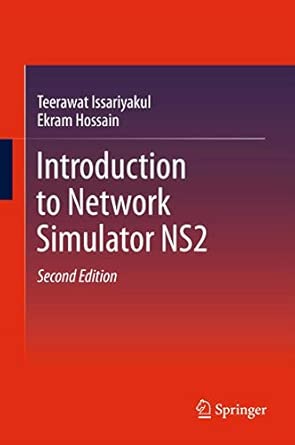
Introduction to Network Simulator NS2 Second Edition 2012 Edition
Author(s): Teerawat Issariyakul (Author), Ekram Hossain (Author)
- Publisher: Springer
- Publication Date: 2 Dec. 2011
- Edition: Second Edition 2012
- Language: English
- Print length: 536 pages
- ISBN-10: 1461414059
- ISBN-13: 9781461414056
Book Description
Editorial Reviews
Review
From the reviews of the second edition:
“This book on ns-2 can be used as a reference by researchers, as well as by undergraduate and postgraduate students. It will be useful for courses related to computer networks. … It has added exercises at the end of the chapters that are meant to be used for assignments, lab exercises, and exam questions. … I recommend this book for all those who are using ns-2 or plan to use it in the future. It will serve as a useful reference.” (S. V. Nagaraj, ACM Computing Reviews, January, 2013)
“The book is designed to be a primer for the network simulator NS2. … This textbook is written for researchers who need to use NS2 for simulation-based communication network performance evaluation. It can also be used as a reference for laboratory work for a senior undergraduate or graduate course on telecommunication networks.” (IEEE Control Systems Magazine, June, 2012)
From the Back Cover
Spurred by a dearth of information on NS2 during their graduate studies, the authors have written this primer on the open-source simulation software to help subsequent generations of students grapple with the program and its uses. NS2, an event-driven simulation program designed specifically for researching computer networks, was conceived in 1989 and has been enhanced ever since. It now includes modules for network functions such as routing, transport layer protocol and applications. Yet basic NS2 tutorials do not cover the skills researchers must master to build additional modules adapted to their research needs.
With most event-driven network simulation tasks now requiring extra configuration, this publication is a welcome learning aid for anyone who needs to go beyond the basics. It provides all the information required to install NS2, run simple examples, modify existing NS2 modules, and to create as well as incorporate new modules into the software. To help researchers grasp the fundamentals, the authors provide comprehensive explanations of several built-in NS2 modules. The book is a boon to those using this powerful investigative tool.


