“Recommended. Lower-and upper-division undergraduates, two-year technical program students, and general readers.” (Choice, 1 March 2011)
“Overall then, I applaud this attempt to produce a slightly different and distinctive introduction to a major area of modern chemistry.” (Reviews, December 2010)
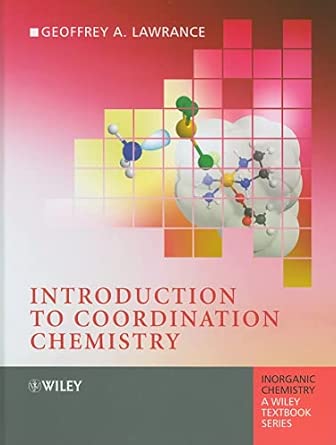
At the heart of coordination chemistry lies the coordinate bond, in its simplest sense arising from donation of a pair of electrons from a donor atom to an empty orbital on a central metalloid or metal. Metals overwhelmingly exist as their cations, but these are rarely met ‘naked’ – they are clothed in an array of other atoms, molecules or ions that involve coordinate covalent bonds (hence the name coordination compounds). These metal ion complexes are ubiquitous in nature, and are central to an array of natural and synthetic reactions.
Written in a highly readable, descriptive and accessible style Introduction to Coordination Chemistry describes properties of coordination compounds such as colour, magnetism and reactivity as well as the logic in their assembly and nomenclature. It is illustrated with many examples of the importance of coordination chemistry in real life, and includes extensive references and a bibliography.
Introduction to Coordination Chemistry is a comprehensive and insightful discussion of one of the primary fields of study in Inorganic Chemistry for both undergraduate and non-specialist readers.
From the Back Cover
At the heart of coordination chemistry lies the coordinate bond, in its simplest sense arising from donation of a pair of electrons from a donor atom to an empty orbital on a central metalloid or metal. Metals overwhelmingly exist as their cations, but these are rarely met ‘naked’ – they are clothed in an array of other atoms, molecules or ions that involve coordinate covalent bonds (hence the name coordination compounds). These metal ion complexes are ubiquitous in nature, and are central to an array of natural and synthetic reactions.
Written in a highly readable, descriptive and accessible style Introduction to Coordination Chemistry describes properties of coordination compounds such as colour, magnetism and reactivity as well as the logic in their assembly and nomenclature. It is illustrated with many examples of the importance of coordination chemistry in real life, and includes extensive references and a bibliography.
Introduction to Coordination Chemistry is a comprehensive and insightful discussion of one of the primary fields of study in Inorganic Chemistry for both undergraduate and non-specialist readers.
About the Author
Professor Geoffrey Lawrance; Professor of Chemistry and Assistant Dean Research (Science & IT), The University of Newcastle, Australia
Professor Lawrance is the author or co-author of over 290 journal articles, review articles and book chapters in a career spanning three decades. He has contributed chapters to Encyclopaedia of Inorganic Chemistry II (Wiley, 2005), and Comprehensive Coordination Chemistry II (Elsevier, 2004).
 Wow! eBook