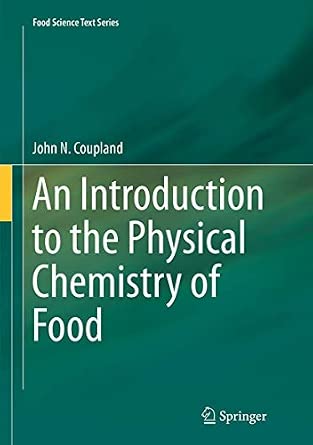
An Introduction to the Physical Chemistry of Food Softcover reprint of the original 1st ed. 2014 Edition
Author(s): John N. Coupland (Author)
Publisher: Springer
Publication Date: 3 Sept. 2016
Edition: Softcover reprint of the original 1st ed. 2014
Language: English
Print length: 195 pages
ISBN-10: 1493938738
ISBN-13: 9781493938735
Book Description
Familiar combinations of ingredients and processing make the structures that give food its properties. For example in ice cream, the emulsifiers and proteins stabilize partly crystalline milk fat as an emulsion, freezing (crystallization) of some of the water gives the product its hardness and polysaccharide stabilizers keep it smooth. Why different recipes work as they do is largely governed by the rules of physical chemistry.
This textbook introduces the physical chemistry essential to understanding the behavior of foods. Starting with the simplest model of molecules attracting and repelling one another while being moved by the randomizing effect of heat, the laws of thermodynamics are used to derive important properties of foods such as flavor binding and water activity. Most foods contain multiple phases and the same molecular model is used to understand phase diagrams, phase separation and the properties of surfaces. The remaining chapters focus on the formation and properties of specific structures in foods – crystals, polymers, dispersions and gels.
Only a basic understanding of food science is needed, and no mathematics or chemistry beyond the introductory college courses is required. At all stages, examples from the primary literature are used to illustrate the text and to highlight the practical applications of physical chemistry in food science.
Editorial Reviews
Review
From the book reviews:
“This reviewer … gained more practical knowledge here than from any other science book he has read. As Coupland presents information relating thermodynamic properties to molecular behavior, he includes very insightful examples, all food-related. They make the topic come alive and more relevant to the real world than other science texts. … This very enjoyable, informative work is also useful for anyone with an interest or background in physical chemistry. Summing Up: Highly recommended. Upper-division undergraduates and above.” (J. Allison, Choice, Vol. 52 (6), February, 2015)
From the Back Cover
Familiar combinations of ingredients and processing make the structures that give food its properties. For example, in ice cream the emulsifiers and proteins stabilize partly crystalline milk fat as an emulsion, freezing (crystallization) of some of the water gives the product its hardness, and polysaccharide stabilizers keep it smooth. Why different recipes work as they do is largely governed by the rules of physical chemistry.
This textbook introduces the physical chemistry essential to understanding the behavior of foods. Starting with the simplest model of molecules attracting and repelling one another while being moved by the randomizing effect of heat, the laws of thermodynamics are used to derive important properties of foods such as flavor binding and water activity. Most foods contain multiple phases, and the same molecular model is used to understand phase diagrams, phase separation, and the properties of surfaces. The remaining chapters focus on the formation and properties of specific structures in foods – crystals, polymers, dispersions and gels.
Only a basic understanding of food science is needed, and no mathematics or chemistry beyond the introductory college courses is required. At all stages, examples from the primary literature are used to illustrate the text and to highlight the practical applications of physical chemistry in food science.
John Coupland is a Professor of Food Science at Penn State where he teaches food chemistry and the physical chemistry of foods. His research is largely focused on food colloids.
About the Author
John Coupland is a Professor of Food Science at Penn State where he teaches food chemistry and the physical chemistry of foods. His research is largely focused on food colloids.
 Wow! eBook