Wow! eBook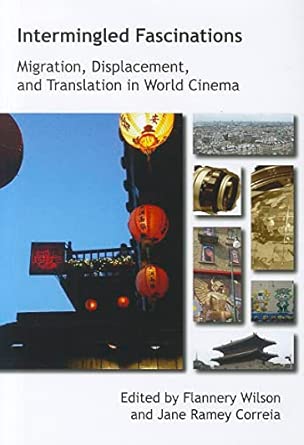
Intermingled Fascinations: Migration, Displacement and Translation in World Cinema
Author(s): Jane Ramey Correia (Author, Editor), Flannery Wilson (Author, Editor)
- Publisher: Cambridge Scholars Publishing
- Publication Date: 13 Jun. 2011
- Edition: 1st
- Language: English
- Print length: 160 pages
- ISBN-10: 1443829544
- ISBN-13: 9781443829540
Book Description
This collection of essays seeks to expand and refine the study of Sinophone and Franco-Japanese transnational cinema. Chapter by chapter, each author writes about two or three transnational films (and the characters within those films) that highlight issues related to migration, exile, and imprisonment. The essays are connected by themes of displacement, liminality, and (mis)communication. Overall, this anthology seeks to demonstrate that in-depth cinematic analysis is key to understanding filmic representations of diasporic and displaced communities in modern Mainland China and Japan.
Editorial Reviews
About the Author
Flannery Wilson teaches French, Italian, and Film Studies and she is learning Mandarin. Among other pieces, she has published an article on Wong Kar-wai and Deleuze in Modern Chinese Literature and Culture. She is interested in the cinematic connections between France, Italy and greater China. She currently lives in Upland, California with her husband, dog and cat. Jane Ramey Correia teaches French, literature, and film. Her research interests include Japanese and French 19th and 20th century literature, spatial theory, liminality, and film. In the spring of 2010 she won the Barricelli Memorial Grant for her paper entitled “The Architecture of Homelessness: Space, Marginality, and Exile in Modern French and Japanese Literature.” She currently resides in Venice, California with her husband and their two cats. Wilson and Correia met in 2005 while they were graduate students in the Comparative Literature and Foreign Languages department at the University of California, Riverside.
Excerpt. © Reprinted by permission. All rights reserved.
INTRODUCTION
FLANNERY WILSON AND JANE RAMEY CORREIA
Shih Shu-mei’s book Visuality and Identity: Sinophone Articulations Across the Pacific is a monumental achievement. Throughout the course of the book, Shih succeeds not only in defining the term “Sinophone”– she creates an entirely new concept that she deems the “Sinophone”. Of course, she does not (nor could she be expected to) resist providing a careful definition of the term, as a means of introducing her readers to the notion of the Sinophone so that we will be able follow her later arguments. She broadly defines the Sinophone, therefore, as: “a network of places of cultural production outside China and on the margins of China and Chineseness, where a historical process of heterogenizing and localizing of continental Chinese culture has been taking place for several centuries” (2007, 4). For Shih, the term denotes heteroglossia; Sinitic languages are by their very nature heterogeneous and resist easy classification. One might also compare the Sinophone to other similar concepts such as the Francophone, the Anglophone, or the Hispanophone in that it denotes a certain precarious and potentially problematic connection to the “mother- country,” yet at the same time, the term is inextricably linked to the “mother-country” by its very nature.
The most interesting aspect of Shih’s conception of Sinophone studies is that she is clearly opposed to (what she views as) the essentializing and constrictive practice of linking these studies to “Chinese culture”. Because Sinophone visual practices (films, artwork, etc.) must be situated both locally and globally, Shih argues that the distribution and reception of these visual art forms are carried out in a global capitalist context. This global capitalist context consists, in turn, of a multitude of different identity-types, which Shih lists.1 She sketches out these various types of identities so that the ones that she deems useful to her study of Sinophone visual practices can be analyzed. Again, what Shih does not find useful to her study, are any analyses of these visual practices that would seek to definitively link Chinese culture to the Chinese diaspora. To labelsomeone as “Chinese,” argues Shih, means to define that person based on how closely he or she fits into the mould of Han identity, which would be utterly restrictive.
Shih does not, however, argue for some sort of unrealistically relativistic definition of the Sinophone. The Sinophone, she says, should be thought of residually; this notion should be centered on certain immigrant communities throughout the world, as well as on other locations outside Mainland China such as Taiwan, Singapore, and British- ruled Hong Kong. Because the field of Sinophone studies transforms according to immigrant living conditions, and is associated with certain places, Shih calls for a spatially and temporally specific modus operandi. As a “collective” of responsible scholars in the midst of a developing field, she asks that we utilize Sinophone studies as a means to shatter the myth of Chineseness as a symbolic totality.
And yet we remain slightly resistant to and uncomfortable with the term “Sinophone” as coined by Shu-mei Shih. If we take the Sinophone to be defined as: “a network of places of cultural production outside China and on the margins of China and Chineseness…” (2007, 4, my emphasis), then Shih is correct in her assertion that the Sinophone is always an inexact copy of “Chineseness” as defined and predetermined by those on the Chinese Mainland (i.e. of Han decent, Mandarin-speaking, etc.). Yet by willfully excluding Mainland China in her definition of the Sinophone2, Shih reaffirms the dichotomy of dominance/minority resistance from which she seeks to break free. By painting China as the dominant empire that must be destabilized by the outlying Chinese diaspora, she manages not only to separate outlying communities further from the mainland, but also, paradoxically, to reinforce their connection to it. If we are to assume that the world is now “borderless” (2007, 6), why create a needless border between China proper and the marginalized diasporic communities?
FLANNERY WILSON AND JANE RAMEY CORREIA
Shih Shu-mei’s book Visuality and Identity: Sinophone Articulations Across the Pacific is a monumental achievement. Throughout the course of the book, Shih succeeds not only in defining the term “Sinophone”– she creates an entirely new concept that she deems the “Sinophone”. Of course, she does not (nor could she be expected to) resist providing a careful definition of the term, as a means of introducing her readers to the notion of the Sinophone so that we will be able follow her later arguments. She broadly defines the Sinophone, therefore, as: “a network of places of cultural production outside China and on the margins of China and Chineseness, where a historical process of heterogenizing and localizing of continental Chinese culture has been taking place for several centuries” (2007, 4). For Shih, the term denotes heteroglossia; Sinitic languages are by their very nature heterogeneous and resist easy classification. One might also compare the Sinophone to other similar concepts such as the Francophone, the Anglophone, or the Hispanophone in that it denotes a certain precarious and potentially problematic connection to the “mother- country,” yet at the same time, the term is inextricably linked to the “mother-country” by its very nature.
The most interesting aspect of Shih’s conception of Sinophone studies is that she is clearly opposed to (what she views as) the essentializing and constrictive practice of linking these studies to “Chinese culture”. Because Sinophone visual practices (films, artwork, etc.) must be situated both locally and globally, Shih argues that the distribution and reception of these visual art forms are carried out in a global capitalist context. This global capitalist context consists, in turn, of a multitude of different identity-types, which Shih lists.1 She sketches out these various types of identities so that the ones that she deems useful to her study of Sinophone visual practices can be analyzed. Again, what Shih does not find useful to her study, are any analyses of these visual practices that would seek to definitively link Chinese culture to the Chinese diaspora. To labelsomeone as “Chinese,” argues Shih, means to define that person based on how closely he or she fits into the mould of Han identity, which would be utterly restrictive.
Shih does not, however, argue for some sort of unrealistically relativistic definition of the Sinophone. The Sinophone, she says, should be thought of residually; this notion should be centered on certain immigrant communities throughout the world, as well as on other locations outside Mainland China such as Taiwan, Singapore, and British- ruled Hong Kong. Because the field of Sinophone studies transforms according to immigrant living conditions, and is associated with certain places, Shih calls for a spatially and temporally specific modus operandi. As a “collective” of responsible scholars in the midst of a developing field, she asks that we utilize Sinophone studies as a means to shatter the myth of Chineseness as a symbolic totality.
And yet we remain slightly resistant to and uncomfortable with the term “Sinophone” as coined by Shu-mei Shih. If we take the Sinophone to be defined as: “a network of places of cultural production outside China and on the margins of China and Chineseness…” (2007, 4, my emphasis), then Shih is correct in her assertion that the Sinophone is always an inexact copy of “Chineseness” as defined and predetermined by those on the Chinese Mainland (i.e. of Han decent, Mandarin-speaking, etc.). Yet by willfully excluding Mainland China in her definition of the Sinophone2, Shih reaffirms the dichotomy of dominance/minority resistance from which she seeks to break free. By painting China as the dominant empire that must be destabilized by the outlying Chinese diaspora, she manages not only to separate outlying communities further from the mainland, but also, paradoxically, to reinforce their connection to it. If we are to assume that the world is now “borderless” (2007, 6), why create a needless border between China proper and the marginalized diasporic communities?