 Wow! eBook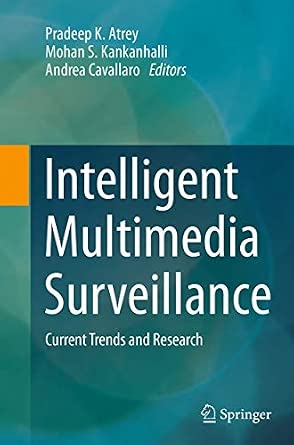
Intelligent Multimedia Surveillance: Current Trends and Research Softcover reprint of the original 1st ed. 2013 Edition
Author(s): Pradeep K. Atrey (Editor), Mohan S. Kankanhalli (Editor), Andrea Cavallaro (Editor)
- Publisher: Springer-Verlag Berlin and Heidelberg GmbH & Co. K
- Publication Date: 23 August 2016
- Edition: Softcover reprint of the original 1st ed. 2013
- Language: English
- Print length: 192 pages
- ISBN-10: 3662514532
- ISBN-13: 9783662514535
Book Description
Intelligent multimedia surveillance concerns the analysis of multiple sensing inputs including video and audio streams, radio-frequency identification (RFID), and depth data. These data are processed for the automated detection and tracking of people, vehicles, and other objects. The goal is to locate moving targets, to understand their behavior, and to detect suspicious or abnormal activities for crime prevention. Despite its benefits, there is societal apprehension regarding the use of such technology, so an important challenge in this research area is to balance public safety and privacy.
This edited book presents recent findings in the field of intelligent multimedia surveillance emerging from disciplines such as multimedia computing, computer vision, and artificial intelligence. It consists of nine chapters addressing intelligent video surveillance, video analysis of crowds, privacy issues in intelligent multimedia surveillance, RFID technology for localization of objects, object tracking using visual saliency information, estimating multiresolution depth using active stereo vision, and performance evaluation for video surveillance systems.
The book will be of value to researchers and practitioners working on related problems in security, multimedia, and artificial intelligence.
Editorial Reviews
From the Back Cover
Intelligent multimedia surveillance concerns the analysis of multiple sensing inputs including video and audio streams, radio-frequency identification (RFID), and depth data. These data are processed for the automated detection and tracking of people, vehicles, and other objects. The goal is to locate moving targets, to understand their behavior, and to detect suspicious or abnormal activities for crime prevention. Despite its benefits, there is societal apprehension regarding the use of such technology, so an important challenge in this research area is to balance public safety and privacy.
This edited book presents recent findings in the field of intelligent multimedia surveillance emerging from disciplines such as multimedia computing, computer vision, and artificial intelligence. It consists of nine chapters addressing intelligent video surveillance, video analysis of crowds, privacy issues in intelligent multimedia surveillance, RFID technology for localization of objects, object tracking using visual saliency information, estimating multiresolution depth using active stereo vision, and performance evaluation for video surveillance systems.
The book will be of value to researchers and practitioners working on related problems in security, multimedia, and artificial intelligence.


