 Wow! eBook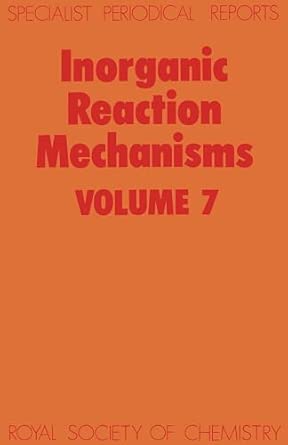
Inorganic Reaction Mechanisms: Volume 7
Author(s): A G Sykes
- Publisher: Royal Society of Chemistry
- Publication Date: 1 Jan. 1981
- Language: English
- Print length: 463 pages
- ISBN-10: 0851863159
- ISBN-13: 9780851863153
Book Description
Reflecting the growing volume of published work in this field, researchers will find this book an invaluable source of information on current methods and applications.
Editorial Reviews
Excerpt. © Reprinted by permission. All rights reserved.
Inorganic Reaction Mechanisms Volume 7
A Review of the Literature Published Between January 1978 and June 1979
By A. G. Sykes
The Royal Society of Chemistry
Copyright © 1981 The Royal Society of Chemistry
All rights reserved.
ISBN: 978-0-85186-315-3
Contents
Part I Redox Reactions By G. V. Buxton, R. D. Cannon, and A. McAuley,
Chapter 1 Electron Transfer Reactions By R. D. Cannon, 3,
Chapter 2 Metal Complexes with Inorganic (Main Group) Substrates By A. McAuley, 61,
Chapter 3 Metal Complexes with Organic Substrates By A. McAuley, 80,
Chapter 4 Reactions between Two Non-metallic Compounds By A. McAuley, 101,
Chapter 5 Pulse Radiolysis Studies By G. V. Buxton, 106,
Part II Substitution Reactions By J. Burgess, A. J. Deeming, L. I. Elding, P. Moore, and G. Stedman,
Introduction By P. Moore, 127,
Chapter 1 Substitution Reactions of Linear Complexes By L. I. Elding, 131,
Chapter 2 Substitution Reactions of Square-planar Complexes By L. I. Elding, 133,
Chapter 3 Substitution Reactions of Tetrahedral Complexes By L. I. Elding, 157,
Chapter 4 Substitution Reactions of Five-co-ordinate Complexes By L I. Elding, 159,
Chapter 5 Octrahedral Substitution: Aquation (and Solvolysis) By J. Burgess (Oxidation State II) and P. Moore (Oxidation States III–VI), 163,
Chapter 6 Octahedral Substitution: Base Hydrolysis By P. Moore, 200,
Chapter 7 Octahedral Substitution: Formation By J. Burgess (Oxidation State II) and P. Moore (Oxidation States III–VI), 208,
Chapter 8 Exchange and Replacement Processes Involving Solvated and Ligated Metal Ions By J. Burgess, 228,
Chapter 9 Octahedral Substitution: Isomerization and Racemization By P. Moore, 238,
Chapter 10 Complexes with Co-ordination Number Greater than Six By P. Moore, 245,
Chapter 11 Compounds of Main Group Elements (Group III and Higher) By G. Stedman, 251,
Chapter 12 Organometallic Substitution Reactions By A. J. Deeming, 275,
Chapter 13 Effects of Medium on Substitution Reactions By J. Burgess, 287,
Part III Bioinorganic Studies By A. G. Lappin,
1 Introduction, 305,
2 Metal-ion Transport and Complexation, 305,
3 Redox Reactions in Biological Systems, 310,
4 Peroxidase, Oxidase, and Superoxide Dismutase, 326,
5 Coenzyme B12 and Cobaloxime Chemistry, 335,
6 Metal Porphyrin Complexes, 339,
7 Molybdenum-containing Enzymes and Related Molybdenum Chemistry, 344,
8 Oxygen Transport Proteins, 348,
9 Metal-catalysed Non-redox Processes, 356,
Part IV Organometallic Reactions By A. J. Deeming,
Chapter 1 Intramolecular Exchanges and Isomerizations, 367,
Chapter 2 Metal–Carbon Bond Formation and Cleavage, Including Oxidative Addition and Reductive Elimination, 387,
Chapter 3 Insertion Reactions, 404,
Chapter 4 Ligand Reactions, 412,
Author Index, 426,
CHAPTER 1
Part I
ELECTRON TRANSFER REACTIONS
By
G. V. BUXTON
R. D. CANNON
A. McAULEY
1
Electron Transfer Reactions
BY R. D. CANNON
1 Introduction
This Report covers the period January 1978 — June 1979 inclusive, with the addition of some earlier references which were not available at the time of writing the previous Report. Likewise, the most recent issues of some journals are not covered, and these omissions will be rectified in the next Report.
As in previous volumes, it has not been possible to discuss every paper published, but the Tables of rate data at the end of the chapter have been made as comprehensive as possible. It is hoped that the cumulative series of these Tables will be of lasting value as a guide to the literature.
2 General and Theoretical
A short review on ‘electron tunnelling’ contains references to the development of electron-transfer theory, and to some more recent experimental work. A review on inelastic atom-atom collisions includes the theory of gas-phase electron-transfer processes. Developments within the Marcus adiabatic theory are considered under the first two headings.
Effect of Internuclear Distance. — Brown and Sutin have discussed the rates of a series of ruthenium(III) + ruthenium(II) exchanges. These increase in the order [Ru(NH3)6]n+<[Ru(NH3)5py]n+<[Ru(NH3)4(bipy)]n+<[Ru(NH3)2(bipy)2]n+<[Ru(bipy)3]n+, and this is attributed to the increasing internuclear distance due to increasing bulk of the ligands. Two main effects can be distinguished: a decreasing coulombic work term ωr and decreasing reorganization energy λ, mainly due to the outer-sphere contribution. Two alternative expressions were considered for the second-order rate constant k:
[MATHEMATICAL EXPRESSION NOT REPRODUCIBLE IN ASCII] (1)
[MATHEMATICAL EXPRESSION NOT REPRODUCIBLE IN ASCII] (2)
where Z is the bimolecular rate constant for uncharged species and K0, ket are the formation constant of the precursor complex and the rate constant for intramolecular electron transfer. The reorganization energy, defined by
[MATHEMATICAL EXPRESSION NOT REPRODUCIBLE IN ASCII] (3)
is subdivided into inner- and outer-sphere contributions,
λ = λin + λout (4)
where
[MATHEMATICAL EXPRESSION NOT REPRODUCIBLE IN ASCII] (5)
[MATHEMATICAL EXPRESSION NOT REPRODUCIBLE IN ASCII] (6)
Here f1 and f2 are force constants for the breathing modes of the metal–ligand bonds, N is the co-ordination number, and Δa is the change in bond length associated with the electron transfer; q is the amount of charge transferred, a1 and a2 are the overall radii of the complexes, and r is the distance of closest approach, assumed to be r = a1 + a2; Do and Ds are the optical and static dielectric constants of the medium. The difference varies from a ratio of 20 to 75 along the series from [Ru(NH3)6]n+ to [Ru(bipy)3]n+, the values from equation (1) being smaller and also closer to the experiment values. Final theoretical and calculated rates agree within a factor of 2 or better, and for the complex [Ru(NH3)5py]n+ the calculated value of ΔG* is close to the value for intramolecular thermal electron transfer in the complex [(NH3)5Ru(4,4′-bipy)Ru(NH3)5]5+, predicted from the energy of the intervalence charge-transfer absorption. Thus the evidence is generally in favour of the Marcus kinetic formulation, equation (1), rather than the equilibrium formulation, equation (2).
Long-range electron transfer involving relatively mobile electrons produced by radiolysis continues to receive attention, but will not be reviewed at length. Recent theoretical developments include studies of electron mobility in molecular crystals, by the process of hopping from one trap to another. On the other hand, for systems in which electrons are produced by pulse radiolysis, in a glassy matrix which also contains strongly accepting centres, it has been argued that trap-to-trap hopping is unimportant compared with direct transfer from the initial site to the acceptor, and that the latter process is controlled by the well known principles of outer-sphere electron transfer. Further experimental evidence has been reported for long-range transfer of mobile electrons in glassy matrixes such as 10M-NaOH in H2O at 77 K. Experiments showing long-range electron transfer between reactants in widely separated monolayers have been mentioned in an abstract, but not described in detail.
Effect of Driving Force. — Linear free-energy relationships, or rate comparisons along a series of apparently similar electron-transfer reactions, are now widely used as criteria of mechanism, but Gould has provided a timely warning against the undiscriminating use of such arguments. He shows a correlation of rates of reduction of 16 penta-ammine cobalt complexes, by Cr2+ and Eu2+, eight of which are structurally constrained to outer-sphere pathways whereas the others are known to be mainly inner-sphere; they all fit a single linear correlation:
[MATHEMATICAL EXPRESSION NOT REPRODUCIBLE IN ASCII] (7)
The same applies to a series of U3+ + Cr2+ reactions:
[MATHEMATICAL EXPRESSION NOT REPRODUCIBLE IN ASCII] (8)
Electron-transfer quenching of excited [RuL3]2+ ions (L = 2,2′-bipyridyl or related ligands) by organic oxidants as reductants can be used to test the Marcus relationship between ΔG≠ and ΔG[??] since the redox potentials of the donors can be varied over a wide range by means of substituent groups. Previously, Rehm and Weller observed a non-Marcus dependence (in a different, wholly organic system), in that as ΔG[??] passed into the range for inverted behaviour ΔG≠ levelled off. What might be termed the converse behaviour has since been observed in the system [RuL3]2+ + ArNO2 with various nitro-aromatics as oxidative quenchers. As ΔG[??] is made more positive, rates diminish at first, according to the Marcus parabolic law, but then there is a change to a linear dependence of ΔG≠ on ΔG[??], of slope 1.0. The proposed mechanism is shown in equation (9), where A denotes the quencher. If step 2 is rate determining, the
[MATHEMATICAL EXPRESSION NOT REPRODUCIBLE IN ASCII] (9)
overall quenching rate constant is given by
kq’ = K1k2 (10)
and a decrease in the oxidizing power of A produces a decrease in k2, and an increase in k-2, according to the Marcus equation. After a certain point, however, step 3 becomes rate determining, and the quenching constant is given by
kf = KMz (11)
after which kq’ is proportional to K2, as observed.
Mention has been made previously of the possibility that the maximum electron-transfer rate observed in a series of reactions, as the driving force is increased, may be due to the onset of diffusion control, unrelated to the redox properties of the reactants. This has usually been discussed by amending the value of Z in the Marcus equation (1). Thus for uncharged reactants in water at room temperature Z ≈ 1011 M-1 s-1, but for like-charged reactants it may be very much less. Brunschwig and Sutin have now proposed a different formulation in which Z is a parameter independent of the encounter rate. Writing the general bimolecular electron-transfer mechanism as
[MATHEMATICAL EXPRESSION NOT REPRODUCIBLE IN ASCII] (12)
[MATHEMATICAL EXPRESSION NOT REPRODUCIBLE IN ASCII] (13)
where A+·B is the outer-sphere precursor complex and k1 is the specific rate of encounter, the overall specific rate is obtained in the steady-state approximation as
[MATHEMATICAL EXPRESSION NOT REPRODUCIBLE IN ASCII] (14)
The limiting cases are kobs = k1, when k2 [much greater than] k-1, in the diffusion-controlled limit, and
kobs = k1k2/k-1 = k12 (15)
when k2 [much less than] k-1. The specific rate given by the Marcus theory is the second of these, i.e. k12. Hence the theoretical curve of log kobs as a function of log K12 takes different limiting forms. When Z [much less than] k1 it is a parabola with its maximum at kobs = Z; when Z [much greater than] k1 the parabola is truncated, with a flat maximum at kobs [??] k1. A consequence is that at low driving force, where [partial derivative](log k12)/ [partial derivative](log K12) ≈ 0.5, rates of electron transfer depend very little on Z, and at high driving force, if diffusion control takes over, rates again depend very little on Z. The feature which does depend strongly on Z is the value of log K12 beyond which the curve turns down again into the inverted region. Data for a series of reactions involving electronically excited complexes are cited in support of this model. The log kobs–log K12 curve shows a pronounced flattening which can be attributed to the diffusion effect. At the highest driving force, there is an apparently significant deviation, but not to the extent required by the Marcus theory. As already discussed, this is attributed to nuclear tunnelling effects.
The Role of Bridging Groups. — The mechanisms of bridged electron-transfer reactions, and the structures of bridged dinuclear complexes, have been reviewed from the standpoint of molecular orbital theory. For the M — X — M unit (precursor or successor complex, or transition state), MO’s are constructed from the orbitals of the metal ion M, and are used to predict whether the symmetric configuration L5M — X — ML5 is more or less stable than the asymmetric form L5M — X ··· ML5. In this way the symmetric structures observed in the basic rhodochromic ion [{Cr(NH3)5}2O]4+ and the nearly symmetric bridging in ‘ruthenium red’ [(NH3)5RuORu(en)2ORu(NH3)5]6+ are rationalized, as are the asymmetric structures of the CrFCr units in Cr2F5 and the PtBrPt units in various mixed-valence PtII/PtIV compounds.
For electron-transfer reactions, extended Hückel-type calculations are mentioned which rationalize the order of rates F vice versa. Calculations of the amount of charge located on the bridging atom at the symmetrical configurations are used to distinguish ‘chemical’ transfer from double exchange or resonance processes. For a model system [Cl5CrIII···Cl···CrIICl5]6-, resonance transfer is favoured. A further distinction is drawn between ‘smooth’ electron transfer, in which the symmetry of the orbital containing the transferred electron remains unchanged, and ‘sudden’ transfer, in which one or more electrons change from a σ- to a π-orbital or vice versa or in which the electron must change between two orbitals of the same symmetry but very different energy. It is suggested that, in general, reactions of the first type will tend to involve net transfer of the bridging group, whereas the second type will not. In some cases, however, if not all, the argument is tantamount to rationalizing the relative inertness or lability of the metal centres before and after the reaction; hence this theory overlaps with previous discussions to a considerable extent.
Outer-sphere reactions are also considered. For the hypothetical reaction [CrIIICl6]3- + [CrIICl6]4-, it is suggested that the inclusion of a Na+ ion in the transition state is sufficient to transform the reaction from non-adiabatic to adiabatic, and that the overall effects of counterions on such reactions are too great to be regarded as mere electrostatic stabilization of the encounter complex. Less credible is the conclusion that water molecules themselves can act as effective ‘catalysts’ for outer-sphere electron transfer, a single water molecule between the reacting complexes leading to a resonance energy increase of 6 kcal mol-1.
Non-adiabatic Theories. — In the biological field, increasing use is being made of the non-adiabatic multiphonon theories of Hopfield- and Jortner, These theories take account of the vibrational states associated with the reactants’ and products’ electronic configurations. The overall transfer probability involves probabilities from all reactant states to all product states, expressed in Hopfield’s formalism as a double integral involving the bandshapes of the photoelectron emission and absorption spectra of the reducing and oxidizing centres respectively. When these are approximated by Gaussian functions of equal width, so that the dependence of electronic energy on nuclear configuration becomes parabolic with equal curvature, and when the temperature is high enough so that the separation of vibrational states is smaller than kBT (where kB is the Boltzmann constant), the rate constant is given by
[MATHEMATICAL EXPRESSION NOT REPRODUCIBLE IN ASCII] (16)
where the activation energy EA is given by
[MATHEMATICAL EXPRESSION NOT REPRODUCIBLE IN ASCII] (17)
ΔE = Eb – Ea being the overall energy change for the reaction and Δ the vibronic coupling parameter. This equation has the familiar Marcus form, with Δ corresponding to the reorganization energy λ [cf. equation (3)]. The tunnelling integral Tab is estimated by performing an electron tunnelling calculation with a barrier of suitable chosen energy.
(Continues…)Excerpted from Inorganic Reaction Mechanisms Volume 7 by A. G. Sykes. Copyright © 1981 The Royal Society of Chemistry. Excerpted by permission of The Royal Society of Chemistry.
All rights reserved. No part of this excerpt may be reproduced or reprinted without permission in writing from the publisher.
Excerpts are provided by Dial-A-Book Inc. solely for the personal use of visitors to this web site.


