 Wow! eBook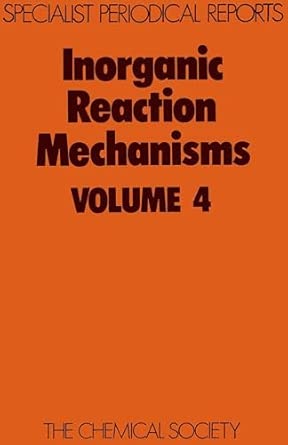
Inorganic Reaction Mechanisms Vol 4: Volume 4 Edition. ed. Edition
Author(s): A McAuley
- Publisher: CRC Press
- Publication Date: 1 July 1988
- Edition: Edition. ed.
- Language: English
- Print length: 420 pages
- ISBN-10: 0851862853
- ISBN-13: 9780851862859
Book Description
Reflecting the growing volume of published work in this field, researchers will find this book an invaluable source of information on current methods and applications.
Editorial Reviews
Excerpt. © Reprinted by permission. All rights reserved.
Inorganic Reaction Mechanisms Volume 4
A Review of the Literature Published Between July 1973 and December 1974
By A. McAuley
The Royal Society of Chemistry
Copyright © 1976 The Chemical Society
All rights reserved.
ISBN: 978-0-85186-285-9
Contents
Part I Electron Transfer Processes,
Introduction, 3,
Chapter 1 Reactions Between Two Metal Complexes By K. L. Scott, 5,
Chapter 2 Metal Ion–Ligand Redox Reactions By A. McAuley, 36,
Chapter 3 Reactions of Water and Hydrogen Peroxide By A. McAuley, 80,
Part II Substitution and Related Reactions,
Chapter 1 Non-metallic Element By G. Stedman, 93,
Chapter 2 Inert Metal Complexes: Co-ordination Numbers Four and Five By J. S. Coe, 115,
Chapter 3 Inert Metal Complexes: Co-ordination Numbers Six and Higher By P. Moore, 129,
Chapter 4 Labile Metal Complexes By D. N. Hague, 209,
Chapter 5 Solvent Effects By J. Burgess, 236,
Part III Reactions of Biochemical Interest By D. N. Hague,
1 General, 251,
2 Metal Ion Transport, 251,
3 Metal Complex Formation: Non-redox Systems, 253,
4 Reactions involving Metals in Porphyrins and Related Ring Systems, 255,
5 Redox Reactions involving Metals in other Biological and Model Systems, 268,
Part IV Organometallic Compounds,
Chapter 1 Substitution By R. D. W. Kemmitt and M. A. R. Smith, 275,
Chapter 2 Metal–Alkyl, –Aryl, and –Allyl Bond Formation and Cleavage By R. D. W. Kemmitt and M. A. R. Smith, 293,
Chapter 3 Homogeneous Catalysis By R. D. W. Kemmitt and M. A. R. Smith, 305,
Chapter 4 Insertion Reactions By R. D. W. Kemmitt and M. A. R. Smith, 331,
Chapter 5 Reactions of Co-ordinated Ligands By R. D. W. Kemmitt and M. A. R. Smith, 340,
Chapter 6 Oxidative Addition and Reductive Elimination By R. D. W. Kemmitt and M. A. R. Smith, 349,
Chapter 7 Isomerization: Intramolecular Processes By R. D. W. Kemmitt and M. A. R. Smith, 357,
Errata, 386,
Author Index, 387,
CHAPTER 1
Part I
ELECTRON TRANSFER PROCESSES
BY
A. McAULEY
K. L. SCOTT
Introduction
BY A. McAULEY AND K. L. SCOTT
The format of this Part of the Report follows closely that of previous volumes. Attempts have been made to cover as comprehensively as possible all the areas involving electron-transfer processes in solution. As in previous Reports, compilations have been made of rate and thermodynamic parameters to allow for ready comparisons of the data.
Several articles have been published dealing with differing areas of the subject together with technical aspects. Developments in instrumentation have been brought up to date, and the range of rapid-reaction techniques now available for investigations of reactions in solution has been reviewed. An empirical approach to ligand effects on the kinetics of substitution and redox reactions has been shown to be applicable to a wide variety of reaction systems and the changes effected on the redox properties of metal ions on ligand co-ordination have been discussed. Especially important in this respect are the stabilization of both cations and anions and back-bonding effects. A short review of inorganic reaction mechanisms has been published and mechanistic assignments have been made using terms in empirical rate laws for both complexation and redox reactions of metal ions in aqueous solution. The importance of hydrogen-ion dependences has also been discussed. Reactions of aquocobalt(III) ions have been described using a phenomenological model for redox reactions.’
Metal-ion reduction of both mononuclears and dinuclears carboxylatocobalt(III) complexes have been reviewed. There continues to be substantial interest in this subject and in particular the adjacent-attack mechanism for complexes with simple monocarboxylate ligands now appears to be well understood. The importance of the inner-sphere mechanism in reductions by Eu2+ has been amply demonstrated. Gould has also illustrated the usefulness of the comparison of rate data from the reactions of a common oxidant by several reductants. Many workers are currently involved in attempts to measure first-order rates of electron transfer within precursor complexes. In the search for likely systems, the one chosen by Taube appears to be yielding the most promising results. A long-lived intermediate has, however, been identified in a cobalt(III)-iron(II) electron-transfer reaction. The TII–TIIII exchange reaction has been shown to be a two-electron transfer without intermediacy of TIIII, and redox potentials have been substantially revised.
Redox processes have been described in a review of platinum chemistry with monoammine ligands. Electron-transfer mechanisms involving organometallic intermediates have been discussed. The increasing use of pulse radiolysis has resulted in better characterization of the species produced and the acid–base properties of free radicals in solution have been reviewed. The correlation between redox potentials and pKa values of the radicals emphasizes the role and importance of acid–base equilibria of these species in electron-transfer reactions. Two volumes on homogeneous catalysis involving metal complexes have been published, in which attempts have been made to systematize the chemistry of reactions of metal ions with small molecules both inorganic (e.g. O2, N2, CO, etc.) and organic (alkenes and alkynes).
The increasing interest in the biological aspects of inorganic mechanisms is reflected in several reviews. Redox reactions of metalloporphyrin complexes have been discussed and the principles of catalysis by metallo-enzymes described with particular reference to proteins interacting with oxygen. Among several interesting papers in an excellent two-volume work edited by Eichhorn is one by Sutin on redox reactions in co-ordination compounds.
1
Reactions Between Two Metal Complexes
BY K. L SCOTT
1 Reducing Agents
Chromium(II). — Rate constants and activation parameters for reactions of chromium(II) and of other reductants are given in Table 1 on p. 17.
One of the major interests with Cr is the determination of the mediating role of organic ligands. The simplest of the inner-sphere mechanisms, designated adjacent attack, involves an activated complex in which both metal ions are co-ordinated to a simple ligand, the most common group being carboxylate. Proof that remote attack could occur with bifunctional organic ligands was eventually obtained in the reduction of the isonicotinamidopenta-amminecobalt(III) complex (l). The use of complexes with remote carbonyl groups has enabled Gould to add considerably to the list of reactions proceeding by remote attack. Evidence for this mechanism with the p-formylcinnamato-complex (2)3 comes not only from the very high rate and from the form of the rate law [equation (1)] but also from the detection of a short-lived chromium(III) carbonyl complex. Complex (2) is particularly interesting in that mediating action by ten ligand atoms is involved. The intermediate is similar both in its rate of dissociation (k = 7.6 s at 25 °C) and spectrum to the one identified in the Cr2+ reduction of the p-formylbenzoato-complex. Reduction of the o-formyl-benzoato-complex displays neither of the criteria for remote attack. Nevertheless the rate is considerably greater than for orthodox adjacent attack and it is tempting to resort to the adjacent attack with chelation explanation. The work of Price and Taube shows this not to be valid and the best explanation to be that a pendant group serves to delocalize the reducing electron. Reduction of the 4-benzoylpyridine complex also occurs by fast remote attack. Reactions of the 2,3- [complex (3)], 2,4-,2,5-, and 2,6-dicarboxylatopyridino- and 2-, 3-, and 4- [complex (4)] carboxamido-pyridino-complexes provide interesting comparisons. With the dicarboxylatocomplexes a term in [H+]-1 is apparent in addition to the [H+]-independent term and a chelated chromium(III) product is found in each case. For the 3- and the 4-carboxamido-complexes second-order rate constants are independent of [H+] entirely, as expected for adjacent attack, and unstable intermediates are identified as being the same as those formed in the reduction of the nicotinamido- and iso-nicotinamido-complexes. Complexes (1) and (4) are isomers. With the 2-carbox-amidopyridino-species only a term in [H+]-1 is observed [rate law (2)], the rate is much greater, and the intermediate is stable. Gould has argued that the rate constants for the [H+]-1-path are too fast in the dicarboxylato-series to represent reaction of the deprotonated (1+)-complex whereas Balahura has assigned the path to reaction of the deprotonated 2-carboxamido-complex. Very similar intermediates were postulated in the respective studies.
The factors responsible for the enormous variations in rate when bifunctional organic ligands mediate in electron-transfer reactions are by no means understood, but in the case of simple monocarboxylato-ligands the details of the adjacent-attack mechanism seem particularly well worked out. Sykes has reviewed the contribution that dinuclear complexes have played in this. In all simple monocarboxylato-complexes of the type (5) the point of Cr2+ attack is the carbonyl oxygen and its accessibility is determined by the size of R. The conformation (5) is more strongly demanded as the size of R increases and yet the reverse conformation with the carbonyl group more remote from the cobalt(III) centre is preferred for precursor complex formation. Thus despite the detrimental effect of ethylenediamine ligands, Cr2+ reduction of the chelated glycinato-complex (6) is 35 times faster (at 25 °C) than for glycinatopenta-ammine (7) where the ‘wrong’ conformation is adopted. Gould has established a relationship between second-order rate constants for Cr2+, V2+, and Eu2+ reduction and the Taft steric-substituent parameter (Es). Recent work, notably by Balahura, has added support to the ideas of conformational requirements. Nuclear Overhauser effect studies with the complex [(NH3)5CoO2CH]2+ showed a 17% enhancement in the integrated intensity of the CH peak on irradiation of the cis-NH3 resonance. A significant proportion at least of the formato-complex must be in the preferred conformation for precursor complex formation. In the crystal structure, the oxygen atom in the complex [(NH3)5CoNH2COMe]3+ points between two cis-equatorial ammines and the methyl group is directed away. The Cr2+ reduction of this complex follows the rate law (2) with the deprotonated form reactive. The rate constant is considerably smaller than with the formamido-complex so that a similar situation to the carboxylato-series obtains which can be rationalized in terms of the same conformational considerations. Cr2+ Reduction of the β-styryl-acrylato-complex (8) is retarded by increased [H+], as protonation of the adjacent carbonyl group restricts its availability to Cr2+. As discussed earlier, with a formyl group in the para-position, e.g. in (2), this same protonation has exactly the reverse effect and promotes the remote rate.
Reductions of the di-µ-hydroxo-µ-benzoato-bis[triamminecobalt(III)] complex and the o-chloro-substituted analogue were investigated to see whether any advantage was gained by the introduction of an aromatic ring. The ratios kcr/kv were found to be 0.023 and 0.021 respectively and the mechanism therefore is outer-sphere. No obvious enhancement in rate was observed over the analogous formato- and acetato-complexes. The inability of halides in substituted complexes to affect rates either by functioning as sites for inner-sphere attack or by exerting inductive effects, e.g. [(NH3)5CoO2CCHnF3- n]2+, is quite remarkable. Unless bonded directly to the metal oxidant, as with [(NH3)5CoC1]2+, halides appear to be without effect. Major effects are found in complexes containing sulphur. The Cr2+ reduction of the mercaptoacetato-complex [Co(en)2(SCH2CO2)]+ has been found previously to proceed at immeasurably fast rate. An A-ray study has now revealed that the Co — N bond trans to sulphur is 0.04 Å longer than the average cis-Co — N bond. Greater rates of reduction with sulphur-containing ligands and greater rates of substitution, with the amazingly labile [(NH3)5CoSO3]+ complex as an extreme example, may find common explanation in this trans-bond lengthening.
Correlations of rate-constant data in the form of log–log plots have been used to calculate contributions from outer-sphere paths to reactions proceeding predominantly by inner-sphere mechanisms. Even in the case of Cr2+ reduction of the least reactive [(NH3)5CoO2CR]2+ complexes, e.g. where R = CEt3, the calculated contribution from an outer-sphere path is only 3 % and this confirms the long-held view that essentially quantitative ligand transfer occurs in reactions of this type. The decrease in second-order rate constants with increase in R is more marked with Cr2+ than with other reducing agents. In addition to the steric considerations already discussed, the authors suggest that interference of the orbital-overlap process is an additional factor with Cr2+.
Complete reduction of the dinuclear complex (9) by Cr2+ proceeds in two stages, the first of which gives [Co(NH3)5H2O]3+ at a rate which is independent of [H+], the µ-bromo-complex behaving in the same way. An outer-sphere mechanism clearly does not operate and the surprising inference is that the µ-chloro-bridge provides a site for inner-sphere electron transfer. It is proposed that chloride ion is bonded to three metal centres in the activated complex and that the successor complex [(H2O)5CrIIIClCoIII(NH3)5]5+ rapidly aquates to the observed products.The second stage, corresponding to reduction of [Co(NH3)5H2O]3+, obeys rate law (2) in LiClO4 media with but a single term in agreement with an earlier study; activation parameters have also been reported. A full paper on the reduction of the µ-superoxo-(µ-O-2-complex (10), noted previously, reports the following sequence: (i) outer-sphere reduction of the superoxo-bridge to peroxo-; (ii) inner-sphere reduction of one of the cobalt(III) centres; (iii) two-equivalent reduction of the bridge to hydroxo-; and (iv) reduction of the second cobalt(III). The reduction of the bridge from super-oxo- (µ-O-2) to peroxo- (µ-O2-2) at immeasurably fast rate by an outer-sphere mechanism reflects the similarity in the complex geometries. An inner-sphere mechanism for reaction of the µ-peroxo-complex (11) is also to be expected from its known reactions with non-metallic reductants. The product is a novel µ-peroxo mixed dinuclear cobalt(III)–chromium(III) complex. The mechanism of the third reduction involving two equivalents and reduction of the bridge to µ -hydroxo is still not identified. From the kinetic data, two stages both independent of [Cr2+] are observed. The authors suggest that isomerization and possibly decomposition are rate-determining at this point with Cr2+ acting as scavenger. However, it seems clear that a mixed dinuclear complex, possibly [(NH3)(en)2Co·OH·Cr(H2O)5]5+, is formed and that reduction of the remaining cobalt(III) is by a slow outer-sphere mechanism.
The classic way of demonstrating a mechanism, viz. by product analysis, is not always possible, especially with slow reactions, and the use of linear free-energy relationships is now much in evidence. Sutin has developed an alternative approach to the problem – consideration of the magnitude of the catalytic effect of added anions. This effect is known for the M2+ reduction (M = V, Cr, or Fe) of a hard oxidant by the inner-sphere mechanism, and a particularly useful fact comes from the observation that N-3 is ca. 10 times more effective than SCN- in catalysing the rate. The effect of Cl- and SCN- on the rates of known outer-sphere reactions are given, using the reductions of [Co(NH3)3+, [Co(en)3]3+, and [Co(phen)3]3+ by CrII and VII. At low concentrations of added anion, X-, the rate law is observed to be
[MATHEMATICAL EXPRESSION NOT REPRODUCIBLE IN ASCII]
The results have been used to demonstrate the mechanism in the reduction of the tetrakis-(4-N-methylpyridyl)porphinecobalt(III) complex, [Co(TMpyP)(H2O)2]. Observed rate constants are of the form and in general show the basic characteristics of a second-order reaction of Cr2+ with complex and a term inverse in [H+]. With SCN- all the terms contribute but with Cl- the term in [L-] is absent. In perchlorate media only the terms independent of [Lr] are present. Rates of Cr2+ reduction by the [H+]-1 path are greater than the rates of substitution of aquo-ligands on the complex and it can be fairly easily concluded that the mechanism is inner-sphere with a transition state of the type [Co — OH — CrL]≠. Electron transfer does not occur through the ring. For [H+]-independent terms, rates in the presence of SCN- and Cl- are in the ratio of 55:1. This is similar to the ratio of 61:1 found for [Co(NH3)6]3+ but differs from that for [Co(phen)3]3+ (1.3 × 1O3). Hence an outer-sphere mechanism and transition state of the kind [Co(OH2) — X — Cr]≠ are indicated. Reduction of an analogous iron(III) complex has been re-investigated and the [H+]-dependence shown to be of the same form as for cobalt(III).
Much interest has been shown in reactions of organocobaloximes since the demonstration of their similarity in some cases to Vitamin B. Espenson and Shveima report that, in reactions with Cr2+, essentially quantitative transfer of the alkyl group to chromium occurs, together with electron transfer:
[MATHEMATICAL EXPRESSION NOT REPRODUCIBLE IN ASCII]
The reactions with R = Me, Et, Prn, Me2CH, PhCH2, and Me3CCH2 have been studied. Rates are first order in reactants with a dependence on [H+] which allows specific rates for the neutral and protonated forms of the cobaloxime to be determined. Studies were extended to the corrin complexes themselves with a report on the reductions of methyl-, ethyl-, and aquo-cobalamin:
[MATHEMATICAL EXPRESSION NOT REPRODUCIBLE IN ASCII]
Second-order rate constants are independent of [H+] in the pH range 0 — 2.3. The alkylcobalamins are more reactive than the corresponding cobaloximes, and this difference may result from greater strain imposed by the corrin ring substituents. The authors suggest two mechanisms to fit the experimental facts: the very rare bimolecular-homolytic substitution (SH2) mechanism, or a redox reaction, involving transfer of a carbanion in a concerted process. Either reaction presents conceptual difficulties. The Cr2+ reduction of the related [Co(Hdmg)2(NH3)2]+ complex proceeds at a surprisingly high rate according to the rate law (1).
Reduction of the organochromium(rn) complexes [Cr(H2O)5(CHI2)]2+ (ref. 29) and [Cr(H2O)5(CH2I)]2+ (ref. 30) has been studied by a titrimetric method. Stoicheiometries are respectively given by the equations
[MATHEMATICAL EXPRESSION NOT REPRODUCIBLE IN ASCII]
The rate in each case is first order in [Cr2+] and [CrIII] and independent of [H+]. With CrCH2I2+ a long-lived intermediate aquates with formation of CH at a rate which identifies it as methylchromium(III):
[MATHEMATICAL EXPRESSION NOT REPRODUCIBLE IN ASCII]
An inner-sphere mechanism is assigned and, as with the cobaloximes, thereby implicates extraordinary dinuclear complexes.
(Continues…)Excerpted from Inorganic Reaction Mechanisms Volume 4 by A. McAuley. Copyright © 1976 The Chemical Society. Excerpted by permission of The Royal Society of Chemistry.
All rights reserved. No part of this excerpt may be reproduced or reprinted without permission in writing from the publisher.
Excerpts are provided by Dial-A-Book Inc. solely for the personal use of visitors to this web site.



