 Wow! eBook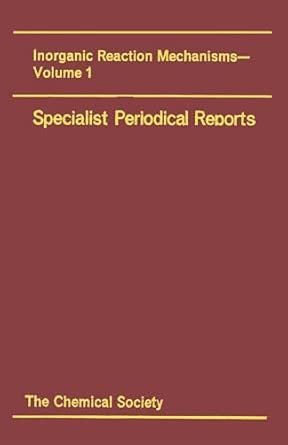
Inorganic Reaction Mechanisms Vol 1: Volume 1
Author(s): J Burgess
- Publisher: CRC Press
- Publication Date: 1 July 1988
- Language: English
- Print length: 353 pages
- ISBN-10: 0851862551
- ISBN-13: 9780851862552
Book Description
Reflecting the growing volume of published work in this field, researchers will find this book an invaluable source of information on current methods and applications.
Editorial Reviews
Excerpt. © Reprinted by permission. All rights reserved.
Inorganic Reaction Mechanisms Volume 1
A Review of the Literature Published between January 1969 and August 1970
By J. Burgess
The Royal Society of Chemistry
Copyright © 1971 The Chemical Society
All rights reserved.
ISBN: 978-0-85186-255-2
Contents
Part I Electron Transfer Processes,
Introduction, 3,
Chapter 1 Reactions Between Two Metal Complexes,
Chapter 2 Metal Ion-Ligand Redox Reactions,
Chapter 3 Reactions Involving Oxygen and Hydrogen Peroxide,
Part II Substitution and Related Reactions,
Chapter 1 Non-metallic Elements,
Chapter 2 Solvent Exchange,
Chapter 3 Metals: Four-, Five-, and Eight-co-ordinate,
Chapter 4 Metals: Octahedral Complexes,
Chapter 5 Reactions of Co-ordinated Ligands, 198,
Chapter 6 Solvent Effects,
Part III Complex Formation with Labile Metals and Reactions of Biochemical Interest,
Introduction, 209,
Chapter 1 Complex Formation with Labile Metals,
Chapter 2 Reactions of Biochemical Interest,
Part IV Organometallic Compounds,
Chapter 1 Substitution and Catalysis,
Chapter 2 Redox Reactions,
CHAPTER 1
Part I
ELECTRON TRANSFER PROCESSES
Introduction
Electron transfer processes involving metal ions are being increasingly studied and the role of metal complexes, together with the dramatic effects which the co-ordinated ligands can have on the reaction rates, are being considered. New and modified techniques enable investigators to examine a larger and more varied range of metal-ion oxidants and reductants. Such is the number of papers currently appearing on these topics that a degree of selection has had to be imposed, but an attempt has been made to cover fairly comprehensively all the areas where studies are being undertaken. Photochemical oxidations have been generally excluded, together with electrochemical processes occurring at electrode–solution interfaces. A number of recent conferences have dealt with several aspects of the subject, and the Faraday Society Discussion on Homogeneous Catalysis with special reference to Hydrogenation and Oxidation has now been published together with the Proceedings of the Eleventh Co-ordination Chemistry Conference. The Plenary lectures at this meeting are also available, and include an article by Halpern on Co-ordination Compounds in Homogeneous Catalysis. Two reports on mechanisms of reaction in solution have also appeared.
In the case of reactions involving two metal ions, redox processes generally involve a single electron transfer step. In 'inner sphere' systems where ligand bridging has been known to take place between the metal centres, the recent emphasis has been to attempt to formulate more precisely the nature of the precursor complexes formed in the initial stages of the reaction. In this context, the most favoured reactants have been the cobalt(III)- and ruthenium(III)-ammine complexes with the strongly reducing chromium(II) or vanadium(II) ions.
Reactions of the type
[MATHEMATICAL EXPRESSION NOT REPRODUCIBLE IN ASCII]
will take place as written if accompanied by a decrease in free energy, and the stability of any complex ion with respect to an intramolecular redox reaction will be dependent on several factors. If the ligand (L) has a low electron affinity, then it will be oxidised. Unlike metal ions, which may undergo changes in oxidation state in single-electron steps without the formation of highly reactive intermediates, ligands acting as reducing agents frequently require two-electron changes to reach a new stable state. The role of metal complexes in metal ion oxidations has recently been discussed for a number of transition metal specie, as has the question of intermediates in oxidations. If a transient complex is formed in the course of the reaction, there are three possible rate-controlling factors :
(a) rate of formation of the intermediate
(b) rate of electron transfer within the complex ion
(c) rate of breakdown of the complex.
Reviews on the aquated cobalt(III) and manganese(III) ions as oxidants discuss the various pathways involved in the interactions of these species with both organic and inorganic substrates.
The catalytic activity of co-ordination compounds in oxidations continues to be examined and, together with the Faraday Society Discussion, other aspects of this area of investigation have been the subject of recent Redox reactions involving bipyridyl and o-phenanthroline complexes of transition metals have been discussed l5 and catalytic oxidations of complexes of manganese, cobalt, copper, and palladium have also been surveyed. Reviews are also available of ruthenium ammine chemistry, and redox reactions involving molybdenum complexes, together with an account of catalase and peroxidase reactivity of copper(II) complexes.
1
Reactions Between Two Metal Complexes
1 Reducing Agents
Chromium(II). — Many reactions have been studied using this reductant and with inert oxidants such as the cobalt(III) ammine complexes it is possible to characterise more fully the 'inner sphere' route in redox systems. Any precursor complexes formed in these reactions would greatly affect the energetics of these systems. The CrII reactions with various Co en2ACl2+ complexes have been studied where A = Cl-, F-, OH2, py, and NH3. The rates are relatively insensitive to the ligand A but several of these reactions have apparently negative activation energies, the situation being described in terms of influence of the rapid formation and dissociation of precursor complexes on the overall reaction rates. Evidence for similar complexes has also been found in the corresponding reactions with trans-Co-(trans-14-diene) (H2O)23+ and trans-Co tet-a(OH2)23+. These macrocyclic complexes are exceptionally acidic (pKa = 4·02 and 2·70 at 25 °C respectively) so that significant concentrations of the oxidant are present as the aquohydrocomplexes and the hydroxy-bridged path is considered to be very reactive. From pH-dependence studies, it is suggested that precursor complexes involving the two metal centres of the form CoIII–X–CrII are sufficiently long-lived to participate in acid-base equilibria, and species (1) is considered to have a longer lifetime than its protonated analogue (2).
[FORMULA NOT REPRODUCIBLE IN ASCII] (1)
[FORMULA NOT REPRODUCIBLE IN ASCII] (2)
The mechanism for these reactions may thus be written as
[MATHEMATICAL EXPRESSION NOT REPRODUCIBLE IN ASCII] (1)
[MATHEMATICAL EXPRESSION NOT REPRODUCIBLE IN ASCII] (2)
where M1 and M2 refer to the two metal atoms and X to the bridging ligand. In the case of outer-sphere oxidations, no evidence has been found for the formation of precursor complexes.
In the reactions with cis- and trans-Co en2(HCO2)2+ complexes, double bridging is considered to occur, and protonation decreases the rate of reduction of the cis complex, but increases the activity of the trans complex. Also with the cis species single and double ligand bridges are formed with the transfer of one or two formate groups to the chromium. Multiple bridging has also been postulated in the reduction of the corresponding oxalatotetrammine complex, the quantitative formation of Cr(ox)+ suggesting the symmetrical transition state:
[FORMULA NOT REPRODUCIBLE IN ASCII]
The effect of the co-ordinating group on the rate of the reaction has been investigated in an interesting comparison of the rates of reaction of the mercaptoacetato bisethylenediamine cobalt(III) complex and its glycollato analogue. The rate of reduction of Co en2(SCH2COO)+ is ~ 2 × 10³ faster than for Co en2 (OCH2COO)+. The reactions are considered inner sphere and the increase in reactivity may be due to less steric hindrance of the larger thiolate group with the methylene, and a lower bond strength and greater covalency of the Co–S bond. The reduction of the linkage isomers (3) and (4), which are N- and O-bonded, respectively, also shows
[MATHEMATICAL EXPRESSION NOT REPRODUCIBLE IN ASCII] (3)
[MATHEMATICAL EXPRESSION NOT REPRODUCIBLE IN ASCII] (4)
marked effects. Isomer (3) is a moderately strong acid and the rate law exhibits an inverse hydrogen ion dependence suggestive of the reactivity of a conjugate base. Reduction proceeds with ligand transfer to yield the O-bonded chromium(III) complex, whereas with (4) no ligand transfer takes place, the hexa-aquochromium(III) ion being produced at a considerably slower rate. Studies have been made with fumarato-cobaltammine complexes, the rates being fairly insensitive to oxidant and close to those found for the acetate complexes.
In an investigation of electron transfer through structural units, it has been shown that the reduction of some pyridinepentamminocobalt(III) derivatives proceeds via an outer-sphere mechanism, the rates for the 3- and 4-methyl derivatives being similar to the pyridine complex itself whereas the 2-methyl and quinoline species react about 100 times faster. In this case there may be steric hindrance between the organic ligand and the cis ammonias, and it may be that a large part of the activation energy for these outer sphere systems is involved in the stretching of the CoIII–N bonds.
Reactions involving ruthenium(III) complexes have also demonstrated the existence of precursor species. In the reduction of cis-RuIII(NH3)4Cl2+, there is no adherence to a normal second-order rate law and a reversible electron transfer prior to the rate-determining step is proposed. The intermediate has been observed spectrally and the mechanism may be written as
[MATHEMATICAL EXPRESSION NOT REPRODUCIBLE IN ASCII]
The K value of 460 l mol-1 is considered too large for the assignment (5), the species (6) being preferred. There may be equilibrium between (5) and
[Ruin(NH3)4Cl2Cr"]3+ [Ru^NH^C^Cr111]3*
[MATHEMATICAL EXPRESSION NOT REPRODUCIBLE IN ASCII] (5)
[MATHEMATICAL EXPRESSION NOT REPRODUCIBLE IN ASCII] (6)
(6) (presumably rapidly established) and the slow step leading to formation of products is one which involves substitution on the ruthenium(II),
(6) [MATHEMATICAL EXPRESSION NOT REPRODUCIBLE IN ASCII]
where k3 ~ 150 s-1. The equilibrium constant for the formation of the chloride bridged binuclear intermediate
[MATHEMATICAL EXPRESSION NOT REPRODUCIBLE IN ASCII]
has been shown to be ~ 4 × 10⁻⁵ l mol-1. Inner-sphere intermediates have also been identified in the reduction of carboxylatopentammine complexes, the rates and activation parameters indicating that the decomposition takes place through ruthenium(II) hydrolysis with ligand transfer to the chromium(III). For the corresponding halogenopentammine complexes the rate law may be expressed as
[MATHEMATICAL EXPRESSION NOT REPRODUCIBLE IN ASCII]
except for the iodide species where the reaction is strongly autocatalytic due to the aquation of the iodide complex:
[MATHEMATICAL EXPRESSION NOT REPRODUCIBLE IN ASCII]
Variation of the rate of dissociation of intermediates of the type [RUIIIClCrIII]4+ with decreasing acidity suggests the equilibrium
[MATHEMATICAL EXPRESSION NOT REPRODUCIBLE IN ASCII]
followed by
[MATHEMATICAL EXPRESSION NOT REPRODUCIBLE IN ASCII]
Addition of vanadium(II) also causes an increase in the rate of decomposition of the binuclear species.
Reductions of monosubstituted iron(III) complexes have been studied, the reactions being inner sphere with rates in the order Br- > Cl- > F- in contrast to the corresponding europium(II) systems. The order does, however, parallel that for the CrII reduction of pentammine-cobalt(III) halide complexes. Reactions with platinum(iv) complexes have been studied, and in the case of [Pt(NH3)5Cl]3+ and [Pt(NH3)5OH]3+ a two-electron change is involved with intermediate formation of CrIV and subsequent production of dimeric CrIII complexes:
[MATHEMATICAL EXPRESSION NOT REPRODUCIBLE IN ASCII]
The reduction of anionic species has also been examined. In the case of hexachloroiridate(IV), there is evidence for both inner- and outer-sphere paths. Path k4 may make a small contribution but was not detected in this study; see Scheme 1.
[FORMULA NOT REPRODUCIBLE IN ASCII]
The spectrum of the dinuclear intermediate involved in the inner-sphere route has been derived (Figure 1). Using thermodynamic data for comparable inner-sphere and outer-sphere complex formation, it has been shown that for the redox processes the enthalpy terms favour the outer sphere whereas the entropies of activation favour the inner-sphere mechanism. The difference in enthalpies of activation for the inner and outer routes is 5·7 kcal mol-1. Dinuclear complexes are also formed in the reduction of hexacyanoferrate. Two products are formed, one of which may be
[MATHEMATICAL EXPRESSION NOT REPRODUCIBLE IN ASCII]
whilst the other is considered to be a protonated species with different bonding of the bridge. As in the case of IrCl62-, the reaction is rapid, with k ~ 5 × 10⁶ l mol-1 s-1. In the chromium(II) reduction of perchlorate, however,
[MATHEMATICAL EXPRESSION NOT REPRODUCIBLE IN ASCII]
the reaction is catalysed by ruthenium(II), the rate law being independent of the chromous species. A mechanism consistent with the data may be written as
[MATHEMATICAL EXPRESSION NOT REPRODUCIBLE IN ASCII]
the first step being rate determining. Electrochemical techniques have been used to study the oxidation of chromium(II) in the presence of chloride and bromide ions and thiocyanate. The data suggest that the anions adsorbed on the electrode surface act as a bridge for electrode transfer and so facilitate the reaction:
[MATHEMATICAL EXPRESSION NOT REPRODUCIBLE IN ASCII]
In the case of thiocyanate product studies have demonstrated the existence of multiple ligand bridges.
Vanadium(II). — An interesting feature of many vanadium(II) redox reactions is the similarity of kinetic data (k, ΔH, ΔS) to those for V2+ substitutions and the possibility that these processes are substitution controlled. The reaction with the oxalatotetramminecobalt(III) complex has been studied, the rate law being
[MATHEMATICAL EXPRESSION NOT REPRODUCIBLE IN ASCII]
and here the rate-determining step may be substitution controlled. The reduction of monosubstituted pentacyanocobaltate(III) ions may also be controlled by loss of a water molecule from the inner co-ordination sphere of the reductant. The reactions
[MATHEMATICAL EXPRESSION NOT REPRODUCIBLE IN ASCII]
where X = Cl-, Br-, I-, SCN-, N3-, and H2O, proceed via ion-pairing with the formation of cobalt(II) intermediates (Figure 2), and in the case of the azido and thiocyanate complexes, the oscilloscope traces point to an inner-sphere mechanism with formation of the corresponding mono-substituted vanadium(III) complexes; see Scheme 2. Rates have also been
[FORMULA NOT REPRODUCIBLE IN ASCII]
compared for the reductions of chloropentamminecobalt(III) complexes with the dinuclear species µ-amido[aquotetrammine cobalt(III)]-[chlorotetrammine cobalt(III)]. The reaction
[FORMULA NOT REPRODUCIBLE IN ASCII]
is followed by a slower reduction of the pentammine-aquo complex, whereas the rate constant for the reaction of (NH3)5CoCl2+ is almost identical to that for the dinuclear complex. Because the activation parameters do not fall in the V2+ substitution-controlled range, the reactions would appear to be outer sphere. It is suggested that the chloride ligand is an active site to explain the similarity of kinetic data for the reactions of the two chloro-complexes.
The reduction of ruthenium complexes has been examined. In the case of the ruthenium(III) pentammine- and tetrammine-halogeno-complexes reactions follow both inner- and outer-sphere paths and there is no parallel in- the trend observed with the corresponding Co species. The reductions of ruthenium(III) ammine carboxylato-complexes are so fast that they cannot involve substitution by a bridging group into a normal co-ordination site in the reducing agent. The reduction of Ru(H2O)5Cl2+ has been studied, the rate being invariant of acidity in the range 0·1 — 1·0 mol l-1.
In reactions with other metal complexes, vanadium(II) acts as reductant in several ways. There is evidence for both one-electron and two-electron exchange paths in the reaction with mercury(II), activation parameters being measured for both reactions. In the one-electron route, mercury(I) is formed as an intermediate:
[MATHEMATICAL EXPRESSION NOT REPRODUCIBLE IN ASCII]
whereas in the two-electron path the products are vanadium(IV) and mercury(0) with subsequent rapid reaction of the latter species as described. The distinction between the mechanistic paths is based on variations in the final concentrations of VIII and VIV, the two-electron process being considered as inner sphere. A one-electron transfer takes place in the reaction with copper(II), the only significant product being CuI. From a comparison of the rate constant and thermodynamic parameters it is concluded that in this case the redox process is again substitution controlled. The rate of reduction of vanadium(V) is acidity dependent, the products being VIII and VIV. In the reaction with neptunium(IV) the rate law
[MATHEMATICAL EXPRESSION NOT REPRODUCIBLE IN ASCII]
is observed, the data being consistent with an outer-sphere mechanism, although the rate constant ka has a value close to that for the substitution of the primary co-ordination sphere of V.
Studies on the one-equivalent reduction of hexachloroiridate(IV) show the rate to be very fast (k > 4 × 10⁶ 1 mol-1 s-1) and that for the corresponding vanadium(III) reaction, in which VOH2+ appears to be the reactant,
[MATHEMATICAL EXPRESSION NOT REPRODUCIBLE IN ASCII]
is too fast to be inner sphere there being little ion-pairing between the vanadium and hexachloroiridate(IV).
Europium(II). — Reductions of monosubstituted iron(III) complexes have been investigated in acidic solutions, the reaction rates being in the order F- > Cl- > Br- in contrast to the reverse order shown by chromium(II). Indirect evidence suggests that reactions are inner sphere, but no ligand transfer is observed owing to the greater lability of the EuIII ion. The reactions with pentammineruthenium(III) carboxylato-complexes are almost identical to the corresponding vanadium(II) reductions. The reaction kinetics may be explained by consecutive second- and first-order reactions:
[MATHEMATICAL EXPRESSION NOT REPRODUCIBLE IN ASCII]
(where R = H, Me, and CF3). The first step is considered to involve the electron transfer, the reaction being too slow to be limited by the substitution of the reductant. The first-order decay observed to yield the products is due to the hydrolysis of the ruthenium(II) complex formed. The reaction
[MATHEMATICAL EXPRESSION NOT REPRODUCIBLE IN ASCII]
has been studied, the subsequent reduction of the vanadium(III) occurring much more slowly. The reaction rate is increased by the addition of SCN-, N3-, and Cl- possibly owing to the interaction of the reductant with vanadium(IV) complexes and at concentrations > 0·1M-SCN-, the complex VNCS2+ is detectable as a product in the stopped-flow apparatus so that the mechanism here may be inner sphere. In the above reaction the transition state is considered to be [VOEu4+], the reactions with the protons being presumed to be fast subsequent steps.
(Continues...)Excerpted from Inorganic Reaction Mechanisms Volume 1 by J. Burgess. Copyright © 1971 The Chemical Society. Excerpted by permission of The Royal Society of Chemistry.
All rights reserved. No part of this excerpt may be reproduced or reprinted without permission in writing from the publisher.
Excerpts are provided by Dial-A-Book Inc. solely for the personal use of visitors to this web site.


