Wow! eBook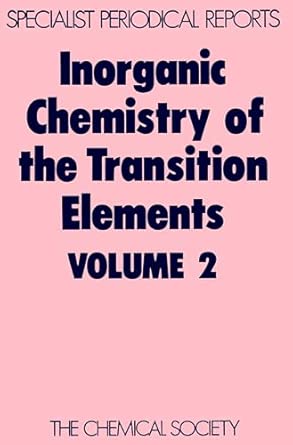
Inorganic Chemistry of the Transition Elmts: Volume 2 Edition. ed. Edition
Author(s): B F G Johnson
- Publisher: CRC Press
- Publication Date: 31 Jan. 1990
- Edition: Edition. ed.
- Language: English
- Print length: 517 pages
- ISBN-10: 9780851865102
- ISBN-13: 9780851865102
Book Description
Reflecting the growing volume of published work in this field, researchers will find this book an invaluable source of information on current methods and applications.
Editorial Reviews
Excerpt. © Reprinted by permission. All rights reserved.
Inorganic Chemistry of the Transition Elements Volume 2
A Review of the Literature Published between October 1971 and September 1972
By B. F. G. Johnson
The Royal Society of Chemistry
Copyright © 1973 The Chemical Society
All rights reserved.
ISBN: 978-0-85186-510-2
Contents
Chapter 1 The Early Transition Metals By C. D. Garner,
Chapter 2 Elements of the First Transitional Period By R. Davis,
Chapter 3 The Nobel Metals By L. A. P. Kane-Maguire,
Chapter 4 The Lanthanides, including Scandium and Yttrium, and the Actinides By J. A. McCleverty,
Author Index, 473,
CHAPTER 1
The Early Transition Metals
BY C. D. GARNER
1 Titanium
Introduction. — The majority of investigations reported this year have been concerned with TiIV–oxygen compounds, although the pale green pyroxene NaTiSi2Oe has been shown to be one of the few known oxides containing Ti. Trigonal-bipyramidal geometry for Ti has been confirmed in TiBr3,2NMe3, with the bulky amine ligands in the axial positions. Five-coordinate TiIV in [Cl3Ti(PhCOCH2COMe)] is consistent with i.r. spectral and molecular weight studies; however, since 1H n.m.r. spectra indicate two distinct β-diketone complexes, the solution equilibrium
[MATHEMATICAL EXPRESSION NOT REPRODUCIBLE IN ASCII]
is suggested. This receives some confirmation from the crystal structure of [TiCl3(acac)], which has shown that in the solid state the compound is a centrosymmetric chloride-bridged dimer.
Studies of titanium tetra-alkyls have been featured in the recent interesting developments of transition metal-alkyl chemistry. Thus tetra-neopentyl-and -1-norbornyl-titanium have been isolated. A low-temperature crystal structure determination of tetrabenzyltitanium has identified an average Ti — C — C interbond angle of 103°, which contrasts with the corresponding value of 111° for tetrabenzyltin, suggesting a weak overlap between the π-ring system and the empty metal d-orbitals in the former compound.
Tetracyclopentadienyltitanium contains two h5- and two h1-cyclopentadienyl rings, and solution n.m.r. studies above 250 K have characterized the first known interchange of h5- and h1-rings. The involvement of titanocene and related species in the reduction of dinitrogen has been further investigated, and the dinuclear complexes {[(C5H5)2PriTi2N2]} and {[(C5R5)2Ti2N5]}(R = H or Me) have been isolated. The latter are believed to involve bridging dinitrogen co-ordinated edge-on between the two titanium centres, (1).
[FORMULA NOT REPRODUCIBLE IN ASCII] (1)
Binary Compounds and Related Species. — Oxides. The dissociation energies of gaseous TiO and TiO2 have been estimated as 600 [+ or -] 21 and 660 [+ or -] 19 kJ mol-1, and 1200 [+ or -] 42 and 1300 [+ or -] 12 kJ mol-1, respectively. The physical properties of liquid TiO2 have been investigated to 2600 K. Further studies of members of the homologous series TinO2n-1 have been reported. γ-Ti3O5 has been obtained by heating a mixture of TiO2 and Ti2O3 (1:1; 900 — 925 °C; 1 month) and shown to have a V3O5-type structure. Crystals of Ti4O7 involve TiO6 octahedra (Ti — O = 200.4 — 202.2 pm) sharing faces, edges, and corners. The heat and entropy were determined electrochemically as –680 kJ mol-1 and 173 e.u.. respectively.
Halides and Oxyhalides. Molecules of TiCl2, prepared by the Knudsen cell technique, have been isolated in solid inert-gas matrices. The i.r. spectrum (33 — 1000 cm-1) suggests that the molecules are linear ([+ or -]10°); however, similar studies indicated that TiF2 molecules are bent. TiCl2 with high catalytic activity has been prepared by the treatment of finely powdered TiO in a quartz tube with the stoicheiometric amount of gaseous CCl4 at 400 — 700 °C. Halogen-exchange reactions of BBr3 with anhydrous TiCl3 and TiCl4, and of BI3 with anhydrous TiCl4, which afford the corresponding anhydrous titanium bromides and iodides, are typical of the general reactions of boron halides with transition-metal chlorides. Borazines may be partially halogenated with TiX4 (X = F or Cl), which is reduced to TiX3. Raman spectra of TiF4 have shown that it exists as tetrahedral monomeric molecules in the gas phase (300 °C) but that the solid involves appreciable polymerization. Vapourphase Raman spectra have also been reported for TiX4 (X = Cl, Br, or I), and the Ti — X stretching force constants decrease in the order Ti — Cl > Ti — Br > Ti — I. This behaviour was also found for ZrX and HfX molecules and appears to be typical of halide complexes in this part of the Periodic Table. The Br n.q.r. spectra of TiBr between 77 and 306 K suggest Br — Ti — Br interbond angles in the range 108.7 — 110.3°, and that the ionic and double bond characteristics of the Ti — Br bond are ca. 60 and 16 %, respectively.
The reaction of TiCl3 with Sb2O3 or As2O3, or of TiOCl2 with SnCl2, affords TiOCl. TiOBr has been prepared by the reaction of Ti with TiO2 and Br2 in a 650 — 550 °C temperature gradient. This latter compound exhibits weak temperature-independent paramagnetism, and involves Ti — O and Ti — Br bonds of lengths 195.2 and 254.4 pm, respectively.
Borides, Carbides, etc. TiB and the mixed diboride TiB2–ZrB2 have been obtained by heating a stoicheiometric mixture of boron and the metal dioxides (1600 — 900 °C; 10-4 mmHg). TiW4B5 and Ti2W3B5 have been characterized by X-ray studies as has (Ti,Nb)B in the Ti–Nb–B system at 1100 — 1800°C. Crystalline, stoicheiometric TiC has been prepared, the crystal lattice constant being 432 [+ or -] 0.O6 pm. The chemical stability of the germanides TiGe, TiGe2, and Ti5Ge3 towards mineral and organic acids, and oxidizing and complexing reagents has been studied, and the new compound Ti6Ge5 has been prepared from the elements at high temperatures. The formation of TiN by a new method involving metal evaporation has been described. TiSe2 has been isolated by passing selenium vapour in a stream of an inert gas, such as argon, over powdered titanium metal at 900 — 1200°C. The chalcogenide inclusion compound TiS2(MeCONH2) has been isolated.
Titanium(II) Complexes. — Very few investigations of this oxidation state have been reported this year. The electronic absorption spectrum of TiII doped in CdTe has been reported, and the hyperfine and super-hyperfine interactions of this ion in MF2 (M = Ca, Sr, and Cd) lattices have been studied at 4.2 K.
The electrochemical oxidation of TiII as Ti(AlCl4)2 in AlCl3–NaCl melts (160 — 330°C) has been shown to proceed in two one-electron reversible steps, as [MATHEMATICAL EXPRESSION NOT REPRODUCIBLE IN ASCII].
A review has been presented of the nitrogen-fixation model which involves the co-ordination of dinitrogen to titanocene, followed by reduction with Na+ naphthalene and hydrolysis, which effect the liberation of ammonia. The bis(cyclopentadienyl)titanium(II) species [(C5Me5)2Ti], [(C5Me5)2Ti]2, and [(C5H5)2Ti]2, have been prepared and their reactions studied. These compounds react reversibly with molecular hydrogen to give hydride complexes, and with dinitrogen to form intensely coloured dinitrogen derivatives. The dinuclear species [(C5R5)2TiN2Ti(C5R5)2] (R = H or Me) which have been prepared in this way are believed to have the structure (1). These bis(cyclopentadienyl)titanium (II) species react irreversibly with carbon monoxide to give the respective dicarbonyl derivatives. Triphenylphosphine undergoes a reversible reaction with [(C5H5)2Ti]2 to give a compound of composition [(C5H5)2TiPPh3]2. This phosphine complex reacts reversibly with molecular hydrogen to give [(C5H5)2Ti(PPh3)H], and irreversibly with dinitrogen and carbon monoxide. Related studies have examined the titanocene-induced fixation of nitrogen in detail, and the reaction sequence given in Scheme 1 has been suggested.” ‘Active titanocene’, prepared by the use of two equivalents of sodium under argon for 6 — 10 days followed by filtration in a drybox, reacts rapidly and reversibly with N2 below room temperature, forming a dark-blue complex. ‘Active titanocene’ is also believed to be a powerful hydrogenation catalyst.
Titanium(III) Complexes. — N-Donor Ligands. A full account of the preparation and properties of Ti[N(SMe3)2] has been published. Crystals of TiBr3,2NMe3 consist of monomeric five-co-ordinate molecules which are basically trigonal-bipyramidal, with average bond lengths Ti — Br = 242 pm and Ti — N = 232 pm, and all Br — Ti — Br interbond angles ca. 120°. It is suggested that in complexes of the type MX3(AMe3)2 (A = N or P) the steric requirements of the AMe3 groups dictate the basic trigonal-bipyramidal geometry, these ligands occupying axial positions. Although the steric requirements of NN-bis-(6-methyl-2-pyridylmethyl)methylamine (Me3dpma) would be expected to favour a five-co-ordinate complex with TiCl3, it forms the adduct (2) in which the metal atom has a distorted octahedral environment.
[FORMULA NOT REPRODUCIBLE IN ASCII] (2)
The three Ti — Cl bond lengths of 229.2(7), 236.4(6), and 241.8(7) pm are significantly different, and the Ti–tertiary nitrogen bond, 221.2(1.6) pm, is shorter than the Ti-aromatic nitrogen bonds, 225.6(1.6) pm (average). X-Band e.s.r. spectra of TiCl3 in pyridine solution at room temperature and 77 K have provided evidence that the dimeric [TiCl3(py)2]2 is the major complex species. It is suggested that this dimer consists of two trans-octahedral TiCl4(py)2 units linked by an edge of two bridging chlorides, the intermetallic separation being ca. 340 pm. TiCl3, MeCN has been prepared by heating TiCl3. 3MeCN at 100 °C. Several mixed solvent adducts were also characterized in this study (see below). At room temperature, TiCl3 forms a 1:3 adduct with CH2C1CN, and the electronic spectrum of this royal blue compound suggests that it has a mer-octahedral structure.
O-Donor Ligands. The pyroxene NaTiSi2O6, synthesized at high pressure (65 kbar) and temperature (1550 °C), is obtained as light-green crystals when quenched to room temperature. X-Ray studies showed that the crystals are of the NaMIIISi2O6 structural type, and the diffuse reflectance electronic spectrum confirmed that this is one of the few oxides known to contain TiIII.
Ti(H2PO4)3 has been prepared by treating titanium disilicide, TiSi2, with H3PO4. The reaction of diethyl chlorophosphate, (EtO)2P(O)Cl, with anhydrous TiCl3 at elevated temperatures leads to de-ethylation of the phosphate and the precipitation of Ti(ethoxychlorophosphate)3.
The crystal structure of hexaureatitanium(III)perchlorate has been determined. The structural details of the cations, which involve a trigonally distorted octahedral TiO6 unit (average Ti — O = 204 pm), are very similar to those found for this ion in the iodide.
A new method for the preparation of [Ti(acac)3] has been reported. Treatment of TiCl3 in toluene, in vacuo, with NH4(acac) for 4 h at room temperature eliminates any oxidation problems. The oxidation of [Ti(acac)3] was also studied and the e.s.r. characteristics of the intermediate were determined. The proton and deuteron n.m.r. linewidths of [Ti(acac)3] and other paramagnetic trisacetylacetonato-complexes and their deuteriated analogues have been measured. In agreement with theoretical predictions the deuteron spectra show significantly better resolution (ca. forty-fold), thus suggesting that useful information can be obtained from deuteron n.m.r. studies of paramagnetic complexes. E.s.r. spectra of TiIII complexes with mandelic, malic, citric, cyclopentane-1,2,3,4-tetracarboxylic. 5-sulpho-, 5-chloro-, and p-amino-salicylic, and phthalic acids, salicylamide, and 8-hydroxyquinoline in DMF solution have provided evidence for dimeric complexes. The magnetic properties of the TiIII pairs have been evaluated and the distance between metal centres estimated to range from 470 pm for TiCl3 (0.1 mol l-1) with mandelic acid (0.3 mol l-1) to 860 pm for TiCl3 (0.1 mol l-1) with 8-hydroxyquinoline (0.3 mol l-1). The reactions of TiCl3 with several co-ordinating solvents have been studied, and the new complexes TiCl3,3L1, TiCl3,L12L2 (where L1 = dioxan and L2 = MeCN, THF, or PrOH), TiCl3,2THF,MeCN, and Et4N[TiCl4,2L] (L = dioxan or THF) have been prepared and characterized by spectral and magnetic studies.
Halogeno-complexes. (NH4)Zn[TiF6],6H2O has been prepared by adding [(NH4)2TiF5] to warm aqueous hydrofluoric acid containing mossy zinc metal, followed by addition of NH4HF2. The electronic spectrum of this compound consists of maxima at 22 124 and 14 535 cm-1 in aqueous solution the former maximum slowly shifts to 19 608 cm-1. It is suggested that this splitting is too great for a Jahn–Teller effect and that the TiIII is in a distorted octahedral environment in this compound. α- and β-modifications of Li3TiF6 have been prepared by treating LiF and TiF3 (3:1) at elevated temperatures and then quenching or slowly cooling, respectively.
TiCl3 reacts with pyridinium chloride in hydrochloric acid solution to form a bright-green crystalline product (pyH)2[TiCl(H2O)], which is stable in an oxygen-free dry atmosphere. The compound may be dehydrated by heating at 127°C. The general theory of magnetic exchange interaction between two atoms with orbitally degenerate wavefunctions has been applied to the interaction of two TiIII ions in the [Ti2Cl9]3- anion. Excellent agreement with the experimental magnetic susceptibility (90 — 300K) was obtained.
Cyclopentadienyl Complexes. Improved routes to [(π-Cp)2TiCl]2 have been described, e.g. by reduction of [(π-Cp)2TiCl2] in THF, with recrystallization from ether. This dimer reacts with L = NH3, RNH2, py, Me2PhP, or MePh2P to form [(π-Cp)TiClL], and with the bidentate ligands L2 = bipy, en, or sym-Me2en, to form [(π-Cp)2TiL2]+. With Ph2PCH2CH2PPh2 a dinuclear complex is formed for which the structure (3) has been suggested.
[FORMULA NOT REPRODUCIBLE IN ASCII] (3)
The complexes [(π-Cp)TiCl2],2py and [(π-Cp)TiCl2],L2 (L2 = bipy or α-picolylamine) have been prepared by allowing the appropriate N-heterocycle to react with [(π-Cp)TiCl2]. The spectroscopic, magnetic, and conductivity data obtained did not distinguish between dimeric or monomeric units for these complexes. [(π-Cp)TiCl2],1.5en was also isolated in this study. The [(π-Cp)TiX2], THF (X = Cl, Br, or I) complexes, prepared by reduction of [(π-Cp)TiX3] in THF, have been characterized as monomeric species involving a pseudo-tetrahedral stereochemistry about the central TiIII. Pyrolysis of these THF complexes results in loss of the solvent molecule.
(Continues…)Excerpted from Inorganic Chemistry of the Transition Elements Volume 2 by B. F. G. Johnson. Copyright © 1973 The Chemical Society. Excerpted by permission of The Royal Society of Chemistry.
All rights reserved. No part of this excerpt may be reproduced or reprinted without permission in writing from the publisher.
Excerpts are provided by Dial-A-Book Inc. solely for the personal use of visitors to this web site.